Planning and costs
Is tile-effect metal roofing still worth buying?
In brief
Buying tile-effect metal roofing can be worthwhile when its parameters match the design and the price of the whole roof fits the budget. A low price per sheet alone does not decide cost-effectiveness. You have to count the actual quantity of covering, the accessories, the installation and the later servicing. It is also worth considering whether cut-to-length sheets or modules suit you better. The answer depends on the roof slopes and the site conditions, not on the general fashion for a given material. First establish the roof requirements: pitch, structure, insulation and the way the attic will be used. The covering must be approved for that situation. A product with an attractive price but an unsuitable minimum pitch is not a good starting point.
Which comparison should you start with?
First establish the roof requirements: pitch, structure, insulation and the way the attic will be used. The covering must be approved for that situation. A product with an attractive price but an unsuitable minimum pitch is not a good starting point. The saving may disappear when the entire roof slope assembly has to be changed.
Then compare variants of similar material quality. Steel thickness, coating and the scope of the warranty should be clearly stated. It is not worth comparing the name ’tile-effect metal roofing’ alone with another offer of unknown parameters. The price difference may result from a real difference in the product, not from a more favourable seller’s margin.
For the investor, the cost of building a specific roof is what counts. The price of one square metre gives only part of the picture. You need to know the quantity of material required after allowing for laps and offcuts. On a complex roof, two quotes with an identical unit price may produce a different cost because of a different sheet format.
What does a current material price example show?
In the price list valid from 28 October 2026, an example metal roof tile panel with a covering area of 0.798 m² costs €8.10 net and €9.96 gross in the PE 25 coating. Converted to an effective square metre, the catalogue states €10.15 net and €12.49 gross. These are catalogue prices for a specific material variant.
They do not constitute a shop price or a forecast for every colour and every delivery. They do show, however, why a panel costing a few dozen zlotys cannot be compared directly with the price of a sheet of a different area. A reliable comparison requires one unit and identical tax information.
This cost is supplemented by, among other things, flashings, screws, the underlay, the battens and gutters. Not all elements will be new during every renovation, but the possibility of retaining them must be checked. A comparison based solely on the sheet area often underestimates the budget required.

When does format help reduce costs?
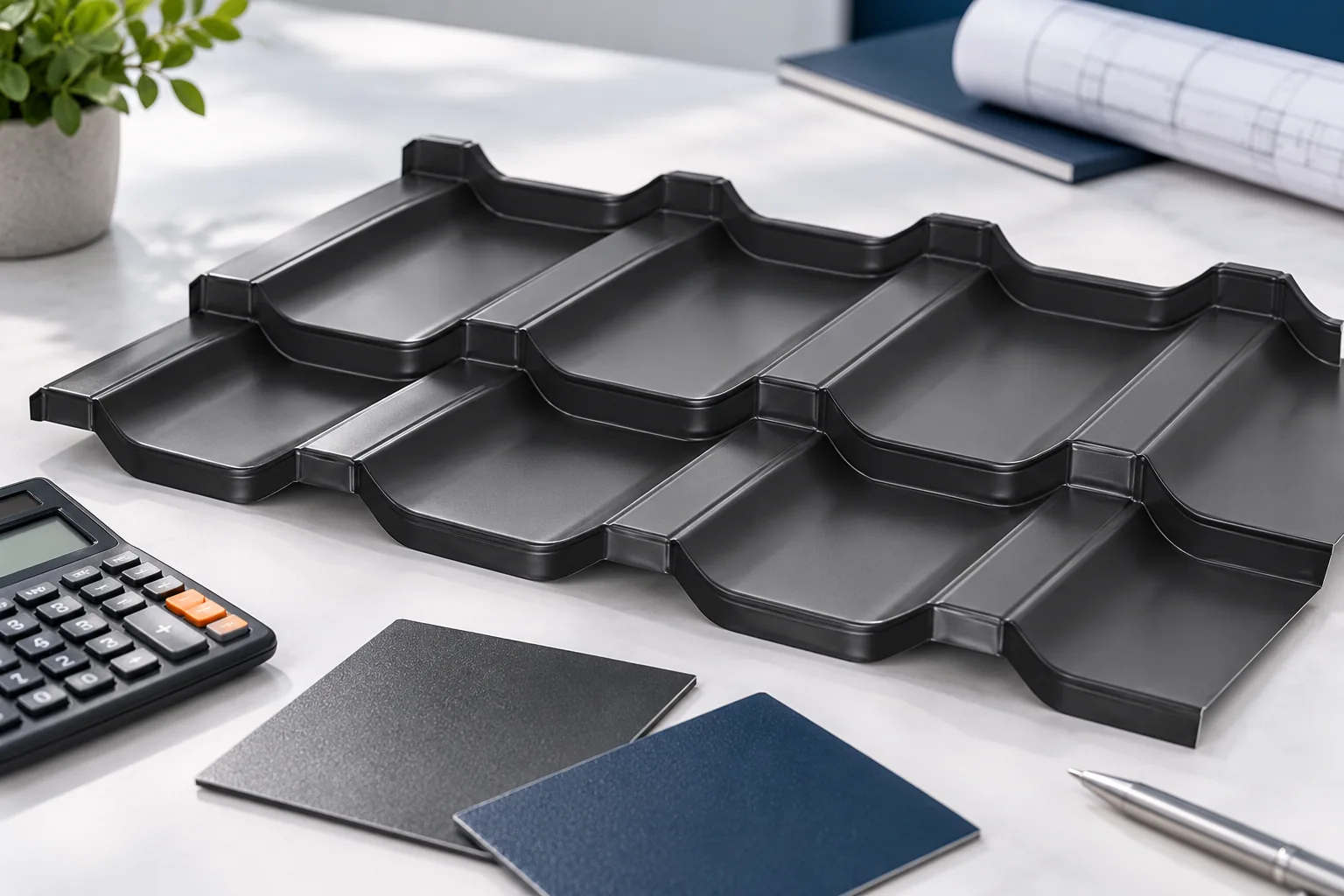
On a simple roof slope, a sheet cut to length can make good use of the roof geometry. It reduces some transverse joints, provided the length is within the recommendations. However, it requires space for unloading and suitable handling. The logistical cost must be compared with the possible benefit of fewer elements.
Modules are easier to deliver in smaller batches and to carry where access is limited. On a roof with many details, they can make cutting easier. This does not mean that every offcut can be reused. The profile direction and joint edges limit such possibilities. It is best to look at the material layout for both variants.
It is worth asking the contractor about the difference in labour intensity for a specific roof shape. Many roof valleys and roof windows can have a greater impact on labour than the panel format itself. The material price without accounting for these works does not yet show which variant will be cheaper once installation is complete.
What does a low covering weight offer?
Tile-effect metal roofing is a lightweight covering material. This can be advantageous during renovation when the load on the existing roof structure is being analysed. It does not, however, exempt you from assessing the condition of the timber, the connections and the entire structure. A damaged element does not become safe simply because the new covering weighs less than the previous one.
The weight of the entire system must be calculated. Additional sheathing, insulation and equipment can change the balance. The designer should also take wind and snow into account. The weight of the sheet metal alone is not enough to state that photovoltaics can be installed on the roof, or the number of supports reduced, without verification.
If a lightweight material allows the structure to remain sound, it may reduce the scope of modernisation. This is, however, a benefit specific to a given project. One should not promise every homeowner that roof structure repairs will be avoided. The decision should follow from an inspection and calculations, not from a comparison of weights in a brochure.
How to assess the cost of later use?
Every roof requires inspection. In the case of sheet metal, the condition of the coating, the fixings, the flashings and the free flow of drainage are important. A small defect repaired early may require only a minor scope of work. A neglected leak can damage the layers beneath the covering. The feasibility of access and servicing of the roof should therefore be included in the cost-effectiveness assessment.
Before purchase, check the warranty terms, the availability of flashings and the possibility of obtaining a matching profile for later repair. Keep the documentation of the material and the installation. It is not worth accepting a single number of years as the certain durability of every tile-effect metal roofing. The surroundings and the manner of use affect the condition of the covering.
Tile-effect metal roofing is a sensible purchase when it suits the task and is correctly installed. Your own comparison of two full cost estimates gives more than a general ranking of materials. It should show what you are paying for now, what will require servicing and which differences matter on your roof.
7 branches. Materials closer to your project.