Installation and execution
Timber connectors: common types and where they are used
In brief
The choice of a carpentry connector is determined by the whole node, not by the shape of the fitting alone. Before buying, check what loads it is to transfer, what the geometry of the components is and in what environment the connection will work. The specified nails, screws or anchors and the installation pattern also matter. An angle bracket, beam hanger or post base may serve different functions, and a similar appearance does not guarantee interchangeability. The documentation gives parameters for a specific arrangement, so it is worth knowing the connection diagram and the conditions for which they were determined.
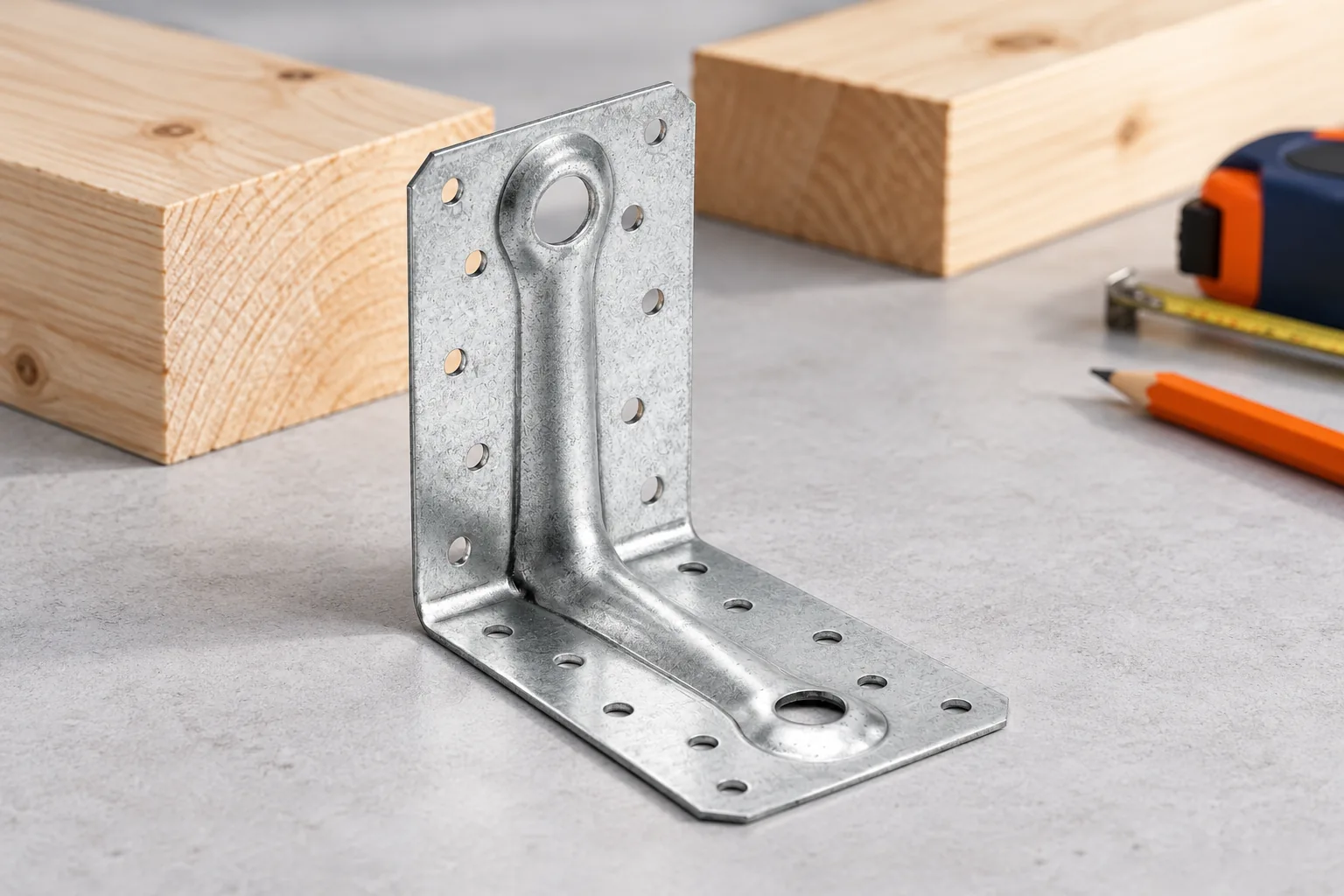
What is an angle bracket used for?
An angle bracket can connect timber elements to each other or timber to another substrate, provided its documentation allows this. Different models have different dimensions, thicknesses and reinforcements. The hole pattern affects how forces are transferred. It should not be selected solely on whether the element fits between the beams.
Some solutions require a pair of angle brackets, and some a specific orientation relative to the load. Changing the installation can change the parameters. A slotted hole also has a specific function. In a designed connection it may allow movement. Blocking it without verification does not necessarily increase the safety of the system.
When is a beam hanger used?
A hanger creates support for the end of a beam at a main element. It facilitates a specific connection without arbitrary cutting of large notches. It must match the width and height of the beam and the loads. Variants with different shapes and fixing methods are available.
The load-bearing capacity also depends on the element to which the hanger is fixed. A strong connector does not automatically strengthen a main beam that is too weak. The entire connection and the required distances are verified. Random wedges should not be inserted into a hanger that is too wide unless such a solution has been provided for and assessed.
What do rafter connectors do?
They are intended for specific connections in the roof structure, for example rafters to a support. Depending on the geometry, they can transfer uplift or horizontal forces. Selection requires understanding how the roof works. A similar shape of two products does not mean the same directions and values of load-bearing capacity.
For a roof with outward thrust, anchoring the wall plate to the ring beam is also important. The rafter connection is just one link in the load path into the building. It is not enough to install a strong connector on a weak support. The design should show the entire load path and how each transition is executed.
What are straps and plates used for?
Straps can contribute to the bracing of the structure if they are designed for that function. They require suitable anchorage points and a suitable method of fixing. A loosely nailed strap does not automatically provide the expected stiffness. What matters is its performance in a specific direction and its compatibility with the other bracing elements.
Perforated plates fixed with connectors differ from the toothed connector plates (nail plates) used in the prefabrication of trusses. The latter are pressed into the timber with suitable equipment. They should not be treated as ordinary sheet metal for hand nailing. The method of production and of forming the node is part of its properties.

How are post bases and anchors selected?
The base connects a timber post to the substrate in a specific arrangement. It may incorporate height adjustment or spacing of the timber from the surface. Its function depends on the documentation. Not every base provides fixity of the post and transfer of moment. This cannot be assessed from appearance alone.
Anchors for concrete must be selected to suit the loads and the substrate. Edge distances, the condition of the concrete and the installation all matter. For an external structure, suitable corrosion protection is required. Using a component intended for a different environment may reduce the durability of the entire connection.
Why are connectors part of the system?
The parameters of the connector are stated for specific nails, screws and a specific arrangement pattern. Replacing them with an arbitrary screw does not automatically preserve the result. The documentation may permit substitution with a clearly specified equivalent. Such a possibility does not mean freedom to choose any similar product.
In the tables, a distinction must be made between characteristic and design resistance. The former is not a ready answer to the question of what weight can be suspended. The design takes account of the relevant factors, directions and load combinations. Parameters of several connectors should not be added without checking their combined action.
How can you prepare a purchase without accidental substitutes?
The schedule should state the exact type, the number of pieces, the material and the required connectors. It is worth adding the installation diagram and the service environment. If the specified product is unavailable, a replacement should be assessed before delivery. A similar size is not sufficient to confirm equivalence.
At acceptance, check the position, the filling of the specified holes and the condition of the coatings. The connector should not be bent open or notched without authorisation. Keep the documentation before the structure is covered. A good selection is a matching set: timber component, connector, fasteners and substrate. Only together do they form a connection with a defined function.
7 branches. Materials closer to your project.