Insulation and thermal insulation
Roof underlay, vapour control layer or protective film?
In brief
Begin by deciding where each layer belongs within the roof assembly, not by the name on the roll. The term ‘roofing foil’ covers materials with different jobs: the membrane beneath the covering helps drain water and vapour, the layer on the interior side restricts moisture ingress, and the protective foil on sheet metal serves yet another purpose. Check the diffusion resistance, intended use and location required by the roof design. Swapping layers can trap moisture in the roof or leave gaps, so specify the material name, parameters and fixing detail on the order.
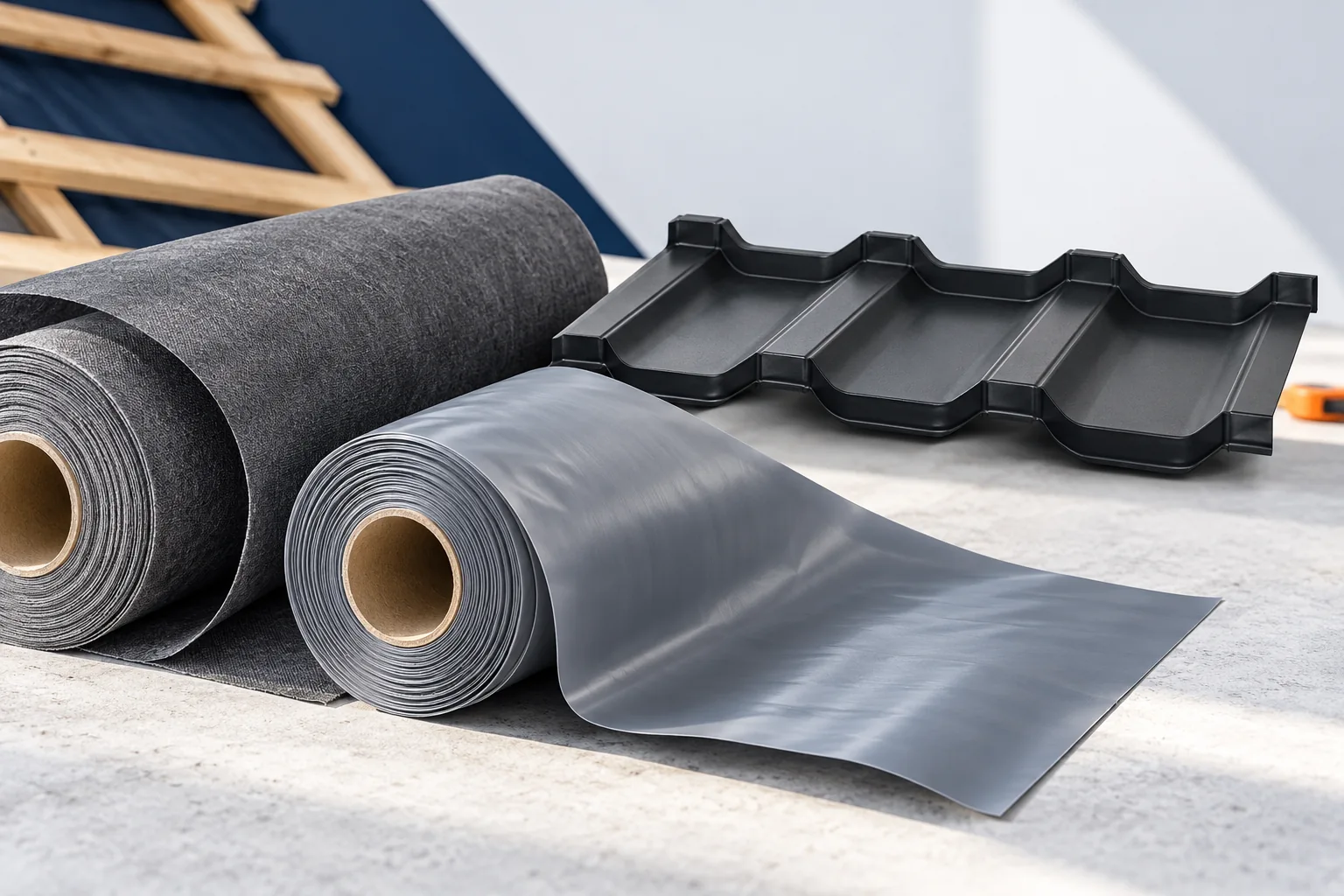
Why is the term ‘membrane’ often too general?
In the shop, similar-looking rolls may have different diffusion resistance and purpose. One layer is intended to facilitate drying towards the outside, the other to restrict vapour flow. Swapping them is not a minor deviation. Therefore the order should include the material type name, parameters and application location resulting from the roof design.
Nor should the underlay membrane beneath tile-effect metal roofing be confused with the waterproof membrane constituting the actual covering of a flat roof. These are different product groups. The material under the covering does not have to be suitable for permanent exposure to weather. Selection based on the word ‘membrane’ alone can therefore lead to using a product outside its scope.
Why is the membrane located under the covering?
The underlay layer takes up water that has penetrated beneath the covering, as well as condensate. It should discharge these towards the eaves in accordance with the detail. At the same time, a membrane with low diffusion resistance allows vapour to pass to the outside. This does not mean, however, that it acts as an open ventilation channel or removes moisture from the bathroom.
Its suitability depends on the parameters and the method of installation. Watertightness, strength, the permitted substrate and resistance to conditions beneath the covering are important. The exposure time to UV radiation must also be observed. Leaving an uncovered roll on the roof for a long time can impair its properties, even if the surface still looks intact.
How does the layer on the room side work?
The layer restricting vapour flow is selected according to the construction of the building component and the interior conditions. Its airtightness is very important. Moist air can penetrate into the insulation through openings and unsealed joints. A high Sd value on the label alone will not help if the material is perforated and not tightly connected to the walls.
The task therefore concerns the entire surface and the details. Pipe penetrations, connections to windows and junctions at walls must be resolved. Tapes and adhesives are selected according to the material and substrate. In more complex arrangements, a moisture assessment is required. It should not be assumed that every film with higher resistance will be safer than the material selected in the design.

Can PIR cladding or non-woven fabric replace the membrane?
A PIR board with a thin facing can participate in the thermal and moisture solution of the roof, but its role depends on the system. The mere presence of an aluminium layer does not ensure the tightness of all joints and penetrations. The board joints and the perimeter must be designed and executed in accordance with their purpose. Other layers must not be removed arbitrarily based solely on the appearance of the board.
Anti-condensation fleece on the underside of the sheet temporarily retains condensate. It has a limited capacity and requires drying out. It is neither insulation nor a universal vapour barrier. It may be useful in a suitably ventilated building, but it will not solve a constant influx of moisture. When selecting it, the conditions of use and the requirements for edges and overlaps must be checked.
What errors occur at junctions?
A common problem is a break in the layer at a chimney or window. On a large, flat surface the material lies correctly, but at the detail water or air finds an open path. These locations cannot be treated as an addition to installation. Collars, tapes and flashings should be prepared before covering begins, not chosen at random at the end of the day.
Another mistake is blocking the required ventilation gap with insulation or flashing. The high vapour permeability of the membrane does not justify blocking the inlet and outlet in a ventilated system. The continuous air path must be checked. An opening at the eaves is not enough if a few metres higher the space is completely closed.
How do you order the right material set?
Gather the roof cross-section, the type of covering, the pitch and information on attic use. Assign a function to each layer. Then select the material and the method of joining it to adjacent elements. Include tapes, collars and seals in the order. Buying just the roll without accessories often ends in replacing them with unsuitable products.
Before covering, it is worth accepting the continuity of the layers and taking photos of the details. The transport film on the sheets should be removed within the period specified in the instructions, as it is not part of the roof insulation. A clear separation of material functions avoids most mistakes. Each layer must work in its place and cooperate with the others.
7 branches. Materials closer to your project.