Insulation and thermal insulation
Comparing PIR, EPS, XPS and mineral wool for roof insulation
In brief
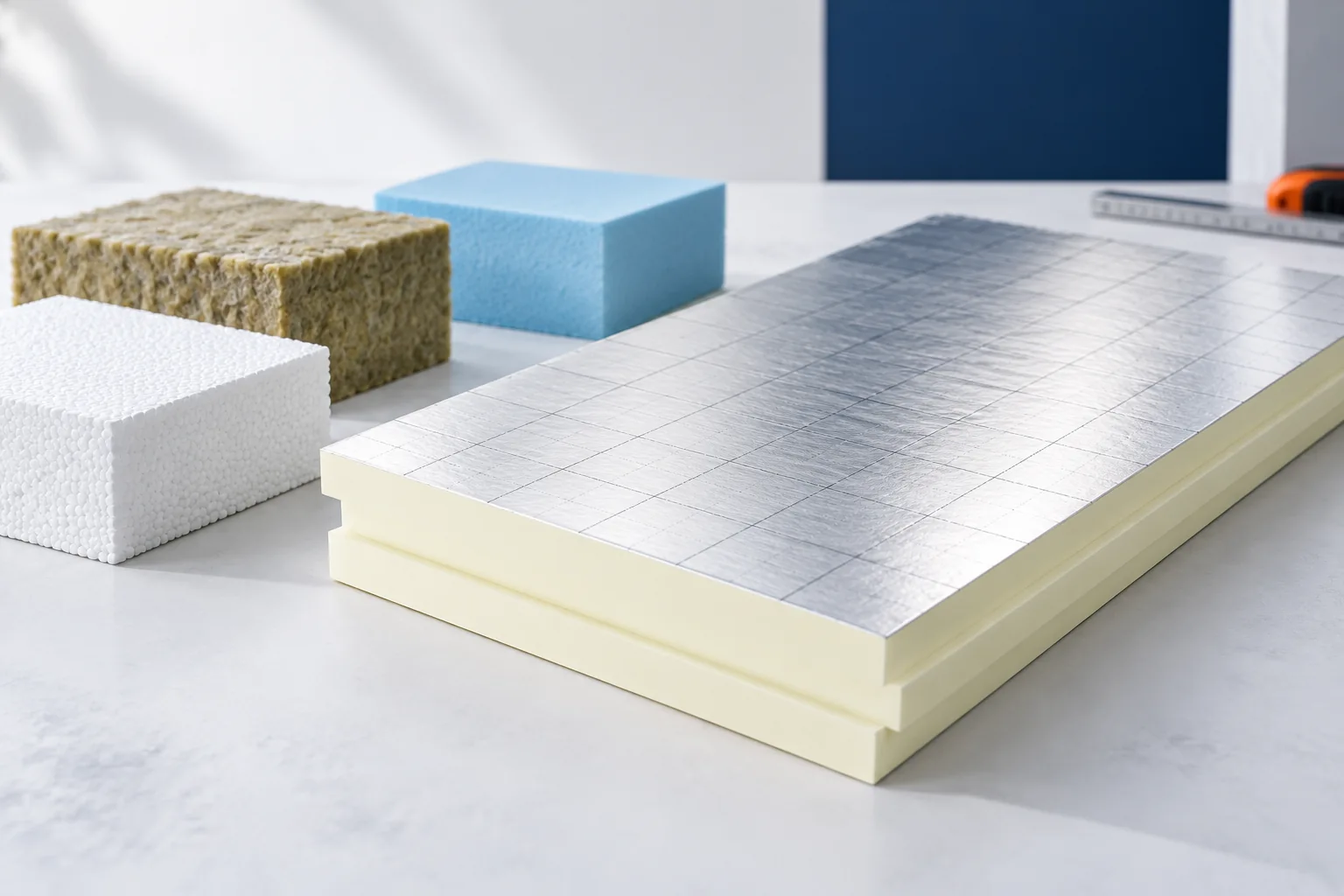
Begin comparing roof insulation with the required thermal resistance, not with board thickness. Check whether the chosen variant meets the project’s fire, moisture and mechanical requirements. PIR with a lower lambda may need a thinner layer than EPS, XPS or mineral wool, which can matter where space is limited. For each product, establish the declared lambda and calculate R as thickness in metres divided by lambda. Only then compare the cost of the whole roof, including thermal bridges, fixings and flashings. Leave final thicknesses to the designer.
What are we actually comparing: lambda, R or U?
Lambda describes heat conduction through a material. The lower it is, the greater the resistance of a layer of the same thickness. Thermal resistance R is calculated as the thickness in metres divided by lambda. The U-value relates to heat transfer through the building component. It should not be equated with the lambda of a single board nor replaced by one simple calculation without checking the assembly.
When comparing offers, compare the declared values for specific products. EPS, XPS and mineral wool do not have one common lambda for the entire category. Differences also occur between PIR variants and types of facings. Design calculations may require values adapted to the conditions of use. First establish the data, and only then compare price and thickness.
What does the example for a 100 mm PIR board look like?
For an example PIR with a lambda of 0.022 W/(m·K), a 100 mm layer gives R of approximately 4.55 m²·K/W. This is the result of 0.10/0.022. To achieve a similar resistance with a material with a lambda of 0.031, approximately 141 mm is needed. At a lambda of 0.036, the thickness rises to approximately 164 mm. Such values are found in various EPS variants, but the selected product must be checked.
At a lambda of 0.033, the required thickness is approximately 150 mm, and at 0.039 approximately 177 mm. The first value may correspond to a selected XPS, the second to a specific mineral wool product. The example compares only the resistance of the material. Actual commercial thicknesses are graded, and the result for the whole roof also depends on thermal bridges, joints and the other layers.
When does thinner insulation give an additional benefit?
A smaller thickness can make the detail at the eaves, parapet or window easier. With internal insulation, it helps to limit the loss of space. During renovation, it sometimes allows part of the alterations to flashings and joints to be avoided. However, these benefits must be checked on the building section. Not every change in thickness leads to a real saving in work.
PIR is sometimes more expensive per same board thickness. A proper comparison includes variants with similar resistance and their installation. The price per cubic metre also does not decide if the required quantities differ. It is worth comparing the total cost per square metre of the finished building component and separately identifying the work that results from the greater thickness.

Which properties can outweigh the thermal result?
Water and loads require separate assessment. XPS with suitable parameters may be suitable for a moisture-exposed assembly in which a standard PIR board with a given facing is not intended. The compressive stress value is not automatically a permissible long-term load. The conditions of use and the documentation for the specific solution are what count.
Where fire or acoustic requirements apply, an appropriate mineral wool build-up may have the advantage. PIR should not be presented as non-combustible. The classification of the whole assembly depends on the layers and installation. Thin insulation with good R does not win if it fails to meet the project’s other requirements. The comparison must leave room for these limitations.
How to calculate cost without apparent savings?
Add up the price of the required thickness, waste, fixings, tapes, sealing layers and labour. Check the unit and the tax. A catalogue price list is a reference point on a given date, not a guarantee of the final quote including transport. Differences between suppliers only make sense once it is confirmed that they relate to the same product and a similar scope of delivery.
Assess the cost of the details separately. A thicker variant may require longer fixings or changes to the flashings, while rigid boards require careful fitting and sealing of the joints. These savings or surcharges should not be entered in advance. The result should come from the design and the contractor’s quote. A simple table of the complete scope shows more than a promotional price for the insulation alone.
What determines a good choice for a roof?
First, the thermal, moisture, fire and mechanical requirements are established. Then the variants that meet them are compared. PIR is particularly interesting where thickness is limited. EPS may be advantageous where there is more space, XPS under properly selected water conditions and loads, and mineral wool where fire and acoustic requirements apply.
Finally, the execution of the continuous layer must be assessed. A gap at the wall and an unsealed service penetration can weaken the effect of a good material. A table of equivalent thicknesses helps to choose a starting point, but does not replace the roof calculation. The best result comes from combining the right parameters with details that can actually be executed carefully on site.
7 branches. Materials closer to your project.