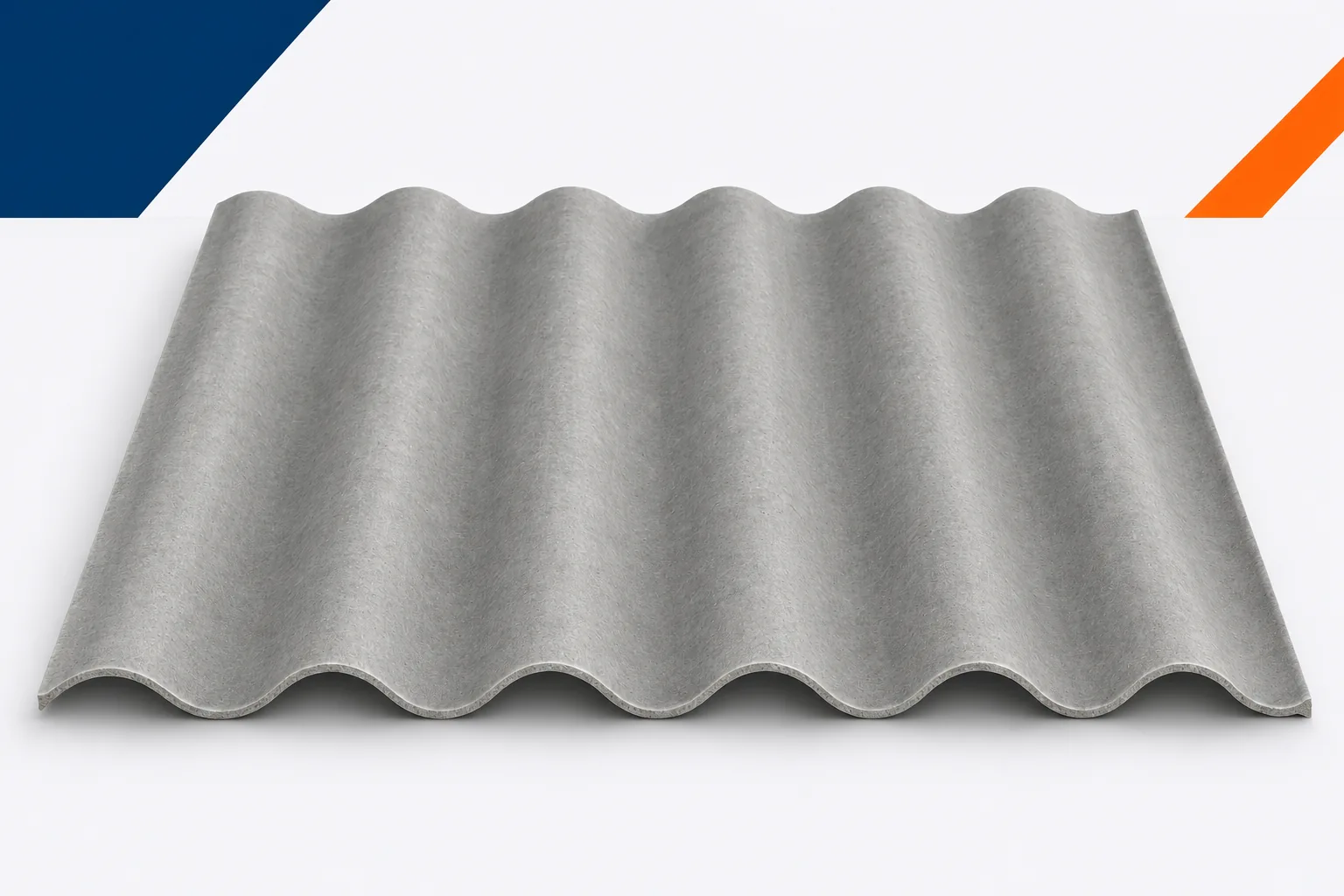
Fibre cement roof coverings
Roof valleys in fibre cement roofing: why they need a separate detail
At a glance
The valley is one of those places where a simple roof stops being simple. Water flows into it from the adjacent roof slopes, and the diagonal cuts change the shape of the sheets. Fibre cement sheets must be planned here with account taken of the support and the drainage. Asbestos-free fibre cement should not be cut at the valley only when there is no room left for the next row. A separate detail makes it possible to assess the tightness, the fixings and the later possibility of cleaning. An ordinary corrugation trough carries precipitation away from a narrow strip of roof. Water from many such strips on both sides reaches the valley. The size of the flow depends on the geometry of the roof slopes and on the rain conditions.
The valley collects water from a larger area
That is why the width and finish of the valley are not chosen on the basis of appearance alone. What matters is the length, the pitch, the catchment areas and the way water is discharged at the eaves. The design should also take into account leaves, small branches and the possibility of blockages forming. A joint that is too tight may look neat but can hinder drainage and maintenance. Here, useful space for draining water takes priority over concealing the flashing.
The diagonal cut changes the conditions of the sheet
After cutting, a sheet may end in several narrow fragments of corrugation. Not every one of them will have sufficient support and room for fixing. Fibre cement boards must be laid out so as to avoid accidental small pieces in the place most exposed to water. The position of the cut in relation to the crests and supports must be checked. It is not enough to assume that the neighbouring sheet will cover the problematic section. At the valley, it may be necessary to supplement the supporting substructure in accordance with the design. A good sequence comprises the cutting plan, the arrangement of the support and only then the preparation of the material. This reduces the risk of corners breaking off during installation and subsequent use.
The flashing must lie within the planned layout
The water-discharging element in the valley works together with the substrate, the laps and the adjacent layers. Its positioning should not create depressions or raised places that hold back precipitation. Fibre cement boards must not press the flashing with random edges. The correct detail defines the covering of the sides, the necessary clearances and the method of fixing. The ability of different materials to move must also be ensured. Screws placed thoughtlessly in the path of the water flow create further penetrations requiring sealing. There is no universal valley width suitable for every building. Copying a dimension from a small shelter to a large hall ignores the fundamental difference in water load.
The laps must not direct precipitation under the covering
In the valley, a logical sequence of all applied layers must be maintained. Water should pass from the higher element to the lower one and on to the drain. Asbestos-free fibre cement requires here conformity with the detail of the selected system, not an arbitrary composition of sealants. The beginning of the valley, its possible joints and its termination at the gutter are executed with particular care. An additional layer of compound will not repair a reverse lap. It may, however, retain contaminants or make a leak harder to identify. Before covering the next section, it is worth checking the continuity of the water path. This is simpler than later dismantling several rows to find a single error.
Different layers can meet beneath the roof valley
In an insulated roof, it is not only external drainage that must be maintained. The underlay, the insulation and the air tightness on the interior side are also important. Fibre cement sheets are responsible for the covering function, but they do not resolve the remaining junctions. The diagonal run of the valley can make continuous ventilation beneath the roof slope more difficult. Provision must be made for how the air will reach the outlet, instead of assuming free flow in every bay. With the roof structure, an assessment of local loads and support is also needed. A minor adjustment to the visible flashing will not replace a correct solution for the concealed layers.
The roof valley requires access for cleaning
Leaves and deposits can accumulate where the water streams meet and change direction. This applies in particular to buildings near trees. Fibre cement sheets are brittle under point loads, so cleaning must not be planned as a walk across the sheets. Safe standing positions and a suitable access route are needed. It is worth providing for them before construction is completed. A valley completely concealed by equipment or difficult to reach from outside will be more costly to maintain. The inspection should cover free flow, the condition of the junctions and signs of displacement. An accumulation of deposits is a signal to act before a leak into the interior occurs.
The acceptance inspection should cover the details before they are covered
Photographs of the support, the laying of the flashing and the successive laps help to assess the workmanship later. A photograph of the finished roof slope alone shows too little. The fibre cement sheets at the valley should be checked for unsupported cut pieces, damaged edges and accidental holes. It is worth comparing the width of the effective drainage path with the design along the entire length, not at a single point. After the first rainfall, the termination at the gutter should also be observed. If water overflows or splashes back under the covering, an analysis of the drainage geometry is needed. The repair should remove the cause, not merely cover the place where moisture becomes visible.
Price a roof with a valley on the basis of the cutting plan and the drainage details. Asbestos-free fibre cement, together with the correct flashings, should form a solution for the specific geometry.
7 branches. Materials closer to your project.