PIR insulation
BauderPIR FA on an existing roof: adding new equipment
At a glance
During the refurbishment, the roof-mounted equipment is to be replaced with a heavier unit. The retained FA and the existing support cannot be assessed solely on the basis of the absence of previous failures. The forces, the contact area and the service access route may change. The detail must be re-checked, even if the installation location remains the same. In a refurbishment, the scope described as a roof with equipment supported on the layers above the insulation requires the old layers to be investigated. The first difficult point to inspect is the bearing area of the foot of the roof-mounted equipment. It is not advisable to determine the thickness of BauderPIR FA solely on the basis of an old drawing. The measurement should cover the force transferred through the support and its actual contact area, taking into account changes made during previous work.
What needs to be exposed before selection
This forms the basis for a support drawing showing the load transfer path and protection of the covering. The purpose of the survey is to answer the question of whether the existing conditions allow thermal insulation performance to be combined with permissible deformation under load.
The right product and the scope of its data
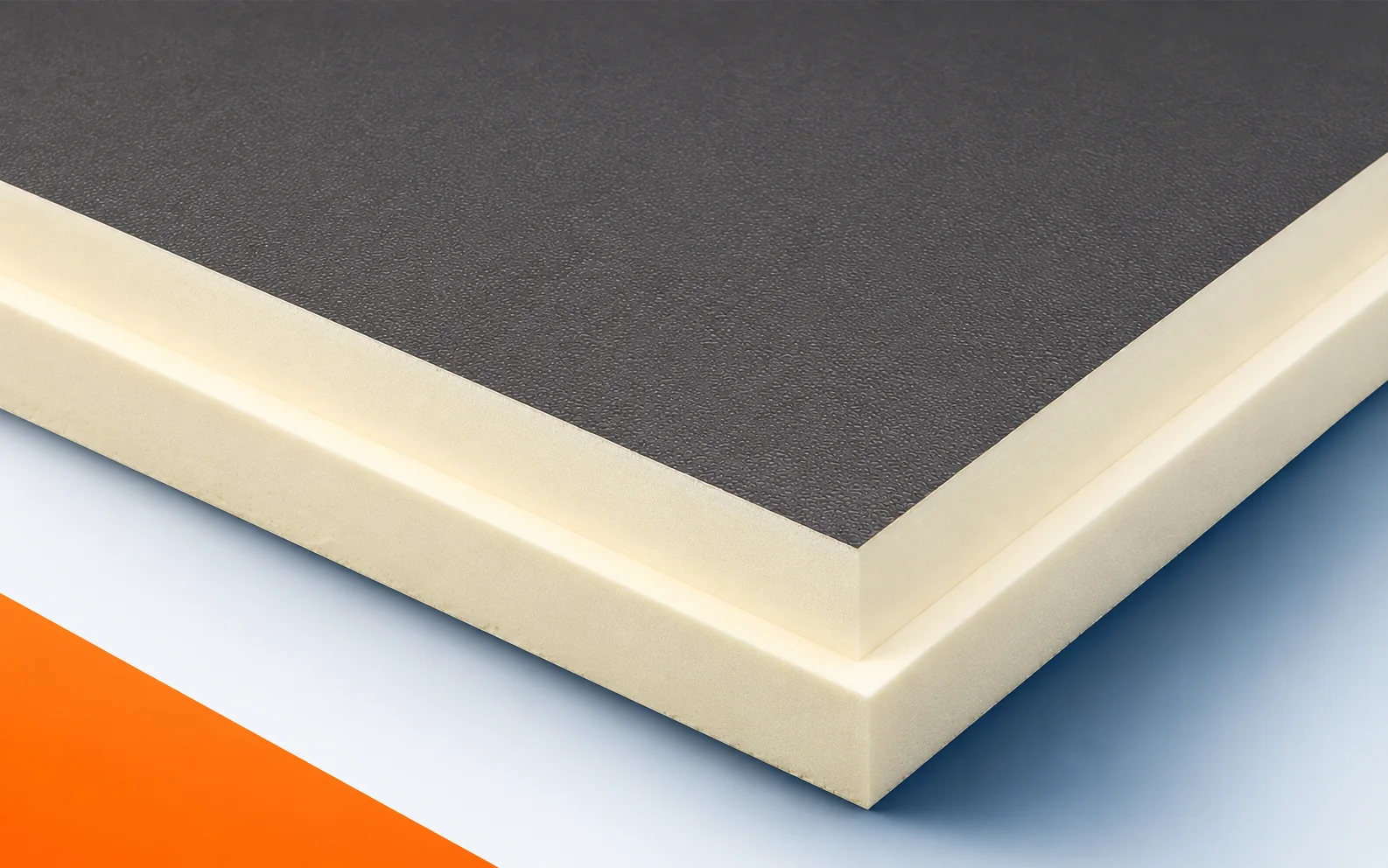
For a new equipment support, first distinguish between short-term compression of BauderPIR FA and long-term sustained load. The Polish data sheet of September 2026 states 24 kPa for long-term load at 2% deformation. This is separate information from CS(10/Y)120, tested at 10%. The CS parameter alone does not determine the load-bearing capacity of the finished roof: the support design must cover the conditions in the documentation and all layers. For full factory identification of the board with PIR core and facings, also retain λD 0.022 W/(m·K) and fire reaction E. The name BauderPIR FA is needed here because the general term polyurethane insulation does not indicate the correct data set.
Example versus the actual state of the renovation
Begin the support check with the actual contact area, which may be smaller than the nominal outline of the foot. If, purely in the example, the force is 0.80 kN and the contact area is 0.020 m², their quotient gives an average of 40.0 kPa. Comparing this figure only with the 120 in the CS designation of BauderPIR FA would be insufficient. The Polish data sheet separately states 24 kPa for long-term action at 2% deformation. The spreading of the load through the layers and the transfer of forces to the structure in accordance with the design must be considered. The calculation does not approve such a support, nor does it replace the design of the entire detail.
Before reusing an old support location, it is worth exposing the area needed for assessment. A surface mark must be distinguished from permanent deformation of the layers. The condition of the covering in the vicinity of the support is also important. New equipment may load different areas than the previous one. The renovation documentation should show this change instead of referring only to the earlier period of use.
The presented calculation for BauderPIR FA serves to provide an initial structure for the decision. In an old building, the result must be confronted with a limitation: the actual size of the load-transferring area. The property of the new board described as a separate assessment of short-term compression and permanent load does not remedy a deficit elsewhere. On site, the verification of strength, bearing area and deformation over time must be separated before the final scope of work is adopted. The verification should be documented by a support drawing showing the load transfer path and the protection of the covering. If it proves inconsistent with the assumption, the BauderPIR FA order must be adjusted before the start of repetitive cutting.
Which scope of repair is justified
One measure under consideration is increasing the actual load-spreading area. A second may be a separate support solution transferring the load in accordance with the design, depending on the result of the exploratory opening. With BauderPIR FA, both variants should take into account the repair location: the contact area of the roof equipment foot. Before the decision, the number 120 kPa must not be taken as the ready permissible support load. The result of the inspection should be assessed by the designer of the support and roof loads, who will link the repair with the other layers. Once agreed, a set of documents is needed covering the supports, penetrations and service route, with information on the elements retained after the refurbishment.
The junction between new and existing material
At the repair location, the connection of the insulation in the vicinity of the equipment base must be identified and its termination at the existing section planned. The top of the new board is the board’s aluminium facing beneath the protective layers; its interaction with the retained materials must be checked. For BauderPIR FA, the matching of the core name is not sufficient confirmation of adhesion or tightness of the joint. The basis for documenting acceptance is a document with the pressure calculation and the conditions of its long-term action. The next stage will be the covering together with the protective layer beneath the support, so the scope of the correction should be closed beforehand. In the refurbishment documentation, it is worth distinguishing the contact area of the roof equipment foot and the boundary between the old and new work.
Phasing in an occupied building
The installation of BauderPIR FA must be linked to the possibility of protecting the exposed section. At every stage, the transfer of forces from the equipment to the structure in accordance with the design is required, also after the old layers have been removed. The location defined as the contact area of the roof equipment foot may require temporary protection against a break in work. The plan should include the covering together with the protective layer beneath the support, so that the timing of the next team corresponds to the state of completion. Responsibility for clarifying conflicts should lie with the designer of the support and roof loads. The polyurethane insulation will then be part of a planned refurbishment whose aim is to combine insulation performance with permissible deformation under load.
Acceptance after reinstating the layers
At acceptance, the scope covering the roof with the unit based on the layers above the insulation must be compared with the scope of the agreed repair. The reference document is the drawing of the support with the load transfer path and protection of the covering, supplemented with actual dimensions. It is worth keeping the document with the pressure calculation and the conditions of its long-term action, because once the layers are closed again the details will become invisible. The ordered PIR boards should have an identity matching the installed BauderPIR FA variant. If the problem returns, a record of how the contact area of the roof unit’s foot was executed will be useful. The review should not be limited to assessing the appearance of the new surface. It must be confirmed that the thermal insulation performance has been combined with permissible deformation under load, and that the cause of the earlier defect has actually been identified.
7 branches. Materials closer to your project.