PIR insulation
Kingspan Therma TR27 for roof repair and thermal insulation
At a glance
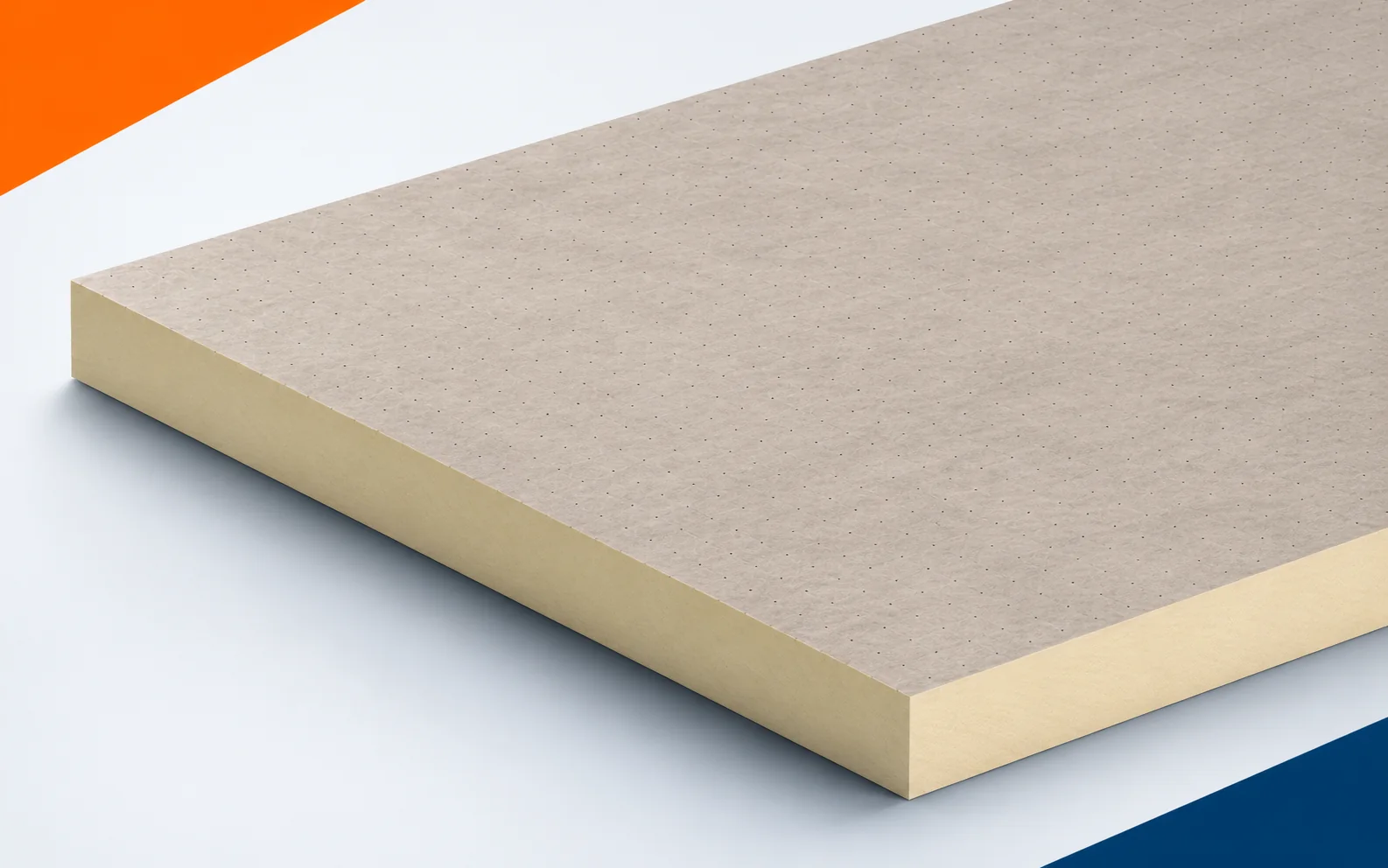
Therma TR27 may fall within the scope of a roof repair, but its suitability depends on what you find beneath the existing covering. It is a PIR board with glass fibre facings on both sides; the catalogue specifies flat roof and terrace build-ups with mechanical fastening, bonding or ballasting in accordance with the system documentation. In a bonded build-up, the condition of the surface and the compatibility of the materials are decisive, so the old layers must be assessed before adopting a new method of laying the covering. The inspection should also cover the junction between the board and the first layer of the adopted covering — this junction co-determines the extent of demolition work and the preparation of the existing roof assembly.
Survey before selection
A new surface does not solve everything: a board with a glass fleece facing is not interchangeable with every variant of PIR in any bonded arrangement. The demolition and repair work are intended to allow the properties of the facing to be used without disregarding the requirements of the specific roof system. Before the PIR boards cover the old layers, document the type of substrate, the membrane variant and the documentation of how all layers are connected.
Removing the cause of the defect
The glass fibre facing of Therma TR27 works together with the layers of the adopted roofing system, which does not make any adhesive suitable nor does it remove the need to prepare the substrate. Before covering the existing structure, examine the surface intended for bonding the covering onto the TR27 facing.
Prepare the surface to be bonded in accordance with the requirements of the specific material set, before the new build-up conceals the places relevant to assessing the cause of the problem. Adding insulation alone does not close the matter, and approval of a specific bonded system does not cover any arbitrary compound with a similar name. The polyurethane foam in the finished product does not replace the repair: first make the connection in accordance with the documentation of the correct board and waterproofing set. After preparing the place, check again the cleanliness and condition of the surface, the application requirements and the method of checking the finished connection, instead of basing acceptance on the appearance of the new surface.
When renovating with TR27, do not automatically treat the old coating as a suitable substrate for bonding — check its condition and compatibility with the selected system, as well as the preparation of the surface. The new glass fibre facing does not remove problems left in the lower layers, which is why the scope of repair work should precede the final choice of the method of connecting the covering.
New layer and old cross-section
For Therma TR27 boards, the declared thermal conductivity is not constant across all thicknesses. At 100 mm it is 0.027 W/(m·K), and the thermal resistance RD reaches 3.70 m²K/W; at 120 mm, respectively 0.026 and 4.60 m²K/W. If the existing roof geometry limits the thickness, consider both variants with their own values, not a single lambda value carried over to both thicknesses.
After changing the TR27 thickness, re-read its lambda value and declared thermal resistance before the limited space forces a revision of the designed cross-section. Data from the old documentation may not correspond to the new build-up, and substituting a single lambda value for 100 and 120 mm will distort the difference in resistance. In the comparison of variants, for the measurements of the existing condition, record RD 3.70 for 100 mm and RD 4.60 m²K/W for 120 mm and relate them to the planned cross-section.
Connection to the existing structure
The Therma TR27 board has a standard format of 1200 × 600 mm. The catalogue provides for square edges or rebated edges, so confirm the geometry and the laying pattern for the specific order. On the sketch of the junction between the old and new parts of the roof, mark the 1200 × 600 mm board near the corner and the termination of the roof flashing.
Match the TR27 edge to the layout of the field and the support of the perimeter elements, including where the new layer meets the retained fragments of the building. Cutting to size on site makes it difficult to preserve the factory side profile that was to form the planned joint. Set the sequence of works so that the last rows are laid out before the perimeter elements of the roof slope are cut. At the acceptance of the termination point of the new polyurethane insulation, assess the actual variant of the edges, the covering area and the sealing of the edge after cutting.
Properties of the boards and stages of the renovation
Access to the equipment on the roof being renovated with TR27 requires an assessment of local pressures and support. The declaration for the board itself states a level of at least 120 kPa at 10% deformation and a reaction to fire of E. Neither of these statements replaces verification of the loads and fire requirements of the complete roof covering.
Stresses in the service zone must be assessed together with the protection and support of the TR27 layer, including where some components remain from the previous system. Changing the layers can reveal other limitations, and the declared 120 kPa at 10% deformation does not mean that every point load is permitted. Before leaving an old component in the system, it is worth designing the support and protection at the location that will be used differently from the middle of the field. In the inspection report and in the repair design, retain the service access area, the support area and the classification conditions of the entire covering.
Cost of recreating the details
When comparing a bonded roof with TR27 against a variant with a different fixing method, assume the same thermal resistance and the same extent of the finished covering. Add the auxiliary layers, the joints and the finishing of details to the cost of the insulation. Only this comparison shows the difference in renovation cost between the considered methods of execution.
Compare TR27 variants for the same thermal resistance and an equally completed roof. The fixing method affects both material consumption and the preparation of the existing surface. After exposing the old layers, agree with the contractor on the board thickness, the type of joint, the auxiliary layers and the flashings. Only a scope defined in this way allows the cost of the entire system to be compared.
7 branches. Materials closer to your project.