PIR insulation
Cutting swissporPIR Alu during renovation: what happens to the edge profile
At a glance
During renovation, cuts of swissporPIR Alu depend on how the new board is to meet the old edge, not on the thickness alone. Identical thickness does not guarantee a matching profile, so before ordering you must identify the existing edge finish and assign the correct edge shapes to the FIT/GK, LAP/SF and TAG/NuF designations. FIT/GK means a square edge, LAP/SF a rebated edge, and TAG/NuF a tongue-and-groove profile. The inspection should include distinguishing these three variants, because similar profile names do not describe the same way of fitting adjacent boards. The terms “polyurethane boards” and “polyurethane foam” are broader than the precise PIR product designation, so they do not replace identification of the edge.
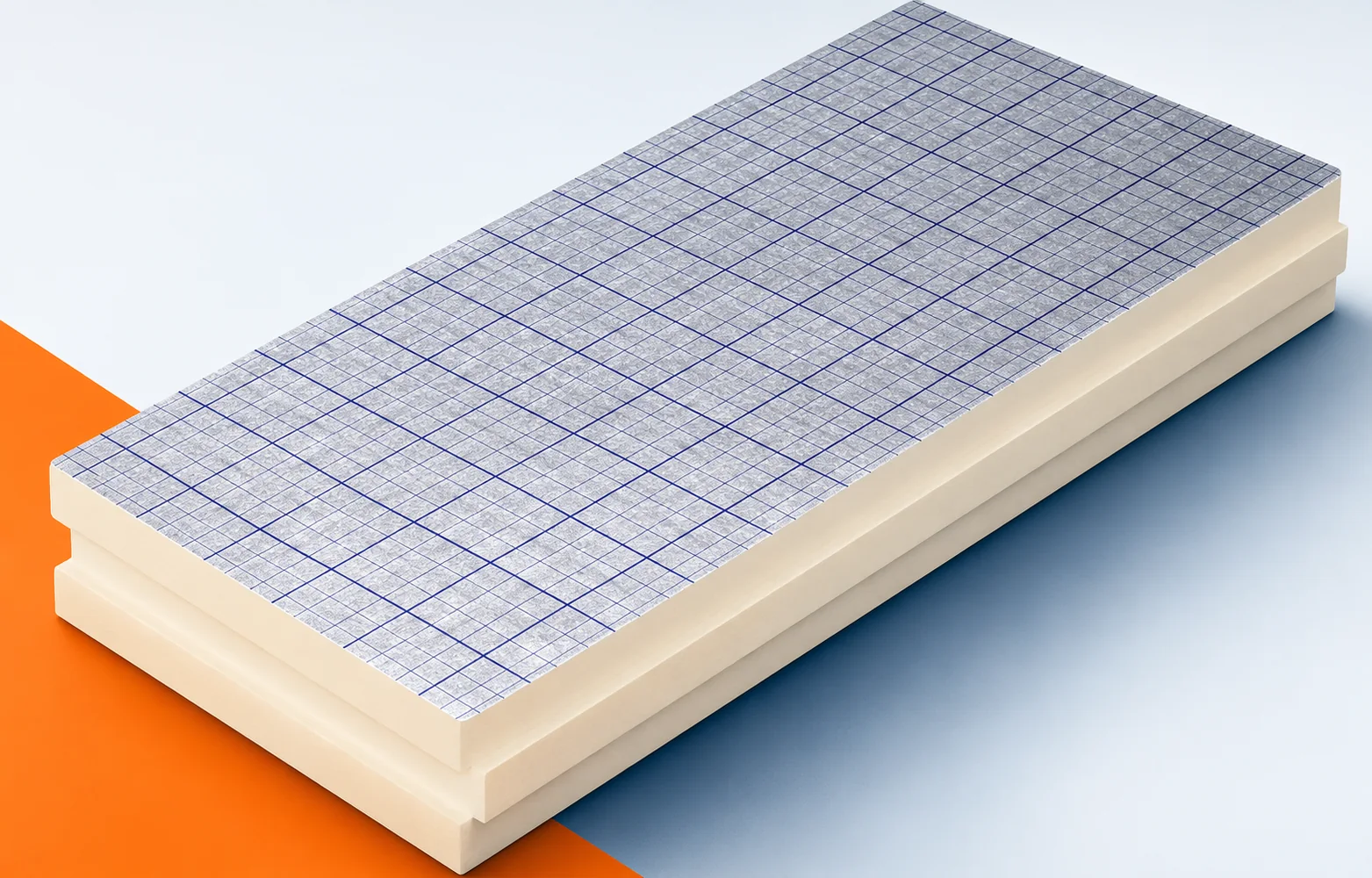
PIR boards with FIT, LAP or TAG edge
A survey of the existing condition should allow the geometry to be ordered in line with the laying and termination plan. Before ordering, check the verbal description of the edge together with a drawing of its actual cross-section and compare the plan with the real dimensions.
Core conductivity and quality of contact
The quality of the cut swissporPIR Alu joint is determined by the fit of the edges, not by a change in the properties of the core. Its declared lambda remains 0.022 W/(m·K) regardless of the edge designation. In a renovation, therefore, the required thermal resistance and the way continuity of insulation is maintained at the termination must be assessed separately.
After taking measurements, it is worth separating the core conductivity of swissporPIR Alu from the quality of execution of its joints. Former assumptions may no longer suffice, since the rebate does not automatically improve the lambda value and does not eliminate the influence of the other thermal bridges. The modernisation should allow the benefit of the profile as an aid to maintaining continuity of the layer to be assessed. In the renovation documentation, keep the thermal properties of the board and the joint plan across the entire surface, instead of relying on the name of the former material alone.
Polyurethane insulation after trimming the edge
The edge after cutting must be clean and undamaged, and the joint with the adjacent board or partition should be fitted without gaps. Cutting removes the factory profile, so at the boundary between the old and new parts check the cut edge of swissporPIR Alu at the wall or at a projecting roof element.
After cutting off the factory profile, the correct end detail of swissporPIR Alu must be recreated, because achieving a fit at the end of the renovation can be difficult. A loose tongue does not replace proper support for the edge section. Plan demolition and installation so that the perimeter is fitted without open joints and unstable parts. Before covering the new polyurethane insulation, inspect and accept the condition of the edge, the width of the cut piece and the solution for its support.
Relative position of the layer joints
In a two-layer system, the joints must be offset relative to one another. With a single layer, the manufacturer recommends shiplap profiles or tongue-and-groove on roofs. Before closing the existing layers, check the offset of the joints in the two layers of swissporPIR Alu.
Before covering the old section, establish the relative position of the joints of the two layers of swissporPIR Alu. Tape on the surface does not recreate the missing core and is not a standalone waterproofing. After preparing the substrate, limit direct gaps through the thickness of the system, without omitting other layers. The inspection covers the layout of both layers and the function of each intended seal, not just the appearance of the new field.
The profile does not replace support
The edge profile of swissporPIR Alu does not act as a structural lock as in sandwich panels and on its own does not ensure the transfer of any span. During the renovation, it is worth reassessing the tongue-and-groove profile as a joint of the thermal insulation.
In the cross-section of the renovated building component, separate the tongue-and-groove fit from the load-bearing capacity of the swissporPIR Alu support. The board’s interlock does not permit arbitrary support spacing, so determine how the full boards are supported and how loads are transferred to the structure together with a survey of the retained layers.
Insulation with polyurethane: the right edge profile when ordering
When comparing edges, check how the usable area and the waste at the edges are calculated, because the quantity ordered results from the board layout and not only from the rectangular area on the plan. Confirm the availability of swissporPIR Alu edge profiles from a thickness of 40 mm according to the instructions before setting the renovation budget.
After assessing the substrate, confirm the availability of the swissporPIR Alu edge before ordering the 20 mm variant, because the profile described for thicker elements cannot automatically be assigned to it. Compare offers only after establishing the actual combination of thickness and edge finish, and in the order verify the delivery designation, the effective coverage and the waste from trimming the perimeter.
A case worth considering
During a renovation, when the new swissporPIR Alu is to be joined to a previously completed section, the existing edge is examined first: it may be straight, profiled or already cut to size. Matching thickness alone does not determine the fit, because the geometry of this edge determines how the cut is made. The joint detail is prepared before laying out a larger area, so that it does not have to be corrected after the fact by pressing in random pieces.
7 branches. Materials closer to your project.