EPS and thermal insulation
Is Uc a parameter of an EPS board?
At a glance
Uc describes heat transfer through a building component, taking the relevant corrections into account. It is not a property of a single EPS board. The material parameter is lambda, and for a layer of a given thickness it is its thermal resistance R. We explain these differences using a simple example and show what is needed to assess an entire wall. EPS has a specific ability to conduct heat. This is described by the λ coefficient, given in W/(m·K). Lambda alone does not include the insulation thickness. Boards of the same material with a thickness of 10 and 20 cm can have the same λD but will provide different thermal resistance. This is the first reason why a single Uc value for the wall cannot be attributed to them.
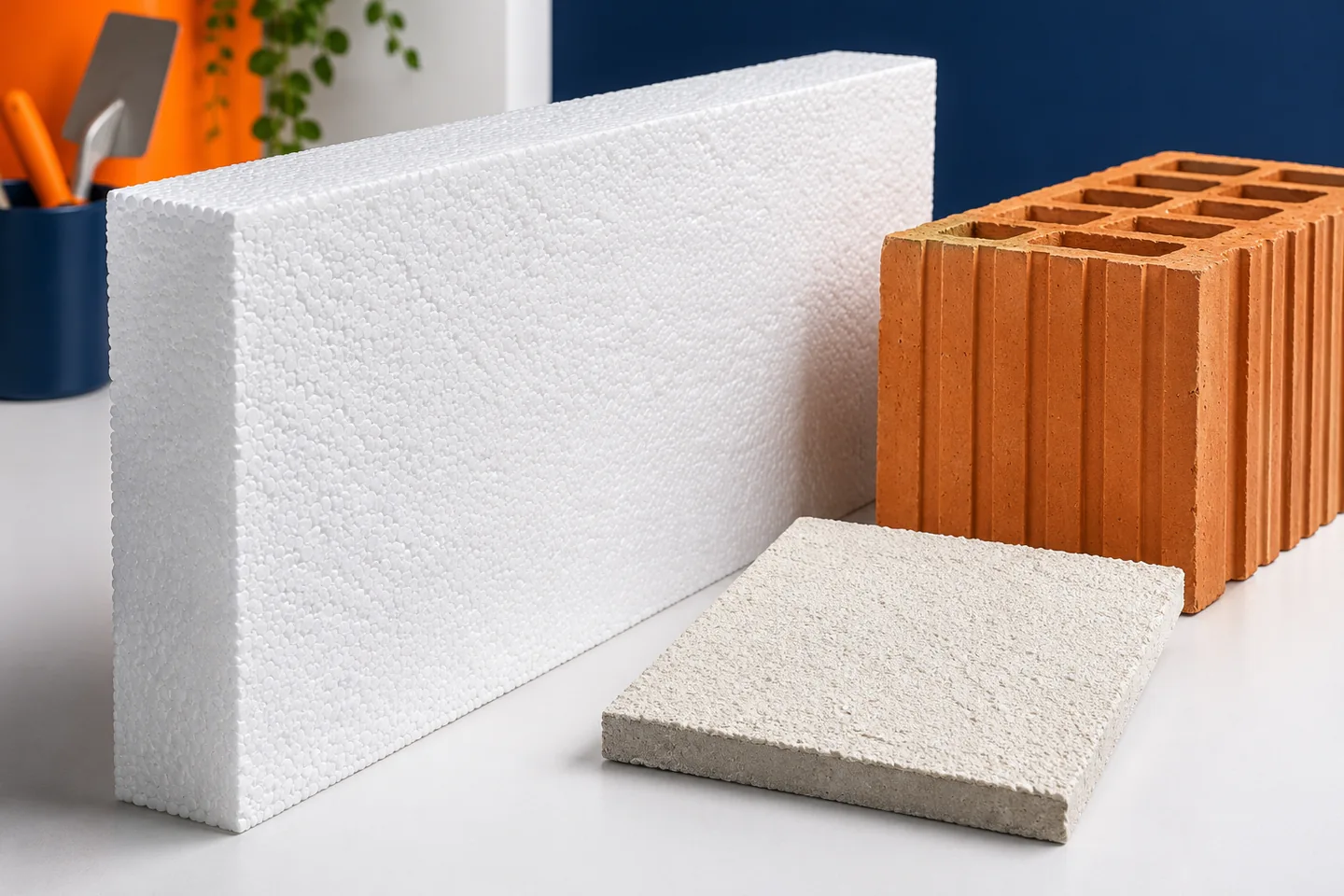
Why is the lambda value looked for on the board?
Once built in, EPS becomes part of the building envelope. Alongside it there are the wall, plasters, intermediate layers and connections to other elements. Their arrangement affects the result. The same board used on two different walls does not necessarily lead to an identical Uc. An assessment based solely on the thickness and colour of the polystyrene omits these differences.
How do R, U and Uc differ?
The thermal resistance R of a homogeneous layer is calculated as d/λ, with the thickness in metres. Its unit is m²·K/W. A higher resistance means a greater restriction of heat flow. In a simple flat system, the resistances of the layers are added together with the appropriate surface heat transfer resistances. Only inverting this sum gives the basic U-value.
The U-value has the unit W/(m²·K). A lower value means less heat flow for the same area and temperature difference. Uc is a value that takes into account the relevant corrections, if they are required in a given calculation. It should not be equated with lambda or with the resistance of the EPS alone. It is a different stage in describing how the building envelope performs.
What does a simple wall calculation look like?
Let us assume, purely for the example, 20 cm of EPS with λ = 0.036 W/(m·K). The resistance of the material is approximately 5.56 m²·K/W. Let us assume that the remaining layers together with the surface resistances give a total of 0.60 m²·K/W. The sum is approximately 6.16 m²·K/W. Inverting it gives a U-value of approximately 0.162 W/(m²·K).
If in this hypothetical example the justified correction were 0.010 W/(m²·K), Uc would be approximately 0.172 W/(m²·K). The magnitude of the correction is adopted here only to show how it works. It must not be added to every wall. The actual result requires data on the masonry, the insulation, the fixings and the method of execution, as well as the application of the appropriate method.
Does Uc cover all thermal bridges?
One should not assume that a single number describes every location in the building. Thermal bridges at the junctions of the wall with a balcony, roof or foundation may require separate assessment. Their influence is taken into account in calculations using appropriate methods. A good Uc value for the wall field does not prove that the corner at the floor has the same surface temperature.
Details matter also for comfort and the risk of dampness. A narrow uninsulated strip can create a cooler spot, even though most of the façade has been executed correctly. The design should therefore cover the junctions, and the execution should maintain the continuity of the layers. It is not enough to buy a board with a low lambda and omit the connections at window sills, plinths or parapets.
Why does a floor on the ground require a different assessment?
Heat flow through a floor on the ground also depends on the geometry of the building, the perimeter and the conditions of contact with the ground. Simply inverting the sum of the layer resistances does not describe the whole issue in the same way as for a typical flat wall. The R value of the polystyrene itself is still useful, but it is only part of the input data.
Similarly, roofs and inhomogeneous building components may require account to be taken of elements with different conductivity. The calculation should correspond to the actual arrangement. A universal internet result of “U for 15 cm of polystyrene” is therefore often incomplete. Without specifying the building component, the materials and the assumptions, it is not known what such a number actually refers to.
How can you check the data in the offer and in the design?
Look for λD, the thickness and, where applicable, RD on the board label. In the design, check the composition of the building element and the calculated U or Uc value. The required result follows from the design and the regulations applicable to the project. Replacing the material should preserve the thermal assumptions and the other requirements. A similar appearance of the boards does not confirm equivalence.
Expanded polystyrene is offered by, among others, Swisspor, Austrotherm, Arbet and Knauf Therm. The documents for their boards describe the properties of the products, while the result for the building element requires a separate calculation.
Uc is also not a direct forecast of annual bills. Energy consumption depends on the area of the building elements, the weather, ventilation, indoor temperatures and heating. A better result for the wall reduces one component of the losses. To assess the whole house, all elements of the balance must be combined. This allows solutions to be compared without attributing to expanded polystyrene effects that it does not provide on its own.
7 branches. Materials closer to your project.