Polystyrene and thermal insulation
What does CS(10)100 on EPS packaging really mean?
At a glance
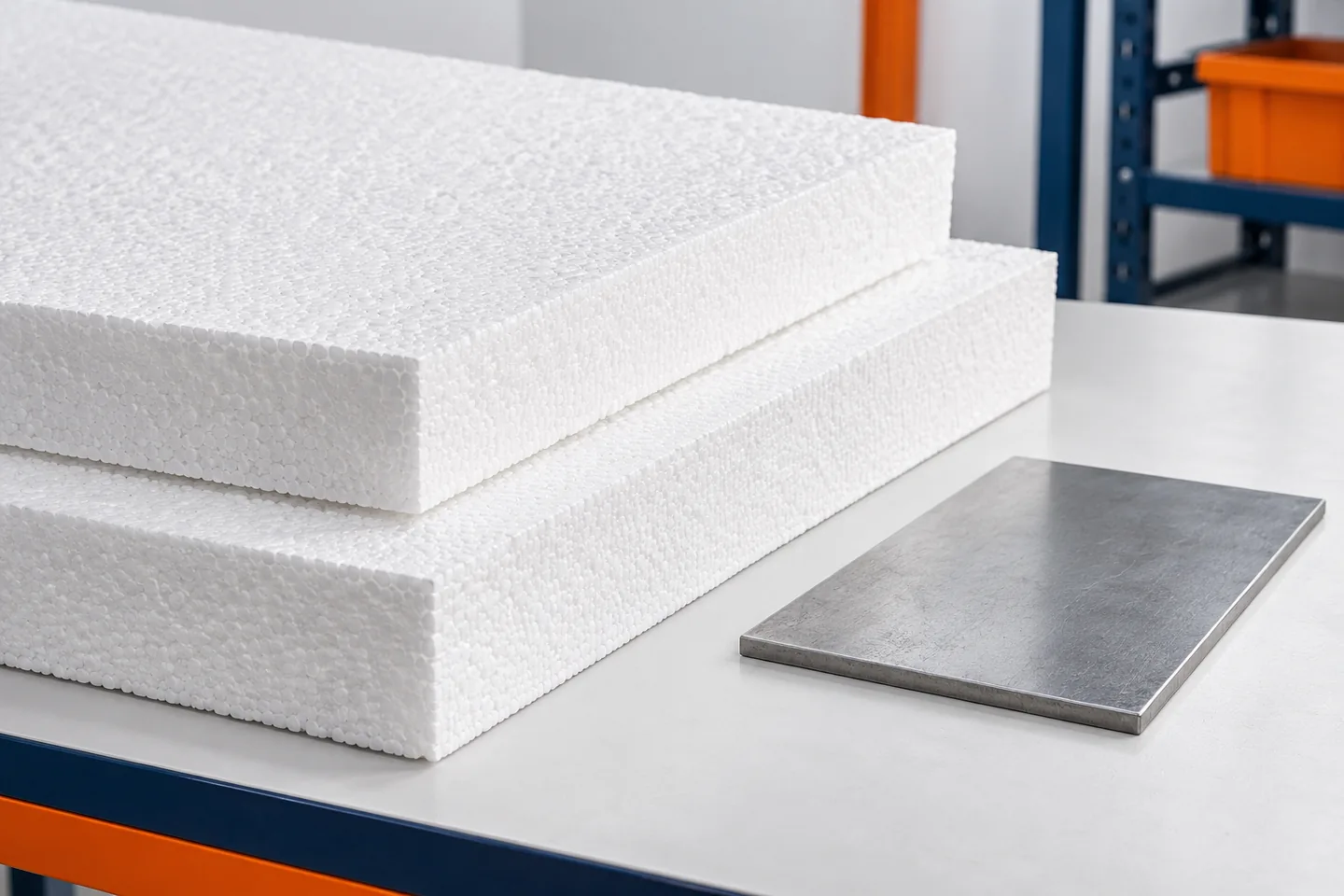
CS(10)100 denotes the compressive stress level at ten per cent deformation of the board. It is an important characteristic of polystyrene for floors and roofs, but not a ready-made service load capacity. We explain the meaning of the number 100, the role of long-term deformation and the reasons why a heavy floor screed must be assessed as a complete system. The symbol CS(10) refers to the compressive stress at ten per cent relative deformation in a specified test. The number 100 denotes the declared level of 100 kPa. A higher level indicates greater compressive stress at the deformation defined in this way. The parameter allows the mechanical properties of materials to be compared, but only if its proper meaning is retained. Ten per cent is a large change in thickness. For a board 100 mm thick, it corresponds to 10 mm.
What exactly does CS(10)100 describe?
A finished floor with tiles or a rigid screed is not usually designed for such deflection of the insulation. Therefore, the CS(10) level cannot be taken directly as the load that the floor can permanently bear without undesirable effects.
Why is the test result not a service load?
A floor or roof is subjected to loads over a long period. In addition to the material’s instantaneous reaction, the increase in deformation under constant load matters. This phenomenon is called creep. Data on the expected duration and the permissible deformation are needed for assessment. A single CS(10) figure does not contain the whole set of this information.
The manufacturer may provide separate recommendations or declarations for long-term loads. The conditions for which they were determined must be read. A single fixed percentage of CS(10) must not be applied to all products. Materials with a similar designation may have different performance data. In the design, the assumed safety margin and the requirements of the entire floor or roof structure also matter.
What do kilopascals mean in practice?
Stress is force related to area. One kilopascal corresponds to one kilonewton per square metre. However, converting units does not change the meaning of the parameter. Converting 100 kPa into another unit of force or mass does not create a permissible service load. It still describes the same test condition associated with ten per cent deformation.
The actual load-transfer area is also important. A weight distributed over the entire floor acts differently from the same weight concentrated on small equipment feet. A screed layer can spread the pressure, but its capabilities depend on thickness, material and reinforcement. It cannot be assumed in advance that every load will be distributed evenly across the entire room.
What loads should be taken into account under the floor?
EPS carries the weight of the subsequent layers and the loads associated with use. The screed, the finish, the equipment and the planned fixed elements all matter. A partition wall, a heavy stove or a large aquarium may require a separate solution. It is not always enough to swap the board for a variant with a higher CS(10). Sometimes the load has to be transferred to the structure in a different way.
The support of the insulation also matters. A board laid over unevenness or over a wide void does not behave like an evenly loaded test specimen. Before the screed is poured, debris must be removed, the material must be adjusted around installations and stability must be checked. Good data from the declaration describe the product. They do not confirm that any given method of laying it is correct.
Does a higher CS(10) always mean a better choice?
A higher level may be needed under specific loads, but it does not constitute a universal quality ranking. For façades, the TR parameter and compatibility with the system are important, among other things. In foundations, water absorption also matters. In acoustic flooring, the elastic behaviour of the material is significant. Excessive focus on a single number can obscure the actual purpose of the application.
Also compare lambda, thickness, dimensional stability and long-term data. Two boards described as EPS 100 may have different thermal insulation performance. This does not automatically mean that the thermally weaker one is defective. It may be intended for different conditions or represent a different material solution. The choice should correspond to the requirements of the project, not to the name of the group alone.
How can CS(10) be used when buying?
First establish the required specification for the given part of the building. Then compare the label and the delivery declaration with the design. Check the data on deformation under long-term load if it is needed for the assessment. Ask for it before purchase when the data sheet gives only CS(10). A lack of information is not a basis for independently adopting a convenient value.
Floor and roof polystyrene are produced by, among others, Arbet, Knauf Therm, Styropmin and Austrotherm. The properties of a specific product must be read from its documentation.
When the service load changes, return to the design assumptions. A residential room converted into a warehouse may require a different assessment of the entire floor. Likewise, equipment installed on the roof introduces new pressures. CS(10) helps to describe the material, but without information on the duration of action, the layer build-up and the distribution of forces it does not provide a complete answer on safe use.
7 branches. Materials closer to your project.