Polystyrene and thermal insulation
What do the dimensional tolerances of EPS boards mean?
At a glance
Dimensional tolerances define the permissible deviations from the declared geometry of a board. They relate to thickness, length, width, squareness and flatness. They affect how well EPS boards fit together and how even the thermal insulation is. We explain how to read the classes, what to measure on delivery and why a factory tolerance does not justify arbitrary gaps. The nominal dimension is the declared size of the board, for example a thickness of 100 mm. The tolerance defines the permissible deviation associated with the given class. It is not an additional thickness to be used in the design. When ordering insulation, you must go by the nominal dimension and the required properties. You cannot assume in advance that every board will turn out thicker by the permitted allowance.
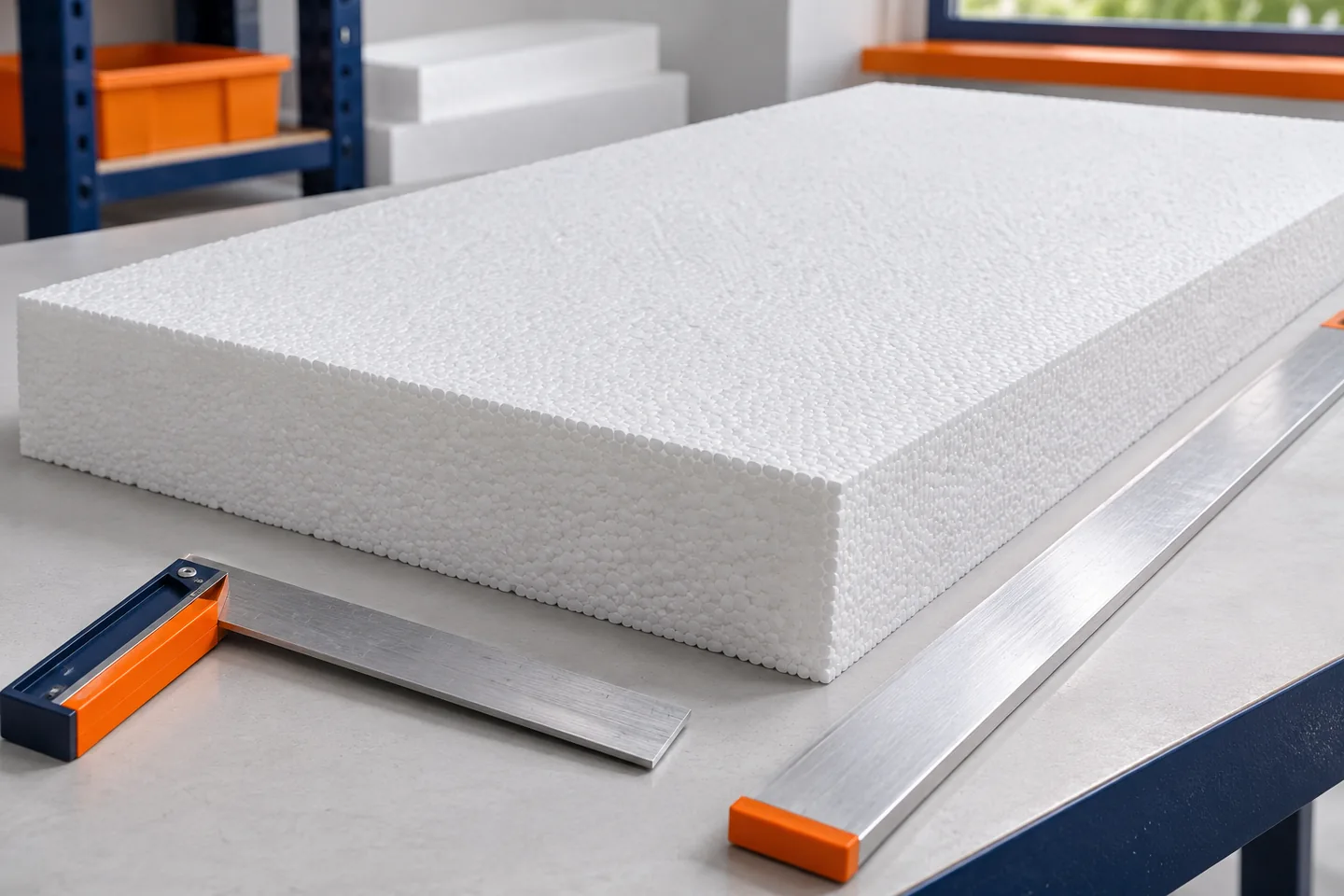
How does the nominal dimension differ from the tolerance?
The tolerance class also does not mean that all elements have exactly the same deviation. Differences within the specified range may occur in a delivery. What matters is that the material meets the declared requirements. The correct measuring method must be used for assessment. Firmly squeezing the edges of a soft material with a calliper gauge can change the result and make a reliable comparison difficult.
What do T, L, W, Sb and P mean?
T refers to thickness, L to length and W to width. The symbol Sb describes squareness, while P describes flatness. In data sheets one finds, for example, T1 with a thickness tolerance of ±1 mm, or L2 and W2 with a tolerance of ±2 mm. Always check the meaning of a specific class in the table for the given product. The code notation is an abbreviation, and the table explains its scope.
Not all values have the same unit. Squareness may be described in millimetres per metre, and flatness in millimetres. That is why reading the number alone without the symbol leads to mistakes. Do not treat the whole code as a series of identical permissible clearances. Each designation concerns a different geometric characteristic and a specific method of checking it.
Why does geometry matter on the façade?
Uneven thickness can create steps between adjacent boards. A deviation from squareness makes tight fitting of the joints difficult, and a bow in the board complicates bonding. All of this affects the preparation of the surface for the reinforced layer. Even good EPS requires careful alignment. Factory parameters do not replace checking the plane during installation.
Minor unevenness can be worked on in accordance with the system instructions, but sanding is not a method of repairing every problem. Permanent deformation or a large defect may require replacing the element. Do not compensate for geometry by arbitrarily thickening the reinforcing mortar. Its thickness and the position of the mesh follow from the ETICS documentation and must be maintained over the entire surface.
What does geometry change in the floor and on the roof?
Under a screed, the boards should form a stable layer of the correct thickness. Rocking of an element may result from deformation, but also from an uneven substrate. These causes must be distinguished. The top EPS layer should not conceal rubble or voids left beneath it. The tolerance of the board itself does not confirm that the entire prepared assembly is level.
On a roof, conformity of thickness with the slope plan also matters. A tapered board deliberately changes thickness in a specific direction. This is not a flatness defect of an ordinary board. It is worth knowing which element has been delivered and where it should go. Mixing boards with different functions can disrupt drainage, even if each product individually meets its declaration.
How can delivery be checked without jumping to conclusions?
Start with the label, format and thickness. Look at several packs from different parts of the delivery. Check the edges, corners and signs of improper storage. An isolated instance of transport damage does not necessarily indicate a defect in the entire batch, but the defective element must be separated. Document the condition before unpacking and moving, so that the cause can be established more easily.
For the measurement, use a level substrate and a suitable instrument. Record the locations and the method of checking. Do not assess the flatness of a board leaning against a curved wall. In the event of a dispute, a check in accordance with the correct test method is needed. A result obtained incidentally on site may indicate a problem, but it is not always sufficient for a formal determination of product conformity.
How should tolerances be taken into account when purchasing?
Compare the material’s geometric requirements with the needs of the system and the installation method. Also check the type of edge and the distinction between nominal dimensions and coverage dimensions, if present. Select the quantity of boards according to the actual area stated by the manufacturer. The edge profile and format can affect how the pack is accounted for, regardless of the declared thickness.
EPS is produced by, among others, Arbet, Yetico, Knauf Therm and Termo Organika. Tolerances must be read from the documentation for the specific board.
Keep the data sheet and photos of the labels until the works are accepted. Once the thermal insulation is covered, it is difficult to reconstruct the geometry of the supplied material. The best result comes from combining correct dimensions, proper storage and precise installation. None of these stages automatically eliminates the errors of the others.
7 branches. Materials closer to your project.