PIR insulation
Replacing XPS with PIR during renovation: what to check
At a glance
During a renovation, the choice between PIR and XPS also depends on the condition of the existing layers. Saving thickness can matter, but it should not obscure moisture and loads. PIR boards are worth considering once the old build-up has been investigated. This allows the new material to address the building’s actual problem. Polyurethane insulation does not have to offer an economic advantage everywhere. Where there is plenty of space, other requirements and the cost of the entire build-up may play a greater role. Where space is limited, a thinner layer can reduce the scope of reconstruction. The real benefit must be costed, not just the slogan. In a floor being modernised, there is often no room to raise the level significantly.
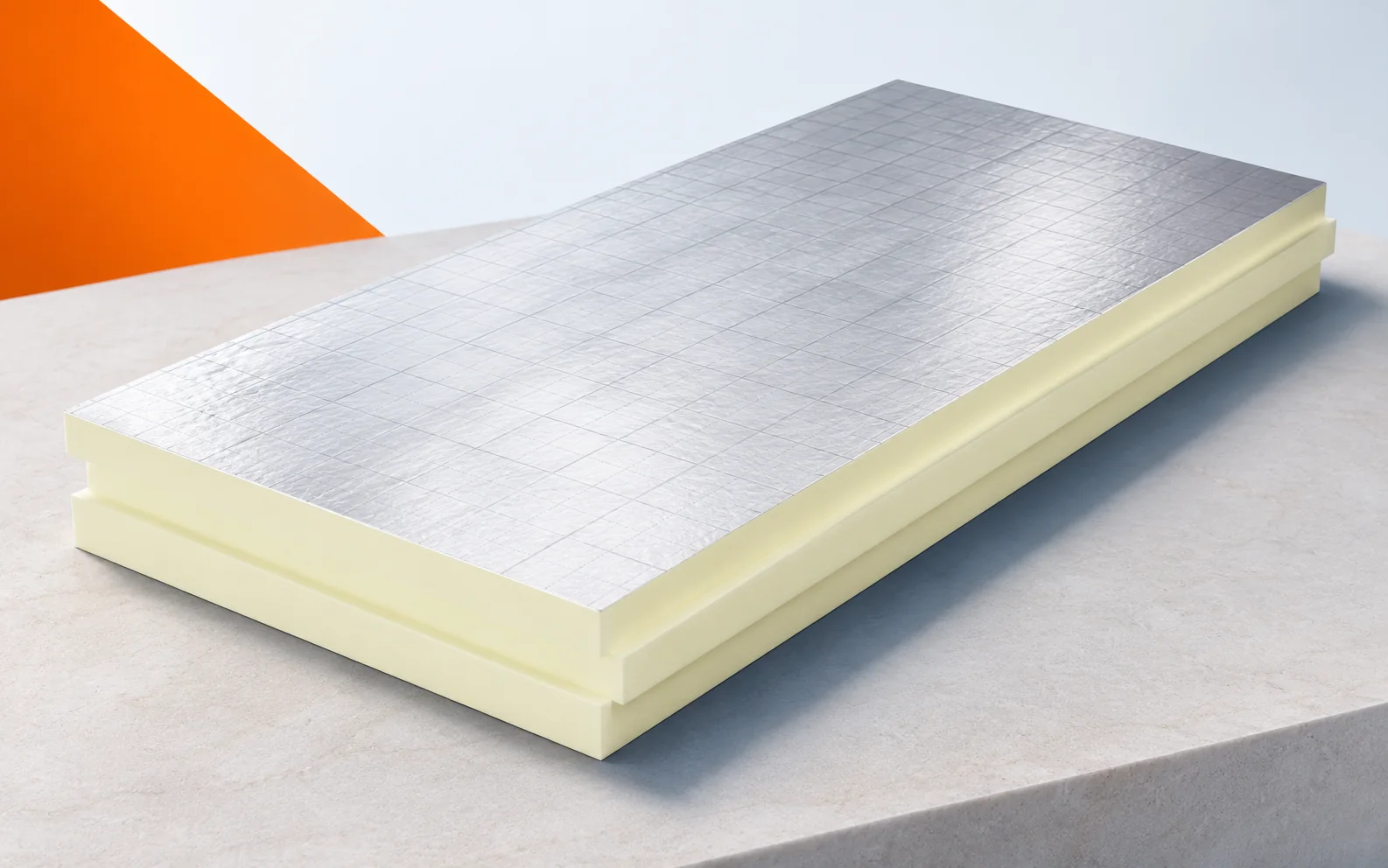
The main advantage of PIR is the space it saves
Under such conditions, polyurethane boards can make it easier to achieve the required resistance. First, however, measure the height at doors and other fixed elements. For the comparison with XPS, include the entire planned cross-section. Choosing a thinner insulator alone does not guarantee that a suitable load-distributing layer and the finish will still fit.
Contact with water matters more than the appearance of the core
Before replacing XPS, establish whether the insulation remains in a dry interior or is used in a basement or an inverted roof. In the latter locations, the possibility of prolonged water exposure must be taken into account. A reference to low water absorption does not settle the material substitution; the product’s intended use and properties relating to its actual service environment are needed.
If the old build-up is damp, the cause must be established before choosing the new insulation. A material with low water absorption does not replace repairing a leak or providing protection against water. Polyurethane insulation can additionally change the drying conditions of adjacent layers. The use of XPS also requires a suitable cross-section. The resistance of the plastic itself should not be treated as a way of leaving an unidentified problem beneath the new floor.
CS and creep describe different things
A board with a high CS may be useful under load, but its conditions of use must be known. Long-term deformation is described by other data, if these have been declared. It must not be assumed arbitrarily that a permanent load may reach the value from the test at ten percent deformation.
In an old building, it is worth separating the load-bearing capacity of the substrate from the strength of the new board. Even a material with high CS will not repair a weakened screed or an uneven bearing. Polyurethane foam transfers loads within the intended system, not on its own. When comparing with XPS, also check the long-term behaviour under compressive loads. A renovation should address the entire cross-section, so that a good property of the new product does not mask the weakness of the retained layer.
The facing and fixing limit the scope for substitution
When sealing joints, use products compatible with the material. Not every foam, adhesive or compound is suitable for all facings. It is worth checking the requirements for the substrate, temperature and moisture during the work. A good product used under unsuitable conditions does not guarantee a correct bond.
The substrate after demolition may differ from what was assumed at the estimating stage. Adhesive residues, unevenness or damage may require preparation. Changing the insulator is not an automatic way to skip this work. The conditions of contact between the specific product and the substrate and the next layer must be checked. In the cost estimate, it is worth keeping a separate item for repair. This way, the choice of material does not depend on the implicit assumption that everything beneath it is sound.
The most common cases where this choice is justified
The order in which a replacement is assessed depends on where the renovation takes place. Where the building element effectively protects the thermal insulation, the primary comparison can be the thermal effect achieved within the available PIR thickness. In the case of moisture, the suitability of the product for such conditions must first be confirmed. A lower lambda does not remove this condition and does not justify a general assessment of XPS as an inferior material.
In a local renovation, the new insulation will join the retained material. It is worth identifying its thickness and condition, instead of choosing a product only by the height of the visible edge. PIR boards and XPS may require a different solution for such a junction. The most important thing is continuity of the required function. If it cannot be achieved within the planned scope, consideration must be given to changing the boundary of the works or rebuilding the detail.
Compare systems with the same function
In the cost estimate, include not only the insulation material but also the preparation of the substrate and the auxiliary layers. Accessories, cutting and delivery costs may differ. A thinner board sometimes simplifies the detail, and sometimes does not bring additional savings. The conclusion should follow from specific quantities and the scope of works.
A reliable comparison of the renovation includes demolition, preparation and restoration of the finish. Insulation with polyurethane can limit the increase in height, which is sometimes a significant benefit. However, its value depends on the specific threshold or connection. It cannot be expressed as a fixed percentage of savings. The two variants should show which elements remain, what will be repaired and what parameters the final building element will achieve.
What to check before modernisation
During the renovation, it turned out that the old layer is damp. Replacing it with thinner PIR will not solve the source of the dampness. The airtightness and the moisture regime of the building element must be checked. The new insulation is selected after establishing the conditions in which it will actually work.
When modernising, do not choose the material before inspecting the critical points. An inspection opening and measurement can change the assessment of the available space and the water conditions. PIR boards offer the possibility of thin thermal insulation, but they require the correct surroundings. Suitable XPS may meet different requirements. The choice should lead to addressing the cause of the problem and maintaining the continuity of the layers. Only then does the comparison of materials serve the renovation, instead of replacing its necessary investigation.
7 branches. Materials closer to your project.