Maintenance and safety
Removing moss from tile-effect metal roofing without damaging the coating
In brief
Before removing moss from coated steel roofing, establish whether it really is moss and check that the coating beneath the deposit is continuous. From ground level the appearance of the deposit can be misleading, so examine safely taken close-ups. The type of soiling and the condition of the finish determine the choice of method and product. Also check whether the problem is confined to an area under a tree, behind a chimney or near accumulated leaves. If corrosion or detached coating is visible, an assessment for repair is needed, as a cleaning product alone will not restore the steel.
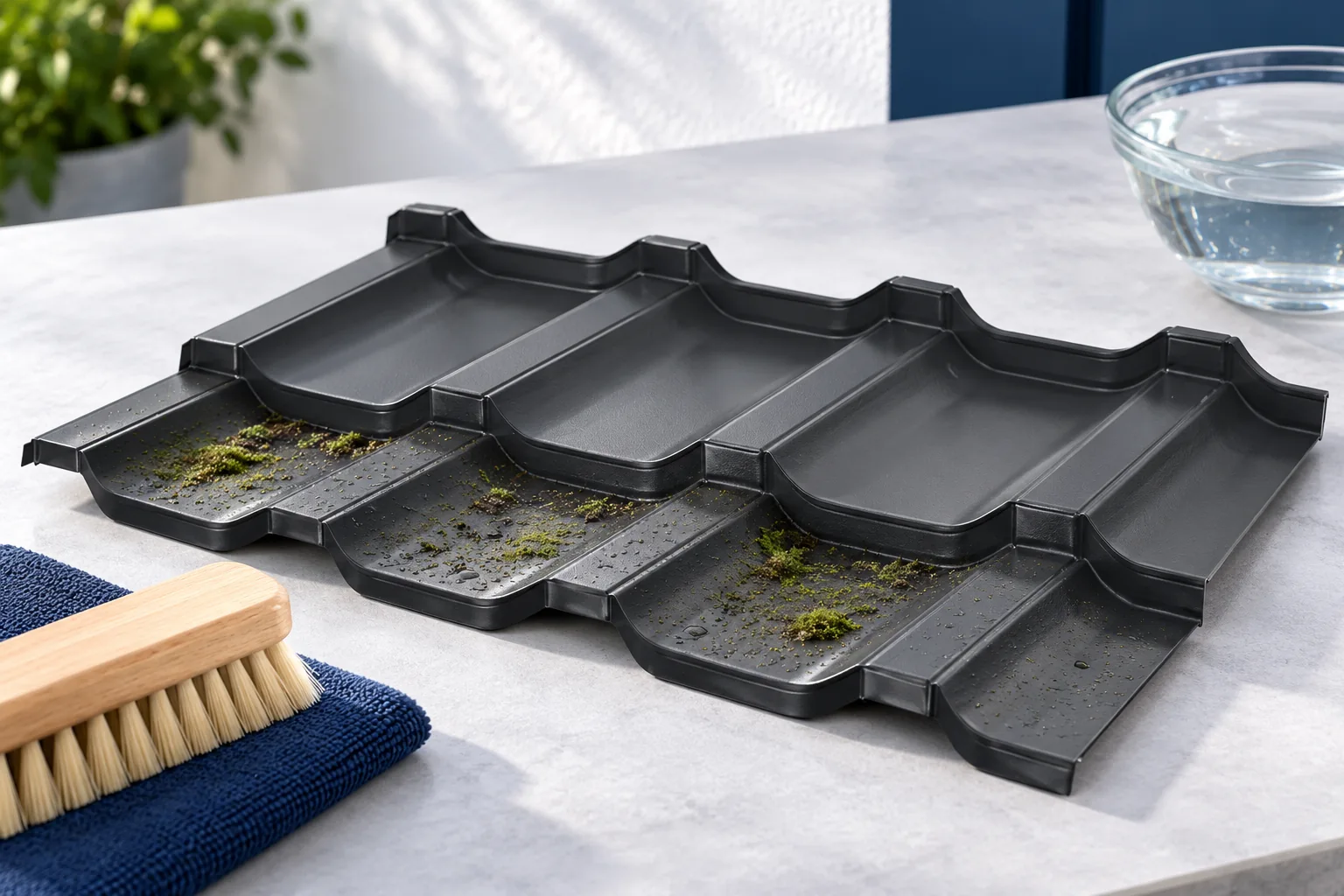
Is every green trace moss?
Various deposits and biological growths can appear on the roof. Their appearance from ground level does not always allow the type to be determined. Before choosing a preparation, examine safely taken close-ups. Check whether the coating beneath the deposit is continuous. A change in colour may also result from soiling or damage to the finish.
The entire roof slope should not automatically be scrubbed. Sometimes the problem is limited to a section under a tree, behind a chimney or where leaves accumulate. Locating the area helps determine the scope of work. If corrosion or detached coating is visible, a repair assessment is needed. The deposit remover alone will not restore the condition of the steel.
Why does the deposit appear in specific places?
Shading and accumulated deposit can extend the drying time of the surface. Leaves trapped in the gutter impede drainage. Branches close to the roof can supply further contamination. It is worth inspecting the surroundings of the roof slope instead of assuming that the problem results only from the type of tile-effect metal roofing.
Also check whether water is standing at defective flashings. A recurring damp strip may indicate incorrect drainage. Removing the deposit will then have a visual effect, but the cause will remain. Before cleaning the entire roof, it is worth removing blockages and determining which details require improvement. This will help limit the rapid return of soiling.
How to choose a cleaning product?
The starting point is the recommendations for the given coating. The preparation should be approved for coated steel sheet and the identified type of soiling. Labelling a product as a roof preparation does not confirm compatibility with all materials. Products for mineral tiles may have different requirements than preparations for a thin organic coating.
Observe the dilution, contact time and rinsing method. A stronger solution does not necessarily work better and may change the appearance of the surface. Do not mix random products. In the case of a biocide, use only the applications indicated on its label. Compatibility with the coating must be confirmed separately.
Why carry out a test on a small area?
A trial patch allows you to assess how the colour, gloss and texture react. Choose an area that can be safely inspected once fully dry. The wet appearance can be misleading. If discolouration, tackiness or a change in texture appears, stop using the product and clarify the method’s suitability before extending the work.
Tools that do not scratch the coating are used to remove loose dirt. Hard scrapers and wire brushes can expose further layers. It is not worth scraping deposits off every profile by force. It is better to choose the right method and contact time for the product than to damage the sheet in an attempt to achieve an instant result.

How should washing and rinsing be carried out?
Water should run off the covering in the intended direction. Do not direct the jet under the laps, into the ridge ventilation or into the seals of penetrations. If a pressure washer is used, its settings and distance must match the recommendations for the material. There is no single safe pressure value for every tile-effect metal roofing sheet and every detail.
The removed deposit should not clog the gutters. It is worth planning to clean the outlet at the end of the work. The runoff of cleaning agents must be controlled in accordance with the product instructions and the surrounding conditions. Do not leave chemical residues in the recesses. Inadequate rinsing can cause streaks or worsen the appearance of the surface.
Who should carry out work on the roof slope?
Access must be matched to the height and geometry of the roof. Wet sheet metal is a difficult surface to move on. It must not be assumed that a low house means safe work without protection. Standing in the wrong place can also dent the covering and create further damage.
The contractor should know the coating requirements and how to move on the specific roof. Before the service, agree the method, the product and the scope of protection for gutters, façade and surroundings. It is also worth asking how the result will be checked after drying. A mere assurance that a powerful pressure washer will be used does not describe the quality of the whole service.
How can re-soiling be limited?
Regularly remove leaves from places where they accumulate and check the drainage. Carry out work near vegetation in a manner appropriate to the plot and the trees. Do not apply an arbitrary protective layer to the sheet. Any additional product must be compatible with the coating and the intended use of the surface. Incorrect application can make future cleaning or repair more difficult.
After washing, inspect for scratches and exposed edges. Record the product used and the date. This will make it easier to assess how long the effect lasts and whether conditions on the roof slope change. The aim is a clean, sound coating without disturbing the joints. There is no need to aggressively remove every trace of ageing if doing so would damage the finish.
7 branches. Materials closer to your project.