Sheet metal and roofing
What steel thickness should you choose for trapezoidal sheet on a specific roof?
In brief
Sheet thickness must be selected together with the profile, support spacing and roof load. There is no single figure suitable for all roof slopes. Also, a higher trapezoidal profile does not give unlimited freedom. For comparison, the data for the specific section and the thickness of the steel substrate are needed, distinguished from the complete coating system. Establish how thickness is stated in the product specification. The steel substrate and protective layers are not the same thing. Comparing a total measurement with a value relating to the steel can lead to error. A clear description of the variant and its tolerances is needed.
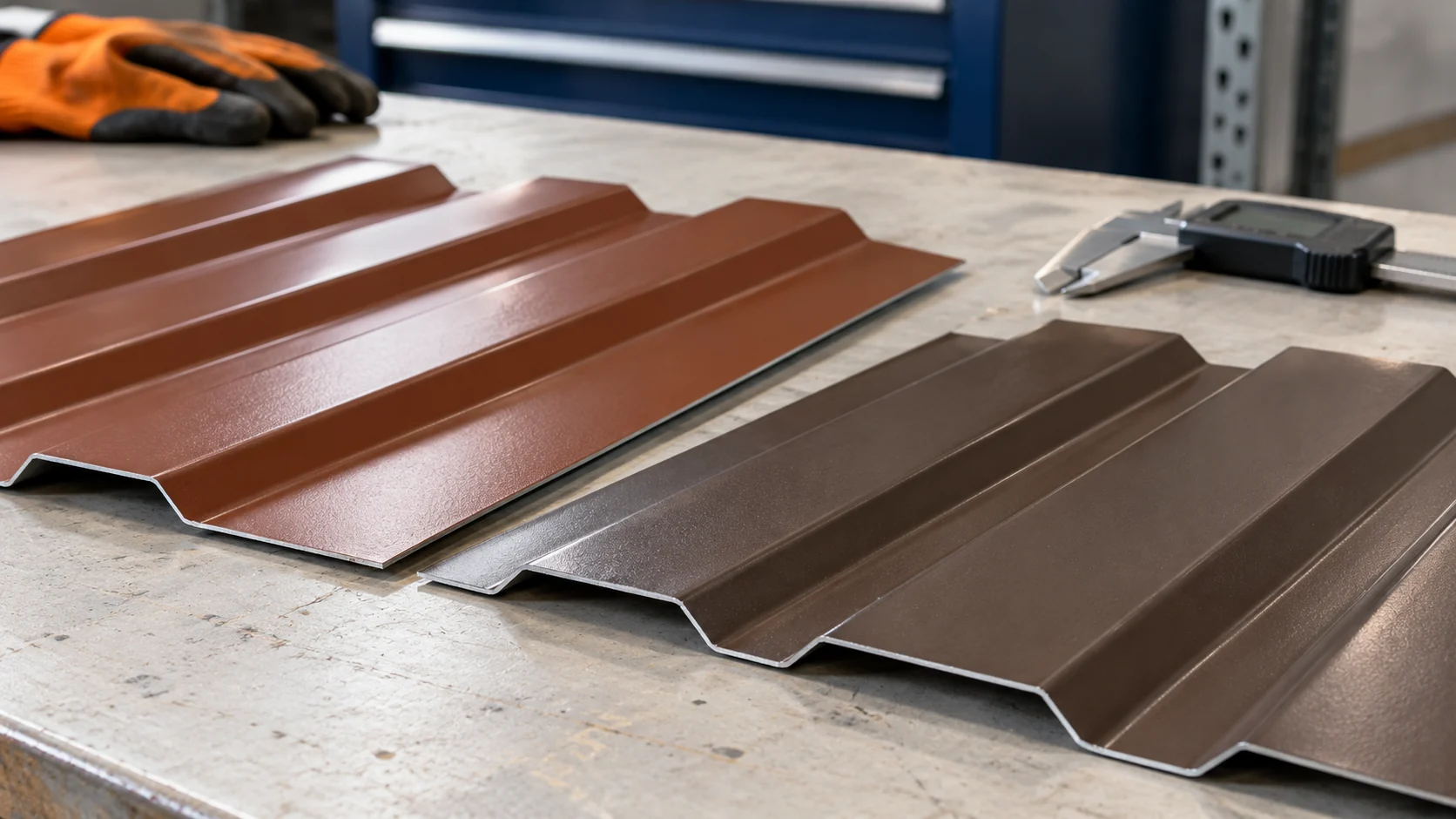
Which thickness should be entered in the order?
Do not judge the sheet only by touch or by the deflection of a small sample in your hand. The impression of rigidity is also influenced by the profile and the width of the fragment. A sample helps you inspect the colour and coating, but it does not replace documents. The parameters of the ordered batch should be stated in the quote.
What does the example range of 0.5–0.7 mm say?
Such thicknesses occur, for example, in one of the T18 roofing families. This does not mean that every version will be suitable for your building. The correct load-bearing data must be used for different thicknesses. The steel grade and the exact geometry must also be confirmed.
Going from 0.5 to 0.7 mm means 40% greater thickness. With the same sheet development, the amount of steel material also increases. However, this cannot be translated directly into a 40% greater permissible span. The behaviour of profiled sheet requires separate verification.
How does the profile interact with thickness?
The height and shape of the ribs influence the section properties. T18 and T35 do not differ only in the amount of metal. They have a different geometry and often also a different cover width. Even a similar designation from different manufacturers does not confirm an identical drawing.
Select the specific profile for the planned structure. Sometimes an alternative to thicker sheet may be a different section or a change of supports. However, this solution should not be chosen without calculations. The change also affects the fixing, flashings and the appearance of the finished roof.
What loads must be taken into account?
The roof carries snow and wind actions, among others. Their values depend on location, geometry and surroundings. Conditions at the wall of a taller building may differ from those on an open slope. A small garage also requires correct selection, despite its small area.
Check the edge and corner zones and the support arrangement. A sheet on two supports may behave differently from a multi-span element. A table for one arrangement does not automatically apply to another. The design should also specify the fasteners and their layout.

Does thicker steel improve corrosion resistance?
Surface durability depends on the protection and the environment, not only on the substrate thickness. The coating must suit the conditions on both sides. Thicker sheet should not be treated as a substitute for proper corrosion protection.
The edges and the method of working are also important. Cutting that generates strong heat can damage the protection. Swarf must be removed promptly. If the roof is in a demanding environment, the coating selection and maintenance rules should be established before comparing the steel price alone.
How does thickness affect transport and installation?
A larger quantity of material changes the weight of the sheets but does not remove the risk of them buckling. Long elements still need adequate support during handling. The coating and the edges must be protected. Improvised lifting can damage even a correctly selected sheet.
On a tight site, plan the transport route and the storage location. Do not shorten elements without checking the new overlaps. The contractor should know the thickness and profile before selecting tools and fastenings. This information should not be left until the delivery is unpacked.
How do you decide between two thicknesses?
First, rule out the variants that do not meet the structural requirements. Then compare the coating, durability, available lengths and full cost. If both thicknesses are permissible, the decision can be based on the design and the service conditions. There is no need to create a single rule for all buildings.
On receipt, check the markings and conformity with the order. Any measurement requires a suitable tool and consideration of how the thickness is declared. Record any discrepancy before installation. Once fixed, it is harder to clarify the condition of the delivery and the scope of responsibility.
When checking a sample, avoid a spot with a cutting burr or local bending. Such a point can distort the measurement result. A single reading should be related to the checking method and the tolerances specified for the material, rather than being treated as a standalone assessment of the entire delivery.
Questions before ordering
Does 0.7 mm always allow you to omit one support?
No. The permissible arrangement depends on the profile, steel grade, thickness and loads. Changing the supports requires re-verification.
Can the coating thickness be counted as equivalent steel thickness?
No. They serve different functions. Comparisons must use the same definition of thickness and the data for the specific product.
7 branches. Materials closer to your project.