Flashings
How many ridge caps should you order for a metal roof?
In brief
The number of ridge caps is best established on a plan of all ridges and then verified by measurement. Dividing a single length by the product’s nominal dimension gives only an approximate result. The order must account for joints, end pieces and differences between roof sections. It is also worth separating the quantity of sheet metal from the scope of installation. A well-described set reduces interruptions caused by the lack of one short element. On a simple roof, one section may be sufficient. With a complex roof shape, there are more ridges and not all have the same profile. The most convenient approach is to mark them on a sketch with consecutive symbols. For each, note the length, adjacent slopes and how both ends are finished.
Give each ridge a designation
The drawing should reflect the actual geometry of the building. If the roofing has already been installed, the documentation must be compared with the as-built condition. A change in the position of an edge can affect the flashings. The measurement should be taken in a way that ensures safe access, with the assistance of the roofing contractor.
Record the total and effective length
A ridge cap has a defined length as a finished element. When joined to the next section, part of this length may be used for the overlap. Both values must be distinguished in the schedule. Without this, one can order a sufficient number of metres of sheet metal and still not close the entire ridge.
The method of connection results from the specific solution. The overlaps should not be shortened independently just so that the material suffices. It is better to calculate the complete set on the basis of the installation detail. It is also worth noting which section will be cut and what will happen to the remaining part of the element.
Match the profile to the junction of the slopes
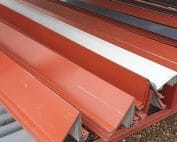
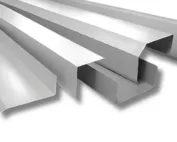
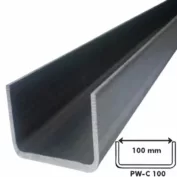
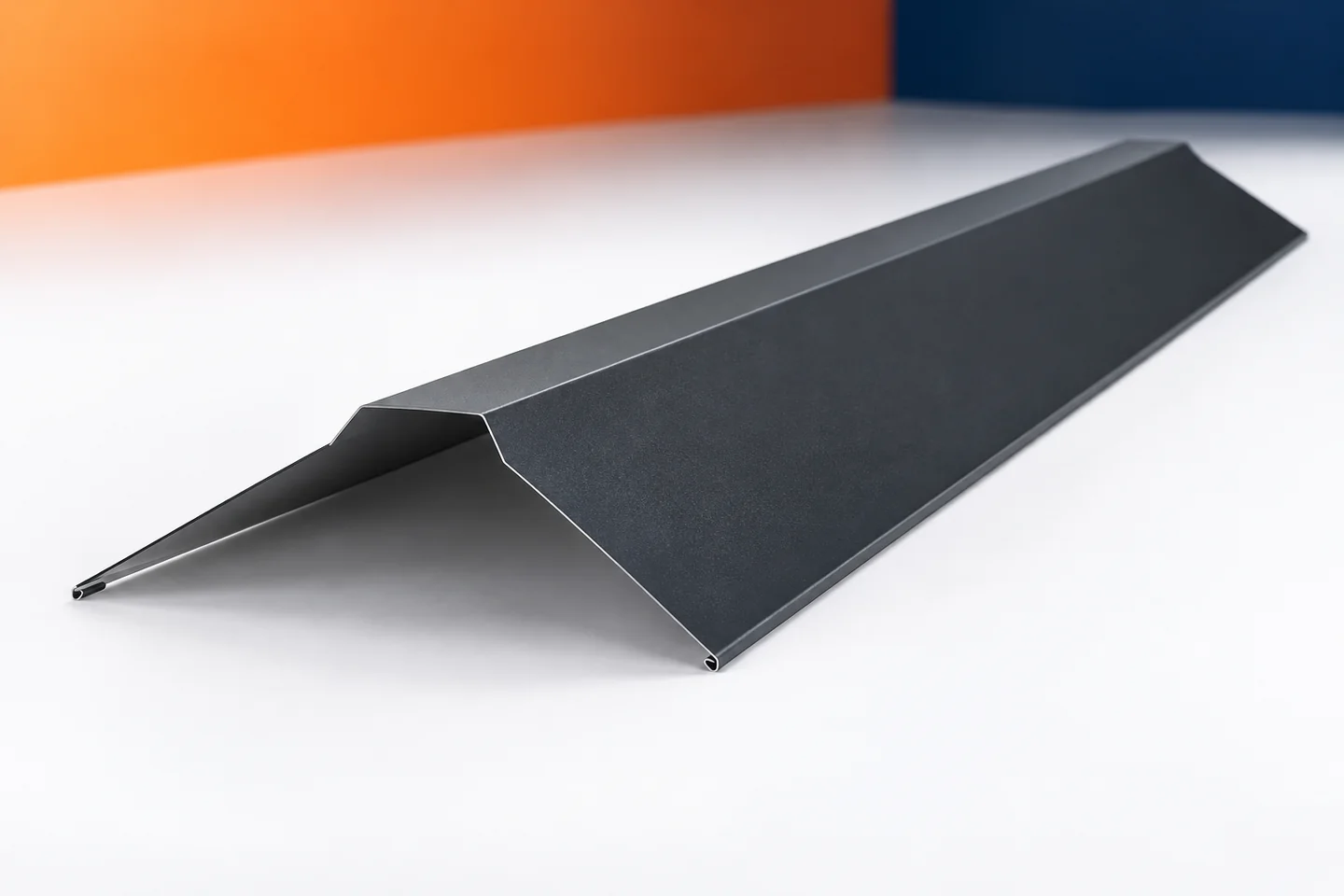
The shape of the ridge cap is needed for the quote, not only its length. The arms, edge bends and the angle between the roof slopes are significant. Different elements may be required for different roof sections. In such a case, they must be separated in the order, even if they have an identical colour.
Ridge caps for tile-effect metal roofing, trapezoidal steel sheet and a specific panel arrangement may differ in their design. The popularity of one cross-section does not mean full interchangeability. The seller should be informed of the roofing used. For an unusual junction, a cross-section drawing prepared by the contractor will be helpful.
Remember the elements at the ends
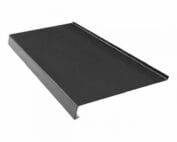
The ends of the ridge meet the verge flashings or other roof flashings. Each such location must be identified before ordering. A neatly cut ridge cap is not always sufficient. The termination may require a separate component or appropriately planned shaping on site.
In a roof with a more complex shape, junctions of several directions also occur. These should not be treated as just another ordinary connection of straight sections. Unusual sheet metal flashings should be entered in the schedule under their own designation. This way they will not disappear in the overall total of ridge metres.

Establish a common material specification
Ridge caps can be ordered in various material versions. Galvanised, aluzinc and coated steel sheets require the selected version to be specified precisely. For coloured components, the surface finish must also be stated. Information about colour does not replace the type of coating and sheet thickness.
It is worth coordinating this choice with the verge flashings and gutter apron strips. Starting profiles, which may serve a different function and have a different thickness, should be checked separately. Chimney flashings should also receive a full specification. One unclear material description can cause discrepancies throughout the entire delivery.
Include transport and the unloading point
A longer component means fewer joints but places different demands on handling. Access to the site, the method of unloading and safe storage must be established. A narrow access route or lack of manoeuvring space can change the delivery arrangements. It is worth checking this before choosing the length of the sections.
Ridge caps should arrive without deformation or surface damage. They should not be planned to be stored among sharp construction waste. A good solution is to label the packs according to roof sections. The team can then more easily find the set intended for a given installation stage.
Close the order with a single version of the schedule
The final list should contain the location symbol, cross-section, length, number of pieces and material. If a measurement correction occurs, the entire document must be changed. Arrangements scattered across several messages increase the risk of an earlier version being used. The date and drawing number help to keep the matter organised.
After delivery, the number of components is compared with the approved list. It is also worth checking the shape of the first piece from each group. This allows an error to be detected before the complete set is taken onto the roof. Ridge caps ordered on the basis of a clear inventory are easier to accept and pass on for installation.
Questions and answers
Is it enough to order as many metres of ridge cap as the ridge is long?
Not always. You need to account for joints, effective length and how the ends are finished. The quantity is determined for the specific installation method.
What should you do when two ridge sections have different angles?
They should be listed as separate items with the correct profiles specified. The same colour does not mean that one shape will fit in both places.
7 branches. Materials closer to your project.