Steel halls and structures
What to check when assembling steel frame connections
In brief
A strong section alone is not enough if the forces cannot be transferred correctly to the next element. That is why connections are among the key points of a steel structure. In a steel hall, bolts, gusset plates, welds and anchors come together here. Each of these parts has a specific function. The quality of a joint is not demonstrated by the number of fasteners alone, nor by the fact that it looks solid once assembled. A connection can transfer different types of forces and have a defined stiffness. In a portal frame, the joints at the eaves and ridge participate in the behaviour of the whole system. Elsewhere, the design may specify a connection with a different function. A detail should not be copied simply because it joins sections of similar dimensions.
The joint must match the assumed structural scheme
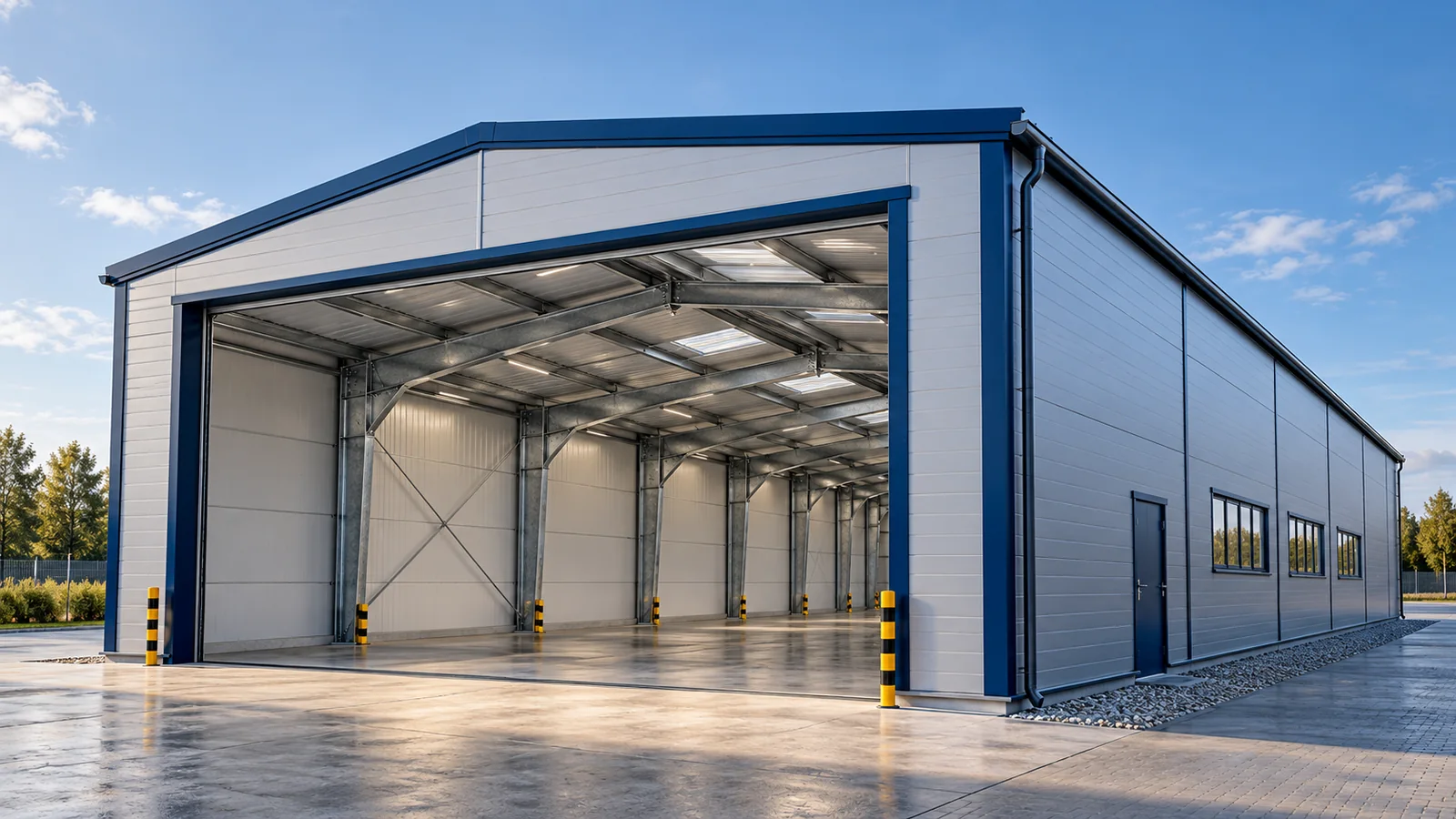
The steel hall must be built in accordance with the scheme adopted in the calculations. Changing the end plate, the bolt arrangement or the support may affect the distribution of forces and deformations. Steel structures require consistency between the design, the construction documentation and the assembly. Improvisation at a joint may affect a much larger part of the building than the changed detail itself.
A bolt is part of a specific assembly
In a connection, the type and grade of the bolts, the nuts, the washers and the length of the fastener all matter. The installation method specified in the documentation must also be followed. Not all connections require the same tightening procedure. It cannot be assumed that greater force on the wrench always means a better result.
In a steel hall, bolts should be identifiable and intended for the given application. Replacing a missing part with a random equivalent requires confirmation. The condition of the surfaces of the mating components is also important. A steel structure may contain different types of connections, so one procedure does not have to be correct for all joints.
Accuracy of holes and components
Prefabrication allows holes and plates to be prepared before delivery. This facilitates assembly if the geometry matches the drawings and the foundations are executed on the correct axes. If parts do not fit, the cause must first be established. Holes must not be enlarged automatically nor material removed from the section to speed up the assembly of the steel hall.
A discrepancy may result from mixed-up components, an incorrect version of the documentation or a setting error. The solution should be agreed with the person responsible for the design. Modular steel structures also require such control. Similar frames are not always identical, especially at gables, openings and braced bays.
Welds and surface protection
Steel structure components are sometimes welded at the works and bolted on site. This division helps prepare repeatable parts, but does not by itself confirm quality. What matters is execution in accordance with the documentation and the required scope of inspection. A weld should not be assessed solely on the basis that its face looks even.
Work on connections may damage the anti-corrosion protection. The repair should correspond to the protection system used and the environmental conditions. In a steel hall, attention must be paid to places that are difficult to access after the enclosure is closed. Missing protection hidden under a component does not disappear just because it is not visible from floor level.

Column bases require coordination
The connection to the foundation includes not only the anchors. The base plate, the level of the support, any grouting and the elements transmitting forces are also important. Their design follows from the structural design. A steel hall may have bases of varying stiffness. The support scheme must not be inferred from the number of visible nuts alone.
The position of the anchors must be checked before installation. An error can make it difficult to align the frame and fit subsequent parts. Steel structures require alignment of axes and levels, not merely the ability to slip the holes over the rods. Any discrepancy must be resolved technically before it begins to affect subsequent joints of the building.
Acceptance should cover the execution
Inspection of connections in a steel hall covers conformity with the documentation, completeness and performance of the required installation activities. Appropriate records and confirmations are needed. The mere sight of a standing frame does not reveal all the characteristics of the joints. Acceptance should therefore not be postponed until the cladding obstructs access to relevant locations.
In the documentation for a steel hall, retain information about agreed changes to connections. Compare the missing part with the full designation, not only with the diameter. A steel structure should be installed according to the current drawings. The tightening method must correspond to the type of connection and the requirements of the design. After an element has been struck, its joint may also require checking.
In a steel hall, leave access to elements requiring later inspection. Retain the identification of the fasteners. Check the complete set of washers. Before repair, determine the cause of the discrepancy so as not to transfer the problem to the next connection. Traces of corrosion at the contact may require assessment of the surface hidden between the plates. A correct connection allows the properties of the sections to be used as intended by the designer.
7 branches. Materials closer to your project.