Mineral wool panels
What does a mineral wool panel offer and what constraints does it impose on site?
In brief
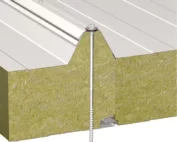
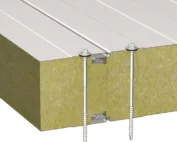
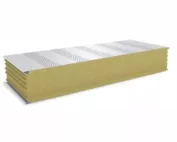
A mineral wool panel combines steel facings with a mineral core. It can be a good choice for specific fire and acoustic requirements. However, it demands attention to weight, transport and protection against moisture. It is worth assessing it against the whole wall, because one favourable parameter does not determine suitability for the building. The facings and core work together as a single element. The panel can form a finished internal and external surface together with the insulation layer. The large format reduces the number of separate operations carried out on site. This is particularly convenient with a regular structural grid.
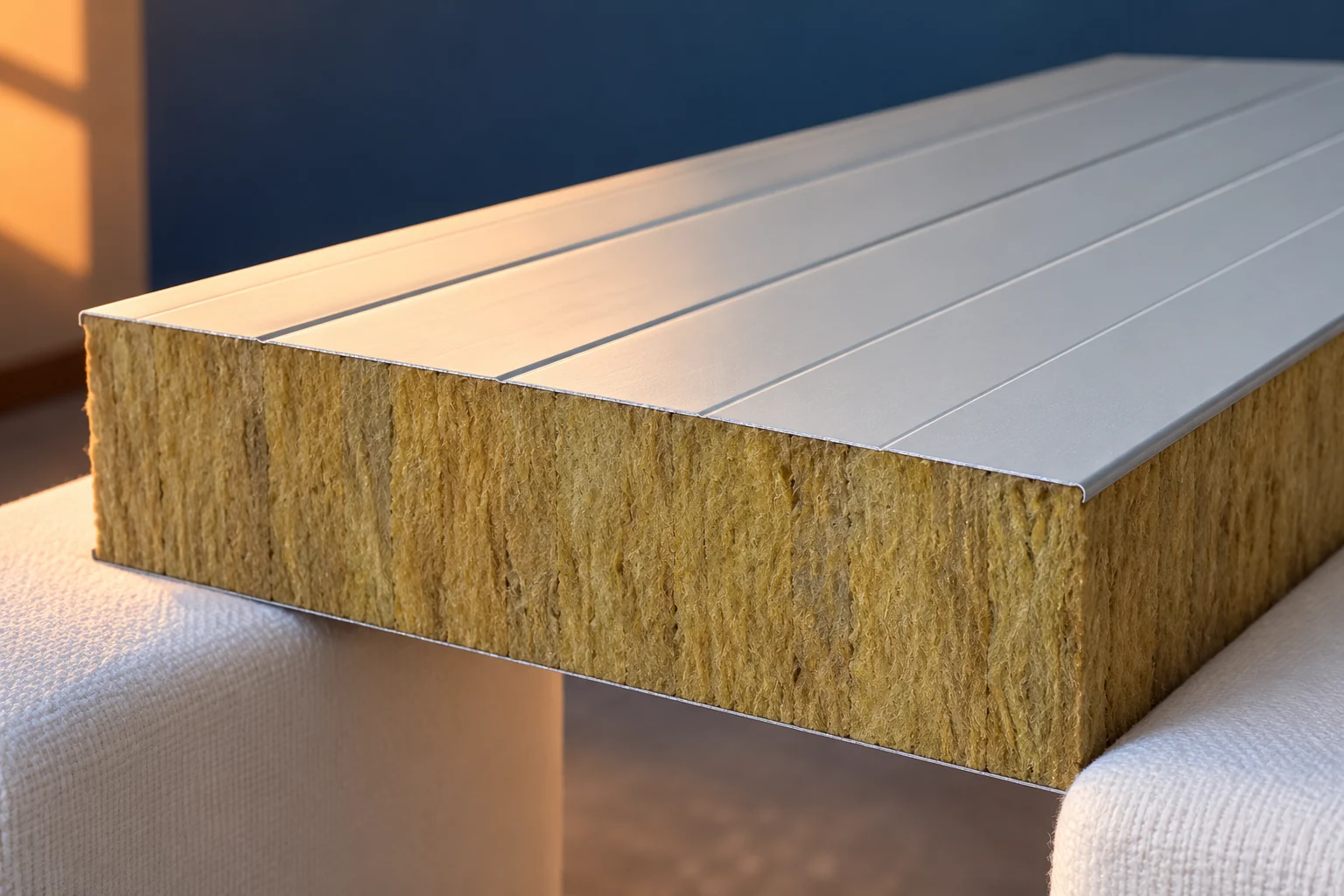
What does the layered construction offer?
This cooperation also means that damage to the layers must be assessed as a whole. Detachment of the facing is not merely a decorative defect. A hole or undercut can affect load-bearing capacity. The panel should not be treated like any steel sheet with loosely inserted insulation. The method of cutting, support and forming penetrations matters for the performance of the entire element.
What are the benefits relating to fire protection?
The mineral core is an important advantage when selecting the envelope for fire requirements. Panels with classifications suitable for specific applications are available. However, this does not mean a single common class for all thicknesses and configurations.
A distinction must be made between reaction to fire and fire resistance. The first describes the behaviour of the product in the development of a fire. The second concerns the element installed in a specific way. The joint, support, sealing and openings are part of the assessment. The advantage of the core is only exploited in a correctly selected system. Simply replacing another panel with a mineral wool variant does not exempt you from rechecking the design.
Does mineral wool always mean the best thermal insulation?
No. At the same thickness, a panel with a different core may have a lower U-value. Thermal design must therefore be based on the declared values of the complete panels. Comparing material names alone is not sufficient.
For example, a 100 mm thick wall panel with mineral wool may have a U-value of around 0.41 W/(m²·K), while a PIR panel of this thickness may have around 0.22 W/(m²·K). These are values for specific variants, not universal market parameters. Joints and thermal bridges must also be taken into account in the design. If wall thickness is restricted at a narrow passage, the thermal difference can be significant. At the same time, fire requirements may lead to a different choice.
How does weight affect a small project?
Panels with mineral wool are usually heavier than panels with lightweight foam of similar dimensions. For an example weight of 19.8 kg/m², a 1 × 5 m panel weighs 99 kg. This is the element alone, without lifting equipment. Equipment selection must take into account the actual weight and the permitted gripping method.
On a restricted site, you need to check the machine’s reach and the offloading area. Shorter panels can be more convenient logistically, but they increase the number of joints. They must not be installed without adequate support. Weight also affects the structure and transport. It is therefore worth comparing the cost of the entire installation organisation, not just the price of the panels per square metre.
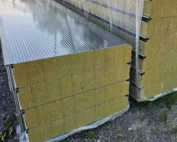
It is also worth checking the load-bearing capacity of the place where the pack is set down. The combined weight of many panels is much greater than that of a single element, and the supports must carry it without uneven settlement.

What needs attention with moisture and acoustics?
The core should be protected against uncontrolled moisture. Tight connections, a proper plinth and end protection are essential. A wet or damaged panel should not simply be closed off with a flashing and the problem considered solved. Its condition and the cause of the water contact must be assessed.
Mineral wool can have a beneficial effect on the panel’s acoustic insulation, but a full steel facing does not act like an exposed absorbent material. Reverberation in the hall may require separate solutions. Noise transmission is also determined by doors, gates, gaps and services. The laboratory result of a single panel should not be attributed to the entire room.
When does the balance of advantages favour such a panel?
It is worth considering when the project requirements match its confirmed properties and the structure and logistics allow correct installation. An approach in which the wall’s function is defined first and then the thickness, module and coatings are selected works well.
| Advantage | What needs to be checked? |
|---|---|
| Mineral core | Classification of the entire fire system |
| Large format | Transport, weight and installation access |
| Ready surfaces | Coatings suitable for both sides |
| Acoustic parameters | Openings, airtightness and interior reverberation |
Such a comparison shows the real benefits and their conditions. It helps avoid a choice based on a single general slogan.
Questions before ordering
Is the greater weight of a mineral wool panel always a disadvantage?
It is not a quality assessment. It is a parameter that must be taken into account in the structure, transport and installation. The choice is determined by the conformity of all properties with the design.
Does the mineral wool in the panel guarantee no reverberation in the hall?
No. Full steel surfaces can reflect sound. Limiting reverberation requires an assessment of the interior and often separate absorbent materials.
7 branches. Materials closer to your project.