Insulation and PIR
What role does the aluminium facing play in internal insulation?
In brief
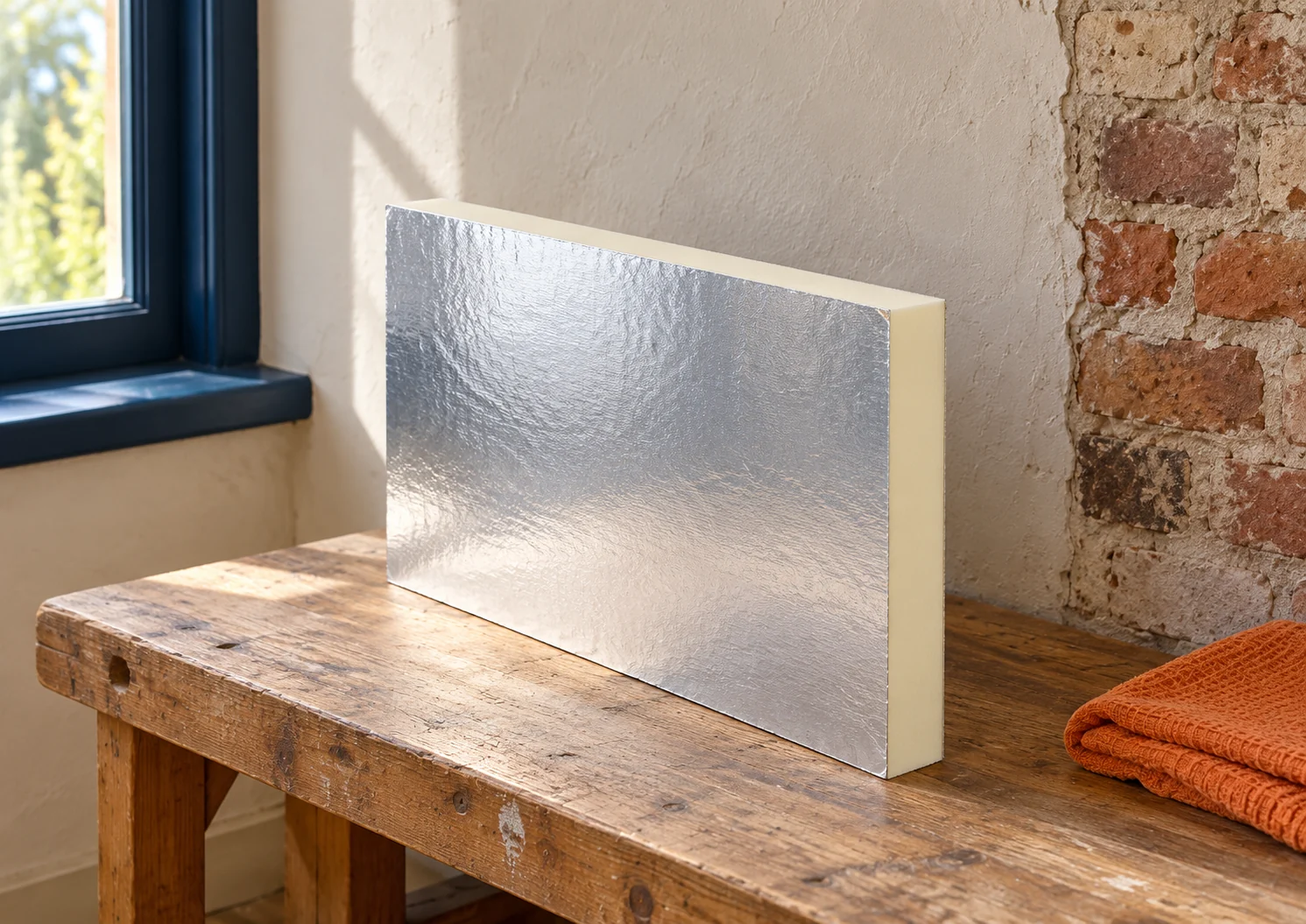
The aluminium facing on a PIR board affects the passage of water vapour through the insulation layer. However, it does not in itself seal joints, corners or service penetrations. With internal insulation, the continuity of the entire system is what matters. Equally important are the condition of the existing masonry and its ability to dry out after the build-up has been installed. The metallic surface may be a multi-layer facing incorporating aluminium, paper and plastic. It should not be treated like any kitchen foil, nor should identical properties be assumed for every shiny product. The declared parameters of the specific product and the solution intended for the wall are what count.
What is actually on the surface of the board?
An insulation board with this cladding is not a steel wall panel. It requires planned fixing and appropriate finishing from the room side. Its core provides thermal resistance. The cladding has its own tasks, but it does not turn the foam into a non-combustible material and does not replace the entire protective build-up.
Why is airtightness more important than shine?
Air from the interior can flow through an open joint. It carries moisture towards the cooler part of the building element. Limiting diffusion through a flat surface alone therefore does not solve the problem. Leak-tight joints between the boards and their termination at the wall perimeter must be designed.
The tape and sealant are selected to suit the cladding and the system. The substrate should be prepared in accordance with the bonding requirements. Dust, moisture or tension at the corner can weaken the bond. Covering a haphazardly applied tape with plasterboard will not improve the durability of a poorly executed joint.
How should reveals and the junction with the ceiling be detailed?
First measure the depth of the reveal, the position at the hinges and the position of the windowsill. Continuous wall insulation can be difficult to connect to an existing window. A thinner strip at the frame requires thermal assessment. It must not be assumed that any thin offcut automatically eliminates the thermal bridge.
At the ceiling and floor, plan the connection of the sealing layer to the appropriate substrate. A floor slab, partition wall and beam can interrupt the insulation. Each such junction should be clear on the drawing. In an old house, it is worth opening up the construction before ordering boards for the whole room.
What should be done with sockets and pipes?
Services are best drawn out before installation. Every cable passing through the airtight layer requires proper sealing. Simply cutting a hole and covering it with a trim does not create such a connection. Clusters of junction boxes and pipes at corners are particularly troublesome.
An installation space on the room side can reduce the number of penetrations. However, it takes up additional space and must fit the entire build-up. Fire protection elements must not be omitted arbitrarily. The routing of cables is agreed with the requirements of the services and the finish.

Can a damp wall simply be sealed up?
First, the source of the water must be determined. A leak, faulty insulation at ground level and condensation require different measures. An airtight lining from the inside can restrict drying in that direction. It should therefore not be used to hide stains on an unexamined scale.
After internal insulation, the existing wall usually operates at a lower temperature. The assessment should take into account its moisture content and external conditions. In a difficult configuration, a simplified vapour flow check alone may not be sufficient. The choice of material should then be preceded by a more detailed analysis.
How should the work be signed off before the insulation is covered?
Check the joints, corners and all service penetrations. Compare the workmanship with the agreed detail. Repair damage to the lining using an approved method. Document the locations that will no longer be accessible after finishing. This will help avoid important connections if drilling is carried out later.
Finally, assess the ventilation of the room. Insulation does not remove the vapour produced during cooking, drying or bathing. Proper air exchange remains necessary. Good workmanship therefore means combining an airtight envelope with controlled removal of moisture from the interior.
How can the cladding be protected from damage during subsequent work?
Agree the fixing points for cabinets, shelves and appliances before closing the wall. The insulation board alone is not a substrate for arbitrary loads. The necessary fixings must be transferred to the appropriate structural element and their passage through the layers resolved.
After installation, do not treat the metallised surface as a place for random screws. A hole made when changing services can impair airtightness. In the user instructions, it is worth indicating the layer build-up and the repair method. This will preserve the result of the work even after later room renovation.
Questions before ordering
Does a shiny lining provide additional thermal resistance in every configuration?
It should not be added automatically. The effect of the reflective surface depends, among other things, on the presence and geometry of a suitable air gap.
Can every PIR board with aluminium be plastered?
No. The surface and the method of finishing must be part of a compatible solution. Boards for plastering may have a different type of facing than boards with aluminium.
7 branches. Materials closer to your project.