Sheet metal and roofing
How do you calculate the full cost of covering a 200 m² roof with trapezoidal steel sheet?
In brief
For a 200 m² roof, multiplying the area by the price of the steel sheet is not enough. First you need to know whether this refers to the slope area or the building footprint. Then come laps, cut-offs and full sheets. Flashings, fixings and labour are calculated separately. A clear breakdown shows where the cost actually arises. Let us assume this is the measured area of both slopes, taking their pitch into account. If the 200 m² refers to the footprint, a geometric conversion will be needed. Eaves also increase the covered area. You should not take the external wall dimensions as the finished roof area.
What does 200 m² mean in this calculation?
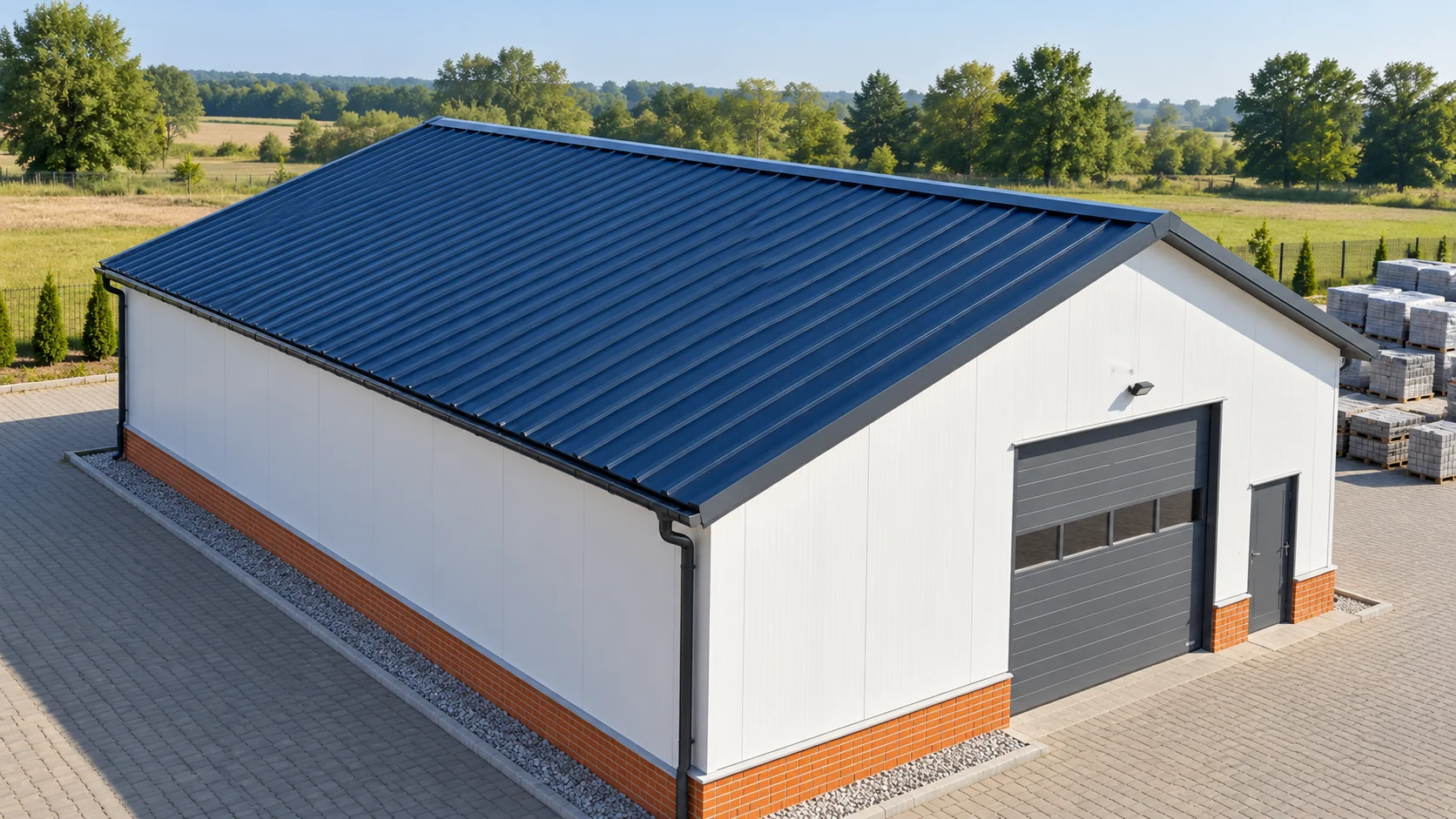
In a simple model, two rectangular slopes are each 20 m wide and 5 m along the rake. Together they give 200 m². Such a roof will have a different cutting layout than a slope with roof valleys and dormers of the same area. The further calculation concerns precisely this simplified model.
How many sheets are needed for a specific covering?
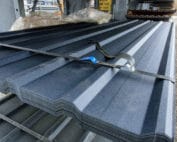
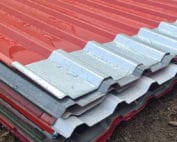
Assume a profile with an effective width of 1.128 m. For each slope, 20/1.128 gives about 17.73 strips, so eighteen sheets are needed. For both sides that is 36 pieces 5 m long, assuming this dimension covers all required terminations.
The purchased effective area is 36 × 1.128 × 5 = 203.04 m². With an overall width of 1.173 m, the overall area of the same sheets is 211.14 m². These are different bases for billing an identical delivery. Rates should not be compared without stating which area they refer to.
What does a sample material calculation look like?
For the calculation, use only the net €11.11 per effective m². The sheet metal then costs 203.04 × €11.11 = €2255.77 net. Divided by 200 m² of finished roof surface, this gives €11.28 net per square metre. This is a worked example, not the price of goods currently on offer.
If the quote uses overall metres, the rate must be multiplied by 211.14 m². You must not take the lower price from such a quote and use the smaller effective area. The result would look favourable but would be based on incompatible units.
How do you calculate flashings without guessing percentages?
In the simple model described, the ridge is 20 m, the two eaves total 40 m, and the four side edges of 5 m each give 20 m. Actual details may change the set of components. The overlaps according to the flashing solution must be added to the covering length.
List the penetration and wall abutment locations separately. A chimney requires its own detail, even if its area is small. Suitable fixings and sealants are also needed. Their quantities are not reduced simply because the steel sheet is lightweight. They result from the structural layout and loads.

How do you add installation, delivery and equipment?
Let us continue the model with agreed net amounts: accessories €601.77, transport €208.30, labour €1620.15 and equipment €231.45. Together with the previously calculated sheet metal, this gives €4917.44 net. Converted to 200 m², the result is €24.59 net.
This is not the cost of the entire structural roof. The example does not include the roof truss, insulation or substrate repairs. Drainage and any dismantling must be added according to the scope. Every quote should clearly state which of these works are already included in the price.
What changes the result most on a real construction site?
Roof valleys, changes in level and short sections increase the number of cuts and terminations. Building height affects access. Long sheets may require a different lifting method than short ones. Limited space around the building can also increase the cost of organising the works.
The condition of the structure matters. If the supports require adjustment, replacing the covering alone will not complete the task. Before ordering, check the geometry and load-bearing capacity. This allows the cost of the chosen material to be separated from repairs that would also be needed with another covering.
How do you compare two variants of the same roof?
Use an identical drawing and scope list. Specify the profile, steel thickness, coating and number of sheets purchased. Check whether both solutions suit the pitch and support spacing. A cheaper material without confirmed suitability is not an equivalent option.
Finally, compare the total sum and the execution conditions. It is worth keeping a calculation sheet with quantities so that only the rates can be updated later. This keeps every price change clear and prevents an additional item from disappearing into a general cost-per-metre figure.
Also ask for a list of pieces assigned to each roof slope. In the model this is eighteen sheets, but the actual final width must be checked at the side flashing. If the roof is not rectangular, measure the width at the eaves and at the ridge. The difference should not be hidden by stretching the overlaps.
Questions before ordering
For a simple 200 m² roof, is it enough to buy exactly 200 m² of sheets?
Not necessarily. What counts is full strips according to the coverage width and cutting layout. The purchased quantity may be greater even without roof valleys and dormers.
Is the sample quote for a 200 m² roof a ready-made offer?
No. These are explicit assumptions for the calculation. Your own cost should be calculated from the current offer and the actual scope of works.
7 branches. Materials closer to your project.