Choosing the covering
Single- or double-module roof sheets: when does a smaller sheet help?
In brief
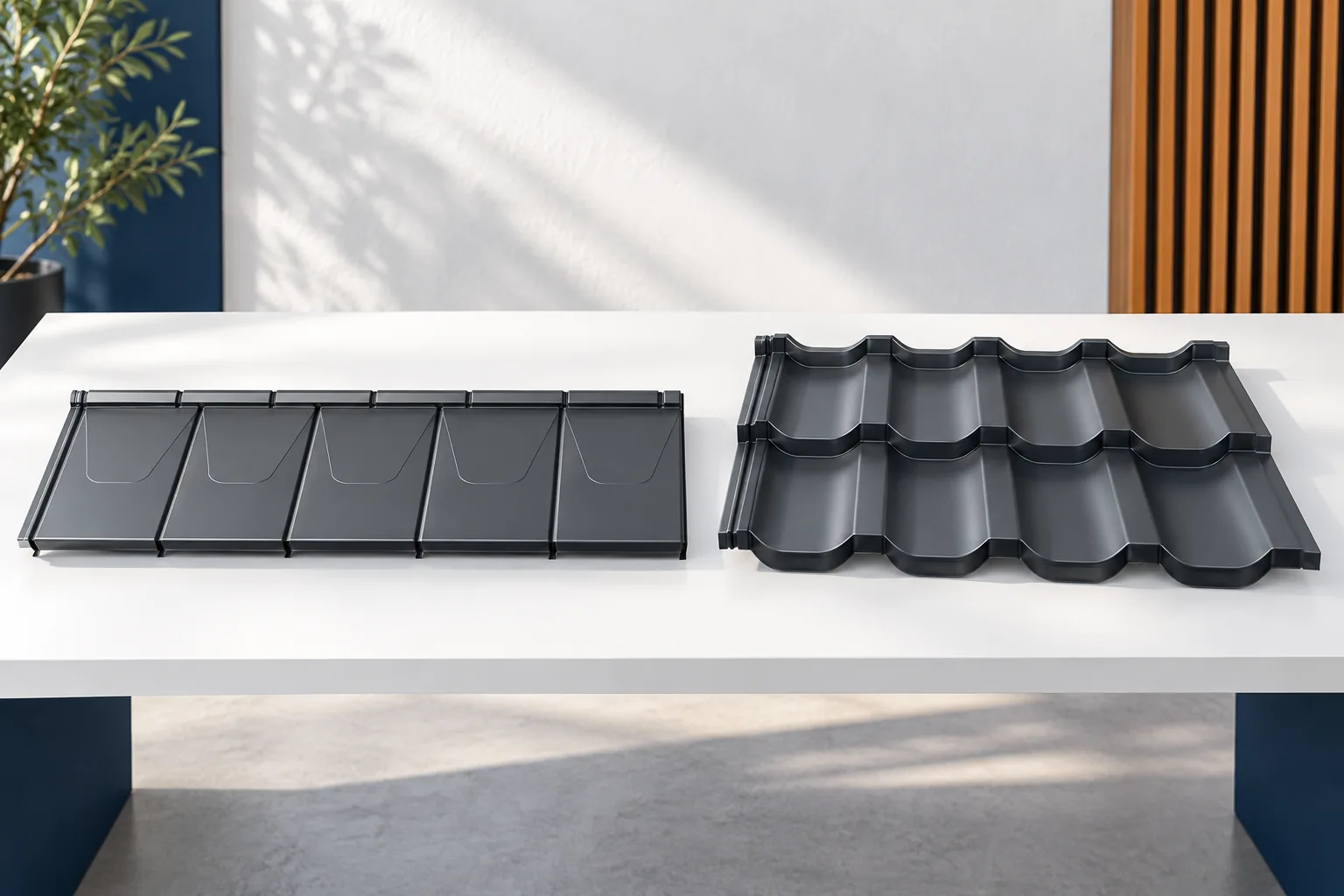
A single-module sheet and a double-module sheet differ in the number of transverse profile rows. The smaller format can make work easier on short roof slopes and where there are many breaks. The larger one allows more roof to be covered with a single element. Neither is always cheaper or simpler to install. The choice requires comparing the cutting layout, the coverage area, handling and the joining rules in the specific system. A module is a repeating section of the profile, defined by the division of the transverse pressings. It is not a universal length for the whole market. In one family it is, for example, 350 mm, but another model may have a different division. The length of the finished sheet is supplemented by the sections needed to make the laps and finish the edges.
What does the manufacturer call one module?
A module is a repeating section of the profile, defined by the division of the transverse pressings. It is not a universal length for the whole market. In one family it is, for example, 350 mm, but another model may have a different division. The length of the finished sheet includes the sections needed to form the laps and finish the edges.
A two-module sheet contains two such rows. This does not automatically mean twice the usable area compared with any single-module panel. First, the cover widths and geometry must match. The effective area of the element is required for ordering. The external dimensions also include the sheet hidden under the adjacent sheet.
Where does a small panel make work easier?
A shorter element is easier to turn in a confined space. This may matter next to a dormer, on a small extension or on a narrow strip of roof slope. It is also simpler to plan its delivery onto the roof when access to the building is difficult. This does not remove the need to support the sheet and protect the coating during handling.
On a complex roof, the small format offers more possibilities for laying out offcuts. The benefit is not guaranteed, however. The cut-off section must have the correct direction of ribs and the edge needed for the connection. Not every offcut can be turned around and used on the other side of the roof. The cutting plan should show the actual material losses.
For a renovation, the way the material is brought in can also be useful. If there is no space on the property for long packs and unloading close to the eaves, shorter elements can make logistics easier. This is an organisational benefit that should be weighed against the cost of more connections. It cannot be priced without viewing the building.
When will two modules be more convenient?
On a wide, simple roof slope, a larger panel means fewer separate elements to deliver and position. The rhythm of the pressings is already maintained in two rows of one sheet. This can streamline the work of a well-prepared team. The final pace also depends on the number of fixings, details and the connection method specified in the instructions.
It is worth checking the weight of a single panel, the packaging method and access to the roof slope. A low total weight of the covering does not mean that the sheet can be carried in any way. Wind makes it difficult to control the sheet. When conditions are unsuitable, changing the format will not replace safe organisation of the works and the decision to stop them.

Does a smaller sheet mean less waste?
Waste depends on the roof geometry, the panel dimensions and the layout of the first row. On a rectangular roof slope, larger elements can be used very well. With many roof valleys and corners, the situation looks different. The most reliable approach is to compare two cutting plans for the same roof, with the same openings and flashings.
Compare the quantity of material purchased, not just the slope area. Take into account the overlaps and the places where a piece is cut off. The reserve should not be set arbitrarily as one percentage for all roofs. Additional panels should result from the cutting plan, the real possibility of damage and any need to keep elements for repairs.
Does the format change the installation rules?
Yes, it can change the overlap arrangement, the fixing sequence and access to the connection points. Do not combine the instructions of two similar-looking systems. The batten spacing results from the module of the selected product. The start of the slope also requires correct positioning of the first batten, the overhang at the eaves and the method of draining water into the gutter.
Checking the squareness of the slope is important with both formats. A small panel will not hide a poorly prepared substructure. Inaccuracies in the first rows can accumulate towards the ridge. Installation must be checked periodically against the established lines. The edges of the sheets should not be forced into place if the cause of the problem is incorrect division or an uneven support.
How do you compare the cost of both variants?
A free quote should cover the entire slope, the accessories and the number of panels. The price per piece can be misleading, because a smaller sheet covers less roof. The price per square metre also needs checking as to whether it refers to the total or the effective area. In addition, compare the same type of coating and steel thickness. Otherwise you are assessing several differences at once.
Ask the installer what exactly the format changes in their work. A good answer should refer to the geometry of the house, unloading and offcuts. If the planned roof is simple, a larger panel may be a sensible choice. With numerous details, it is worth checking the smaller one carefully. The result is decided by the prepared layout, not by the number of modules alone.
7 branches. Materials closer to your project.