Maintenance and safety
What to check on a metal roof after winter
In brief
Start a post-winter roof inspection by following the route rainwater takes. From the ground, look for gutters that sag and flashings that have moved. From the loft, check for damp patches. A stain can point to a problem some distance away, so establish where water is entering or backing up before arranging a repair. Have defects dealt with before the next period of heavy rain. Leave any inspection that requires going onto the roof to someone equipped and trained to work at height.
Inspect the roof from a safe place
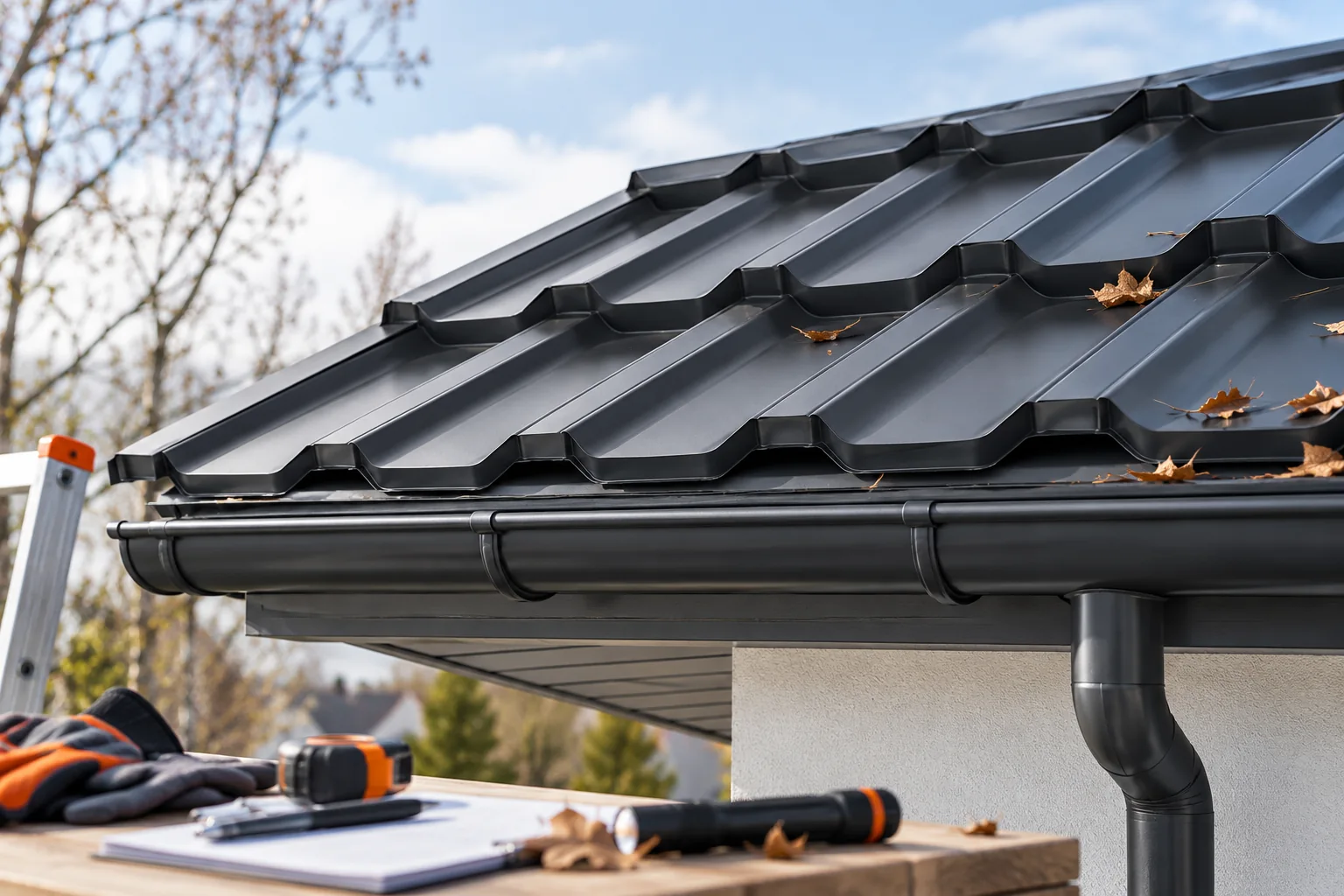
From the ground you can spot a detached piece of flashing, an uneven gutter line or an element that has shifted position. Binoculars or a photograph taken without approaching the edge are helpful. This does not give a complete picture, but it allows you to identify places for closer inspection. Do not go onto a wet or icy roof covering just to check a detail.
Pay attention to objects lying next to the house. A fragment of a fastener or a piece of flashing may indicate damage higher up. If an element is at risk of falling, restrict access to the area below. A close inspection should be carried out by a suitably prepared specialist. A ladder alone does not ensure safe access to and movement on the roof slope.
Check gutters, drains and ends
In winter, gutters can trap leaves, small twigs and sediment. After thawing, the flow and connections should be checked. Water overflowing in one place may indicate a blockage, but also incorrect alignment of a section. It is not worth automatically enlarging the outlet without checking the cause and compliance with the system.
The hooks and pipe clamps must be inspected. Sliding snow can change the geometry of the fixing. A gutter is not intended to retain large masses of snow from the roof slope. If the problem recurs every winter, the required roof protection should be assessed. Straightening a damaged element alone may not remove the cause.
Inspect roof valleys, chimneys and penetrations
Water from two roof slopes collects in the roof valley, so keeping it clear is very important. Debris can impede drainage and hold moisture. The inspection should also cover the edges of cut sheets and the connection points. Do not remove dirt with a tool that scratches the coating or bends correctly laid sheet metal.
Around the chimney and service penetrations, look for deformation, loss of sealing and traces of earlier repairs. If a leak occurs, it is important to identify the path of the water. A visible stain inside does not have to be directly below the damage. Painting over the ceiling or adding a random sealant is not a diagnosis.

Assess the coating and fixings
The surface should be checked for scratches, scuff marks and isolated spots of corrosion. The cause may be branches, left-over metal filings or incorrect maintenance carried out earlier. Small damage should be repaired using a method appropriate to the coating. A large area should not be sanded or covered with an arbitrary paint without assessing the condition of the substrate.
Checking the screws covers how they are seated and the condition of the seal. Not all fasteners need to be tightened automatically. Excessive pressure can damage the washer or deform the sheet. Where a fixing is loose, it is necessary to establish whether the problem lies with the screw itself, the hole or the substrate. The repair method should match the actual cause.
Take a look in the attic and assess moisture
If the attic is accessible, check for visible traces of water ingress, dampness in the timber and the condition of the exposed layers. The observation should be considered together with the weather. Water appearing after rainfall may have a different source from moisture occurring during large temperature differences. Condensation should not immediately be treated as a hole in the covering.
In a ventilated roof, the inlets and outlets must be unobstructed. Blocking them does not improve the insulation. If moisture returns, an assessment of the layer build-up and the airtightness from the interior side is needed. The problem may require improving a detail rather than replacing the entire sheet. The assessment should also cover areas around windows and services.
Check the equipment and service access
Walkways, steps and snow guards should be inspected for deformation and the condition of their fixings. A suspect element should not be tested by standing on it. If the roof has a photovoltaic installation, access to the areas beneath the modules must be taken into account. Doubts concerning the electrical installation should be assessed by a suitably qualified specialist.
After strong wind or unusual snow load, the scope of the inspection may be greater than usual. Where there are signs of structural damage, access should be restricted and an assessment commissioned. Cracks, unusual noises or visible deformation should not be a reason to go onto the roof oneself to take further photographs.
Record the findings and plan repairs
It is worth keeping simple inspection records: date, photographs, location of damage and repair carried out. This makes it easier to compare the condition from year to year. Keep the material data and the maintenance instructions. A product suitable for one coating is not necessarily suitable for another. The manufacturer’s recommendations also matter when washing.
The urgency of the work should follow from the risk. A loose element or an active leak requires prompt action. Soiling without damage can be included in the maintenance plan. A spring inspection helps to identify both types of problem. The best result comes from removing the cause of the fault, with a check of the adjacent layers and without unnecessarily disturbing the sound covering.
7 branches. Materials closer to your project.