Choice of covering
How to assess the environmental impact of a metal roof
In brief
A metal roof can be a sensible environmental choice if it is well specified, durable and uses material sparingly. When assessing an EPD, the first thing to check is whether the declared unit and material variant match the actual roof build-up, not just the thin sheet. It is equally important to establish which life-cycle stages the calculations include. Only on that basis can solutions with the same function be compared, bearing in mind that heat loss depends on the whole assembly rather than the covering alone.
What does the product environmental declaration show?
An EPD declaration presents an assessment of a product’s impact within defined boundaries. The unit, material variant and the stages included in the calculation must be checked. Data given for a square metre of thin steel sheet are not automatically the result for an entire roof with insulation, structure, flashings and installations.
An example declaration for profiled steel products covers production, end of life and benefits and loads beyond the system boundary. It does not declare all construction and use stages. Such a document is useful, but its scope must be known. A single value should not lead to the conclusion that every metal roof has a lower impact than every other covering.
How can the amount of material purchased be reduced?
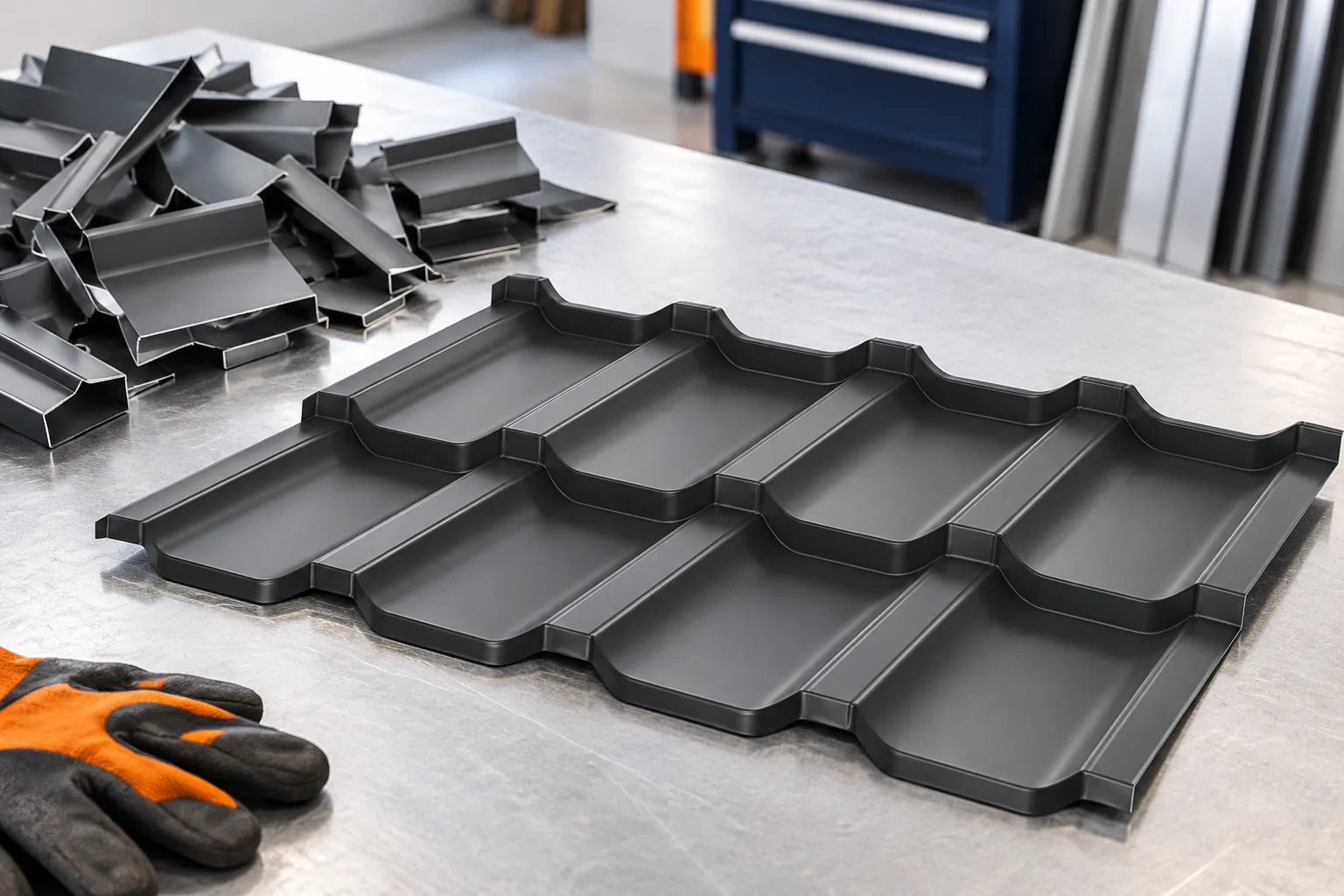
Good cutting optimisation reduces the number of unusable offcuts. On a simple roof, sheets matched to the slope length can be advantageous. Where there are numerous folds, it is worth comparing the modular format. The result depends on the geometry and the connection edges. Not every offcut can be turned around and used elsewhere.
Ordering too large a reserve also increases material consumption. The reserve should not, however, be removed without analysis. It may be needed for correct cutting optimisation or for repair. The quantity is best determined on the basis of actual dimensions and the installation plan. It is particularly worth checking the effective width so as not to confuse the sheet area with the covering area.
Limiting waste is also a task for the crew. Careful transport and storage reduce the risk of damaging new steel sheet before use. A sheet damaged during improper lifting must be replaced with another. A delivery plan, a prepared storage area and suitable tools can therefore bring a benefit beyond mere installation convenience.
Why does durability matter for the balance?
A covering matched to the environmental conditions has a greater chance of performing as intended. The right coating, correct flashings and fastenings are needed. Early replacement of material due to an installation error means additional raw material consumption and further work. It is not worth saving on the detail that determines water drainage.
Regular inspection helps detect local damage before the problem covers a larger area. Sometimes replacing a flashing or improving a connection is enough. However, a specific durability cannot be promised for every steel sheet. The warranty and the actual service life are not the same. The condition of the roof depends on the material, workmanship, surroundings and maintenance.

Does metal covering reduce energy consumption?
Sheet metal alone does not replace thermal insulation. Heat flow is determined by the whole roof, including the insulation and the joints. Leaks and gaps in the insulation can worsen the effect. Energy savings should therefore not be attributed solely to the choice of covering. A comparison of specific building assemblies and the building’s conditions of use is needed.
PIR may allow the required thermal resistance to be achieved with a smaller thickness than a material with a higher lambda. This is a technical benefit, but not ready proof of a lower environmental footprint. Data on production and the entire life cycle are added to such an assessment. A fair comparison with EPS, XPS or mineral wool requires the same function and equivalent thermal performance.
What happens to the steel sheet after dismantling?
Steel can be recovered and recycled. Environmental declarations assume specific end-of-life scenarios. These are model assumptions, not a guarantee that every piece of a specific roof will actually be recycled. It is important to separate the material and pass it on to an appropriate waste recipient.
A single steel sheet and an insulated sandwich panel are different products. The panel also contains a core that is permanently bonded to the facings. The method of handling must be determined for the entire waste, without assuming full recycling of every layer. Reuse of a dismantled sheet also requires an assessment of its condition, holes, geometry and suitability for a new application.
How can two proposals be compared without generic slogans?
Ask for the material documentation, the cutting plan and a complete cost estimate. If an EPD is available, check its validity, scope and product variant. Compare solutions that meet the same thermal, structural and service requirements. Do not automatically subtract the benefits of future recycling from production emissions without explaining the method used.
In practice, it is worth choosing a material suited to the task, limiting losses and enabling later repair. These are concrete measures that can be planned before construction. The slogan “ecological roof” without data explains little. A reliable choice should show the benefits together with the limitations, without promising zero environmental impact.
7 branches. Materials closer to your project.