Choosing the covering
Choosing a roof covering for a holiday cottage
In brief
First decide whether the holiday cottage will be used only seasonally or heated in winter as well, as this changes the roof requirements. Check the minimum pitch for the chosen profile, the support spacing and the loads, not just the appearance of the covering. For year-round use, condensation, ventilation and the continuity of the sealing layer must be assessed; in summer, protection against rain and overheating is key. A sandwich panel can combine covering and insulation, but it needs correct locks and support. Leave the design of the layer build-up to the designer.
How does the way it is used change the choice?
In a cabin used only during the warm part of the year, protection against rain and overheating matters. Once winter heating begins, the humidity conditions change. Warm air from inside can reach the cooler roof layers. A system that caused no problems in summer then requires reassessment.
It is therefore worth deciding whether the building is to remain seasonal. If you anticipate a later change, include it in the design. Adding insulation from the inside without identifying the existing layers can trap moisture. Not every building element can be safely insulated by sliding material into the available space.
When will T18 or T35 sheet work?
Trapezoidal steel sheet gives a simple pattern and can be convenient on a regular roof. T18 has a lower profile, while T35 has more pronounced ribs. Choosing between them requires checking the support spacing and loads. A higher designation does not automatically allow fewer purlins. Data for the specific sheet and its thickness are needed.
Steel sheeting does not in itself provide thermal insulation. Nor does it provide full protection against the noise of rain. Interior comfort is determined by the subsequent layers, their support and the finish. If there is a sleeping area under the roof, it is worth assessing the entire section, not just the cost of the external material.
Or perhaps tile-effect metal roofing?
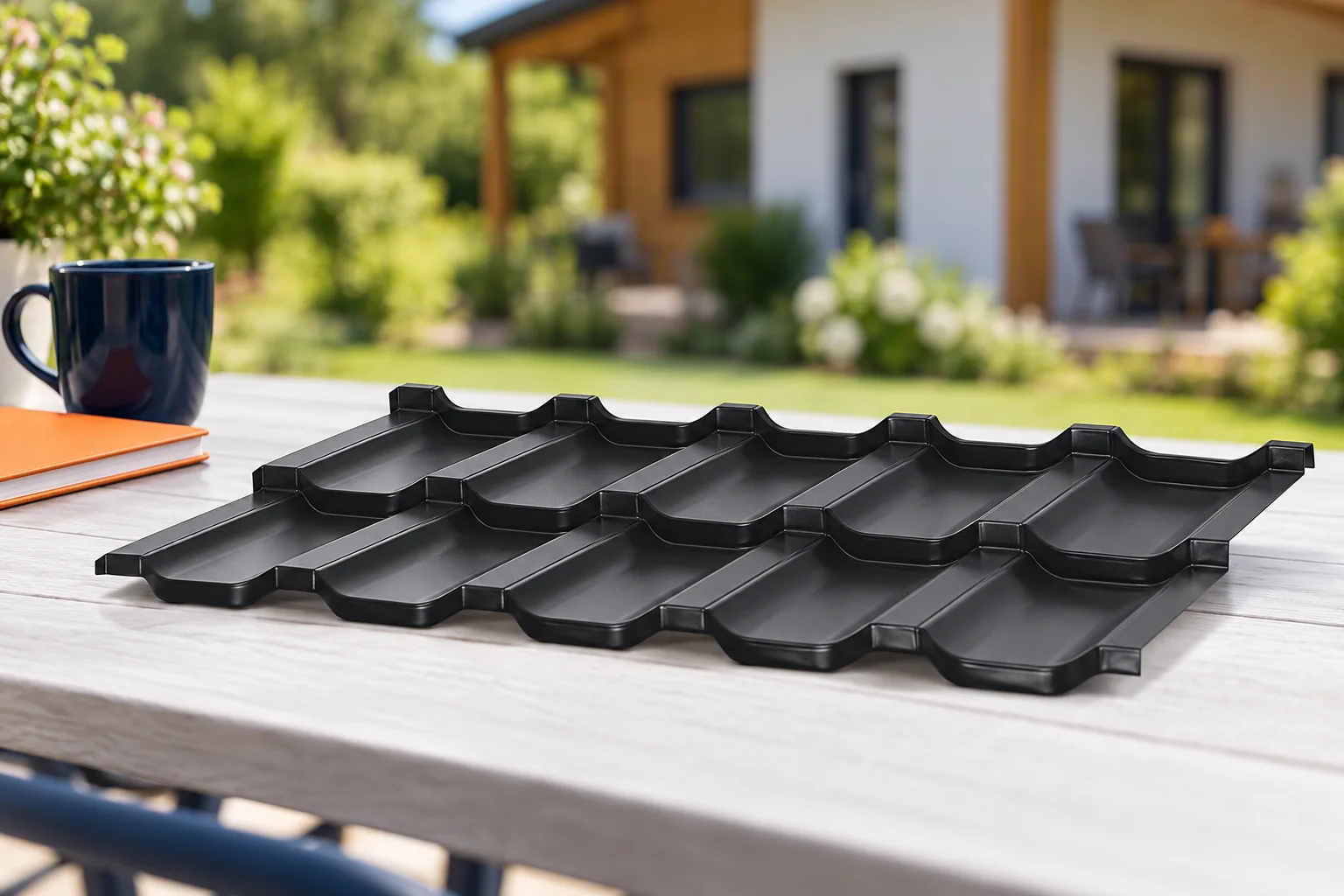
Tile-effect metal roofing may better suit the appearance of a small house with traditional proportions. A format cut to size makes good use of simple roof slopes, while a modular format makes handling smaller elements easier. The benefits should be confirmed by a cutting plan. On a very small roof, even a few offcuts can significantly change the waste proportion.
Check the minimum pitch for the chosen profile. It is not enough to adopt a condition found for another model. Also determine the flashings, ventilation and fixing. A complete set should include the eaves and ridge. The sheets alone in the right colour do not constitute a complete roof order.

When should you consider an insulated panel?
An insulated roof panel bonds a core to two steel facings. It can reduce the number of separately installed layers in a system for which it is intended. For a small cabin, load-bearing capacity and support must also be verified. The tightness of the locks and the junction between the roof and the walls are important.
PIR offers favourable insulation performance at limited thickness. However, such a panel should not automatically be regarded as the best acoustically or as non-combustible. The parameters relate to a specific product and method of construction. It must also be established whether the steel facing on the inside is to remain visible or whether the design provides for additional finishing.
How can you reduce dripping from under steel sheeting?
In a cool interior that is periodically closed, it is worth checking sources of moisture and ventilation. An anti-condensation fleece on the sheet metal can temporarily retain condensate, but it has limited capacity. It must have conditions in which to dry out. It does not replace thermal insulation or correctly designed protection against vapour flow.
In a heated cabin, continuity of the sealing layer on the appropriate side of the building envelope is required. Leaky connections at walls or services can direct moist air under the covering. Opening a window after noticing drops is not the only solution. First, the entire roof system and the way the room is used must be identified.
What should be taken into account on a plot with trees?
Branches, leaves and needles can increase the need to clean the drainage. Roof valleys and areas behind the chimney are particularly important. With a simple roof, inspection is easier to plan, but safe access is still required. You should not stand on a lightweight structure just because it is low above the ground.
When choosing the coating, consider the surroundings and the possibility of regular maintenance. Shade does not always mean a permanently wet roof, but accumulated deposits can retain water for a long time. Gutters and flashings should be accessible for cleaning. Aesthetic concealment of every element must not prevent later inspection.
How can the total cost be compared?
Include the covering, accessories, insulation, substructure and labour in the total. On a small roof area, the share of flashings and transport can be proportionally large. Check whether a vehicle can access the plot. A long sheet can limit joints, but it is difficult to carry along a narrow path between trees or existing buildings.
The cheapest option is not always the one with the lowest price per square metre of external sheet metal. If it requires subsequent insulation or many alterations, the total bill increases. A good choice corresponds to the intended use of the cabin. Then cost, appearance and comfort can be assessed on the basis of one complete solution.
7 branches. Materials closer to your project.