Planning and costs
What do made-to-length and modular tile-effect metal sheets cost?
In brief
Start a price comparison by checking what the quoted square metre represents. The total area of a tile-effect metal sheet differs from the area it covers after overlaps. For made-to-length sheets, the cutting plan affects the order. For modular sheets, you also have to round up to whole units. Compare the same steel thickness and coating. A catalogue example dated 28 October 2026 shows how to turn a unit price into a material cost. For a specific roof, also allow for offcuts, flashings, accessories and installation.
How to read the given catalogue prices?
The made-to-length example uses 0.50 mm steel with a 25 µm polyester coating. Per square metre of effective cover, the catalogue lists €9.11 excluding VAT and €11.20 including VAT. The same sheet costs €8.56 excluding VAT or €10.53 including VAT per square metre of total sheet area. The difference comes from the area used as the basis for the price.
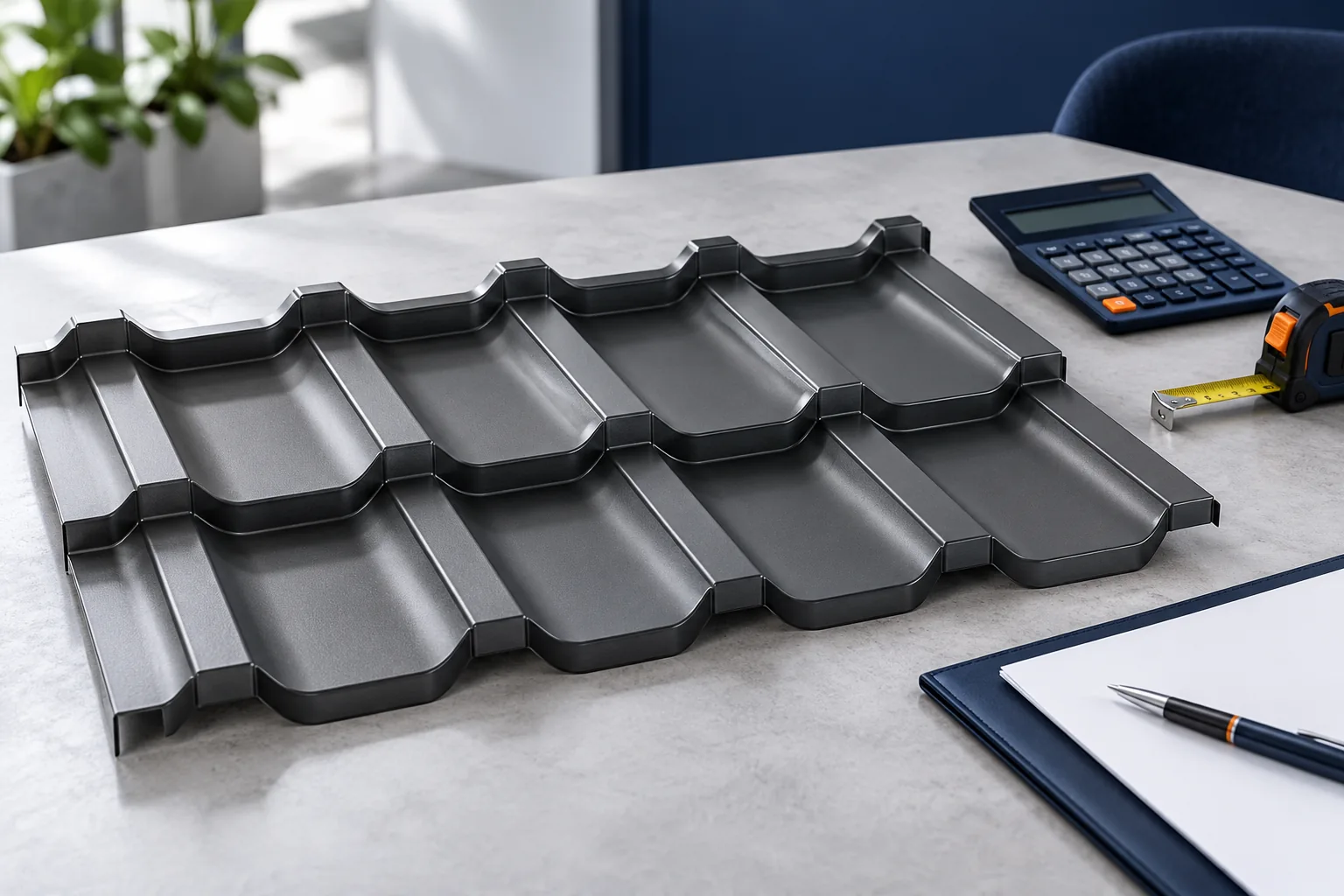
For modular tile-effect sheets with a 25 µm polyester coating, the catalogue lists €10.15 excluding VAT and €12.49 including VAT per square metre of cover. One sheet covering 0.798 m² costs €8.10 excluding VAT or €9.96 including VAT. These figures come from the price list effective from 28 October 2026. An individual quotation may differ.
Why is the total metre sometimes cheaper?
The total width includes the part concealed in the overlap. The effective width describes the width of the area actually covered. The same sheet therefore has more total metres than metres of coverage. A lower price per unit does not mean a lower cost of covering the same roof. Before comparing quotes, they must be brought to a common basis.
Overlaps along the length and offcuts are equally important. The geometric roof area does not have to equal the area of the ordered material. A roof with valleys and dormers requires a separate cutting plan. The same percentage of waste should not always be added. The value results from the sheet format and how the remaining pieces are used.
How much does the sheet metal alone cost in a simple example?
For a like-for-like comparison, assume 100 m² of effective cover, with no cutting waste or rounding up to whole sheets. Multiplying the displayed unit prices by 100 gives €1,120.00 including VAT for made-to-length sheets and €1,249.00 for modular sheets, a difference of €129.00. This compares materials only. A purchase list for a particular house must also account for the roof layout.
Modular sheets are ordered as whole units. At 0.798 m² of cover per sheet, it takes at least 126 sheets for the combined cover to exceed 100 m². At the displayed catalogue price per sheet, the total is €1,254.96 including VAT. This still excludes cutting waste and the effect of the layout on each slope. Use the laying plan to set the order quantity.

How does the coating change the material cost?
In the same example, made-to-length tile-effect sheets with a 35 µm matt polyester coating cost €10.34 excluding VAT or €12.72 including VAT per square metre of cover. Modular sheets with the same coating type cost €11.31 excluding VAT or €13.91 including VAT. Comparing these figures with standard polyester in the same format shows how the finish affects the price.
A higher price should not be the only argument for a coating. It should be matched to the environment, the expected appearance and the maintenance conditions. Matt and gloss do not form a standalone durability ranking. Before you pay extra for a chosen variant, check its parameters and the scope of the warranty. The same colour may be available in several different finishes.
When can the cut format be advantageous?
On a simple roof slope, long sheets can reduce the number of transverse joints and simplify cutting. They require precise measurement, space for unloading and safe handling. With unusual geometry, a larger area of a single element does not automatically mean less waste. Actual cutting layouts must be compared.
Modules are easier to handle as individual elements. They can facilitate work on a complex roof and later replacement of a section. However, the final result depends on the profile construction and the joint layout. It should not be assumed that every module gives identical labour savings. It is worth requesting a quote for both formats for the same project.
What should be added beyond the covering?
The cost also includes ridge tiles, side flashings, valleys, eaves strips, fastenings and seals. There are also the necessary layers under the covering, drainage and safety accessories. Transport, unloading and labour should have a clear scope. For renovation, demolition and the condition of the existing structure are also taken into account.
On a roof with many bends, the share of flashings can be large. Therefore, the price of sheet metal per metre is not enough to choose a contractor or material standard. Ask for a list of quantities, units and variants. This will show whether a lower total results from a more favourable price or from omitting some of the necessary elements.
How to order comparable quotes?
Provide the same plan, dimensions, slope and list of openings. Specify the coating and colour. Ask for information on which values are net, which are gross and what area forms the basis for settlement. Establish the validity period and delivery conditions. Small differences in these points can change the ranking of the most favourable offers.
For the decision, use the total price of the defined scope and the quality of the proposed details. A dated price list is a useful reference point. However, it does not take into account all the features of a specific build. The best comparison shows exactly what you will receive and how much a roof ready for use costs, with the full set of required elements.
7 branches. Materials closer to your project.