Coatings and colours
What makes coated steel sheet suitable for roofing?
In brief
The choice of roofing sheet depends on how the entire layer system matches the building’s conditions, not on colour or sheet thickness alone. It is worth checking the coating documentation, the product’s intended use and the maintenance requirements, especially in coastal areas or near an industrial plant. The steel core provides mechanical properties, a metallic coating protects it, and the outer layers determine colour, texture and part of the environmental resistance. Their arrangement can vary, so two similar-looking sheets may behave differently under prolonged moisture or scratching.
What layers is the material made of?
The steel core is responsible for the mechanical properties of the sheet. It is protected by a metallic coating, and further layers prepare the surface for the organic finish. On the outer side there is a finish that determines the colour, texture and part of the environmental resistance. The exact build-up depends on the product. Not every coated sheet has an identical structure or the same protection on the underside.
The layers perform different tasks, so quality cannot be judged solely by the thickness of the paint. The substrate, adhesion, coating properties and suitability for the intended use also count. Two sheets with a similar appearance may behave differently under prolonged moisture or scratching. The documentation should make it possible to establish which variant was actually ordered and delivered.
How is the roof profile formed?
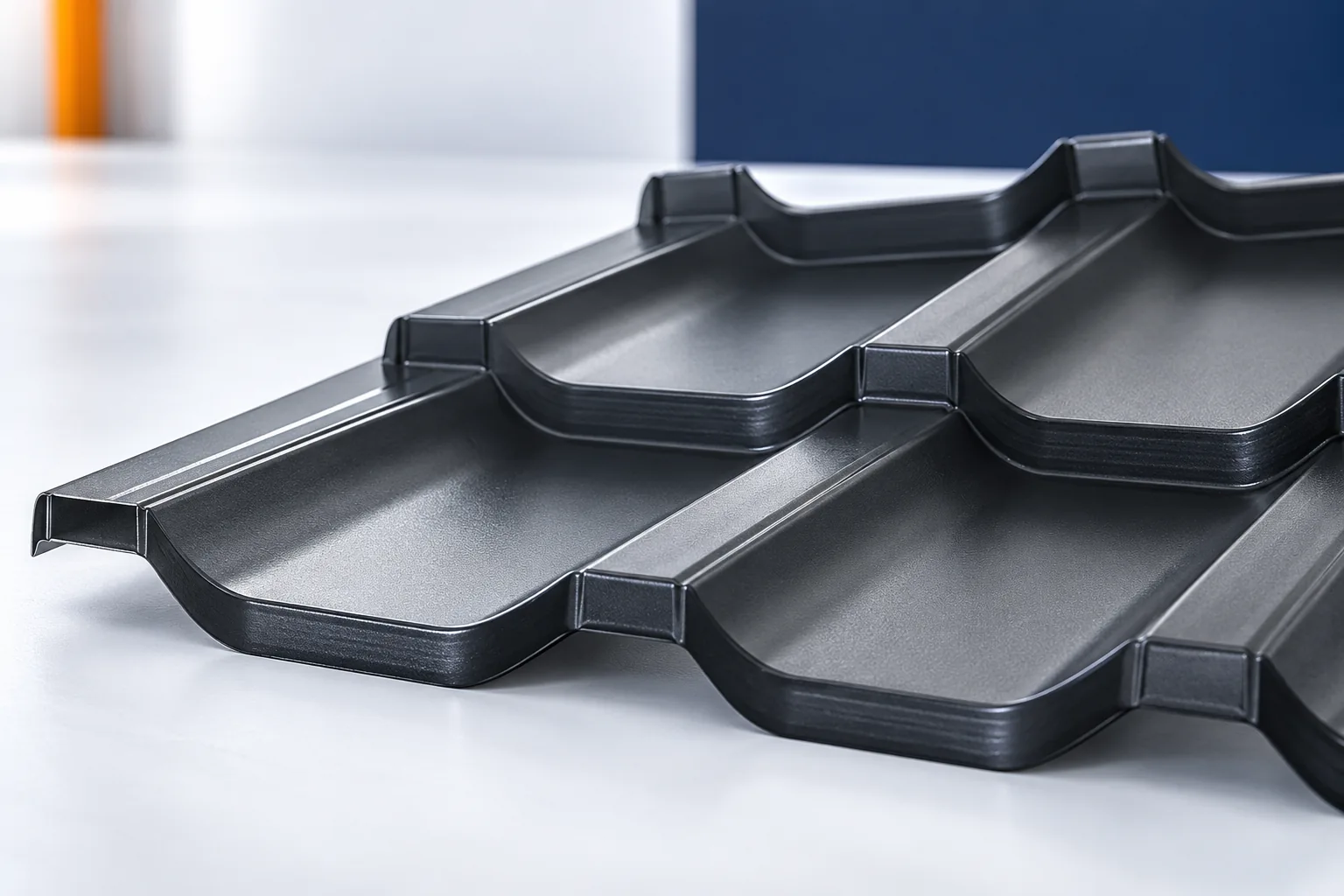
The flat material is formed into a profile, for example trapezoidal T18, T35 or a tile-effect metal roofing sheet shape. The pressings give the sheet rigidity and determine the method of joining. A higher profile usually changes the structural possibilities, but its name does not state the full load-bearing capacity. Steel thickness, cross-section geometry and support data are also needed. Measuring the rib height alone is not enough.
A roof profile should drain water and form a proper overlap. Some families include separate versions for roof and façade. The coating may be on a different side of the cross-section. Turning the sheet over to achieve a neater arrangement of ribs may therefore be a mistake. At purchase, the application must be specified, and on delivery the product must be compared with the agreed specification.
Is thicker sheet always better?
The thickness of the steel core affects rigidity and resistance to deformation. However, it alone does not determine the durability of the coating or the tightness of the roof. A thicker sheet with unsuitable protection may perform poorly in a given environment. Conversely, a suitably selected thinner sheet may meet requirements with closer support spacing. The choice should follow from the parameters of the entire solution.
It is worth checking how the thickness is described in the offer and documents. When assessing the material, a random measurement including the paint should not be compared with the core declaration. Tolerances and the steel grade are also important. For larger spans, load tables are the basis for selection. Buying the “thickest available” sheet without checking the supports may not solve the structural problem.

How to match the coating to the environment?
A roof by a busy road, in a coastal zone or above a damp building works under different conditions than the covering of a typical house in open terrain. Salt, deposits, contaminants and the duration of moisture matter. In such conditions, the scope of application of the coating and the maintenance requirements should be checked. A long warranty period alone does not confirm suitability in every location.
In a farm building, the internal environment also matters. Water vapour and airborne substances can affect the underside of the sheet. The anti-condensation layer does not replace a coating resistant to the given conditions. Ventilation and a means of removing moisture must be addressed. A product intended for dry storage does not automatically become suitable for every livestock building.
Why do edges need attention?
Cutting exposes the cross-section of the material, and an incorrect tool can damage adjacent layers. For coated sheets, use tools permitted in the instructions, without overheating the surface. An angle grinder is the wrong choice. Scattered swarf can leave marks even on sheets that were not directly cut. It must be removed immediately.
Edge protection and minor damage repair are carried out in accordance with the recommendations for the coating. This does not mean covering every surface with random paint. Contact with materials that may cause adverse reactions or retain moisture must also be avoided. Proper treatments, cleanliness and ventilation help more than temporarily hiding defects with a thick layer of touch-up paint.
How to assess the purchase and later maintain the roof?
In the order, record the profile, thickness, type of finish, colour and the basis for calculating the area. On delivery, check the labels and the condition of the packs. Moist sheets must not be left tightly stacked. Drying and storage in accordance with the instructions are required. The transport film is not a protective covering that allows the material to be stored in rain and sun for any length of time.
After installation, film residues, swarf and dirt are removed. In subsequent years, the coating, fasteners, laps and places where deposits accumulate are checked. Gentle cleaning and minor repair carried out in time can limit the development of a problem. Coated steel sheet offers many possibilities, but its properties only become apparent in a well-selected and well-maintained roof.
7 branches. Materials closer to your project.