Maintenance and safety
Planning safe access to the roof and routes across it
In brief
Safe roof access requires a planned route, not improvisation. The key decision is to identify which roof points need regular servicing — chimney, ventilation equipment, drains or installations — and whether access should be permanent or occasional. It is worth checking whether steps and walkways are matched to the covering profile and the correct substrate, and whether their brackets transfer load to the structure. A ladder alone is not enough, and wet sheet metal, unsupported panels and skylights create hazards even on a low building.
When is access to the roof slope really needed?
The roof may require inspection of the chimney, ventilation equipment, drains or installations. It is worth indicating these points and the frequency of servicing. Not every check needs to be carried out by walking on the covering. Some inspections can be performed from a safe position or using appropriate equipment. The method of access should correspond to the task and the capabilities of the building.
The route should not begin with improvised climbing on the gutter or flashings. Water drainage elements are not steps. If the roof will be serviced regularly, a permanent access solution usually makes work organisation easier. Its location must be combined with the building layout, the equipment set-up position and a safe passage onto the roof slope.
What do chimney steps and walkways provide?
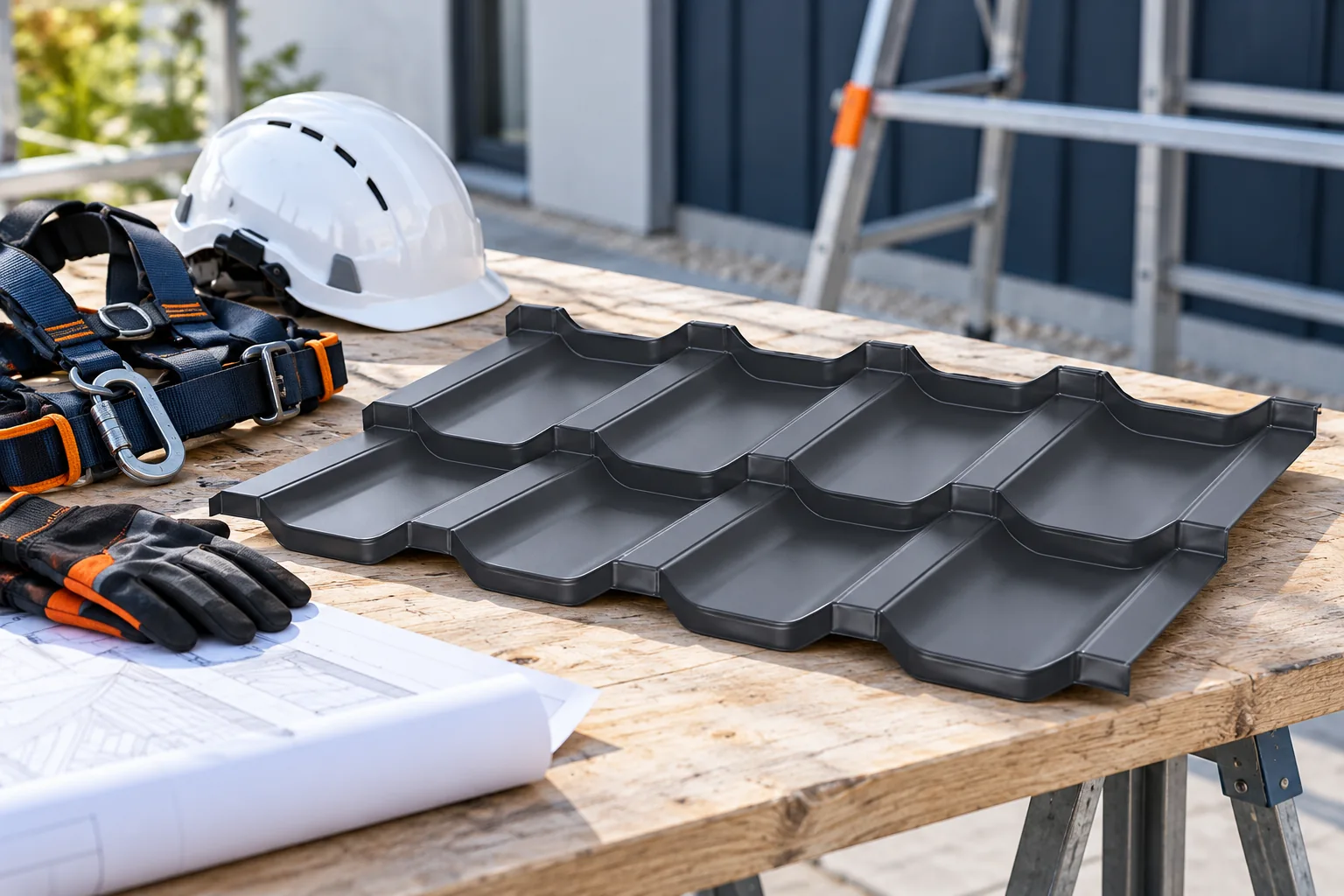
Steps create successive support points, while a walkway provides a place to work or pass by the serviced element. Their brackets must match the covering profile and the intended fixing. A similar shape of the tile-effect metal roofing alone does not guarantee compatibility. It is important to transfer the load to the correct structural element and to ensure the tightness of the connections made.
Roof access should form a logical route. A single step placed far from the access point does not solve the problem of reaching the area. Nor should every walkway be regarded as an anchor point for fall protection equipment. Such use must be explicitly permitted and documented. Two elements may look similar but have different purposes and installation requirements.
What safeguards are needed when working?
Work at height requires proper organisation and fall protection. In health and safety regulations, the reference point is work at least 1 m above floor or ground level, with specified exceptions. This does not mean that a lower edge is always safe. The conditions, surroundings and consequences of loss of balance must be assessed.
First and foremost, appropriate collective protection is used where required and possible in the given arrangement. Individual measures must form a working system. Harnesses alone without a proper anchor point do not protect against falls. Rules for emergency procedures and the possibility of providing assistance are also needed. The selection should not be made only after accessing the roof.

Where can you stand on steel covering?
The rules for movement are specified by the product documentation and the support arrangement. The sheet can carry the designed loads and yet be locally dented by incorrect stepping. Weight should not be placed on loose sheets, edges or unfixed laps. Footwear should match the working conditions and not bring sharp contaminants onto the coating.
Skylights and openings covered with lightweight material are a particular hazard. They must not be treated as a walking surface without confirming their properties and safeguards. In winter, snow can conceal their boundaries. The person organising the work should know the location of such places. An incidental route across the middle of the roof slope is not a safe access plan.
How does the weather change access conditions?
Rain, dew and frost reduce grip. Strong wind can make it difficult to maintain balance, and a carried sheet acts as a large surface catching gusts. Work must be postponed if conditions do not allow it to be carried out safely. There is no single weather condition under which every roof and every task will be permissible. The pitch of the slope and the equipment used also matter.
Snow removal requires a separate plan. The condition of the structure, the snow load and the method of removal without creating unfavourable accumulations must be checked. No single safe snow depth can be given for all roofs, because its weight varies with density and moisture content. The area below must also be protected from falling snow and ice.
What should be prepared for the crew before access?
Provide information on the structure, skylights, installations and existing anchorage points. Establish who organises access and what tasks are to be carried out. Mark out the zone below the works. No unauthorised persons or items susceptible to damage should be present in it. Tools and loose parts also require protection against falling.
After installing the access system, it is worth keeping documentation and photographs of the fixings. During inspections, the condition of the brackets, fasteners and seals is checked. A loose element must be taken out of use until it has been assessed. A well-planned route allows the roof to be serviced without improvisation, but it does not replace the preparation of persons and the safeguards required for specific works.
7 branches. Materials closer to your project.