Maintenance and safety
Preventing corrosion on metal roofing, from cut edges to repairs
In brief
Protecting a metal roof against corrosion depends above all on whether the chosen coating suits the actual conditions around the building and beneath the covering. It is worth checking the coating’s intended use, how edges and fixings are protected, and whether water can drain freely, rather than relying solely on the thickness of the coloured layer or the length of the guarantee. Moisture, contamination and lingering metal filings increase the risk. Regular inspection of details and prompt repair of minor damage using a method permitted for the given surface help catch problems at an early stage.
Which layers protect steel roofing?
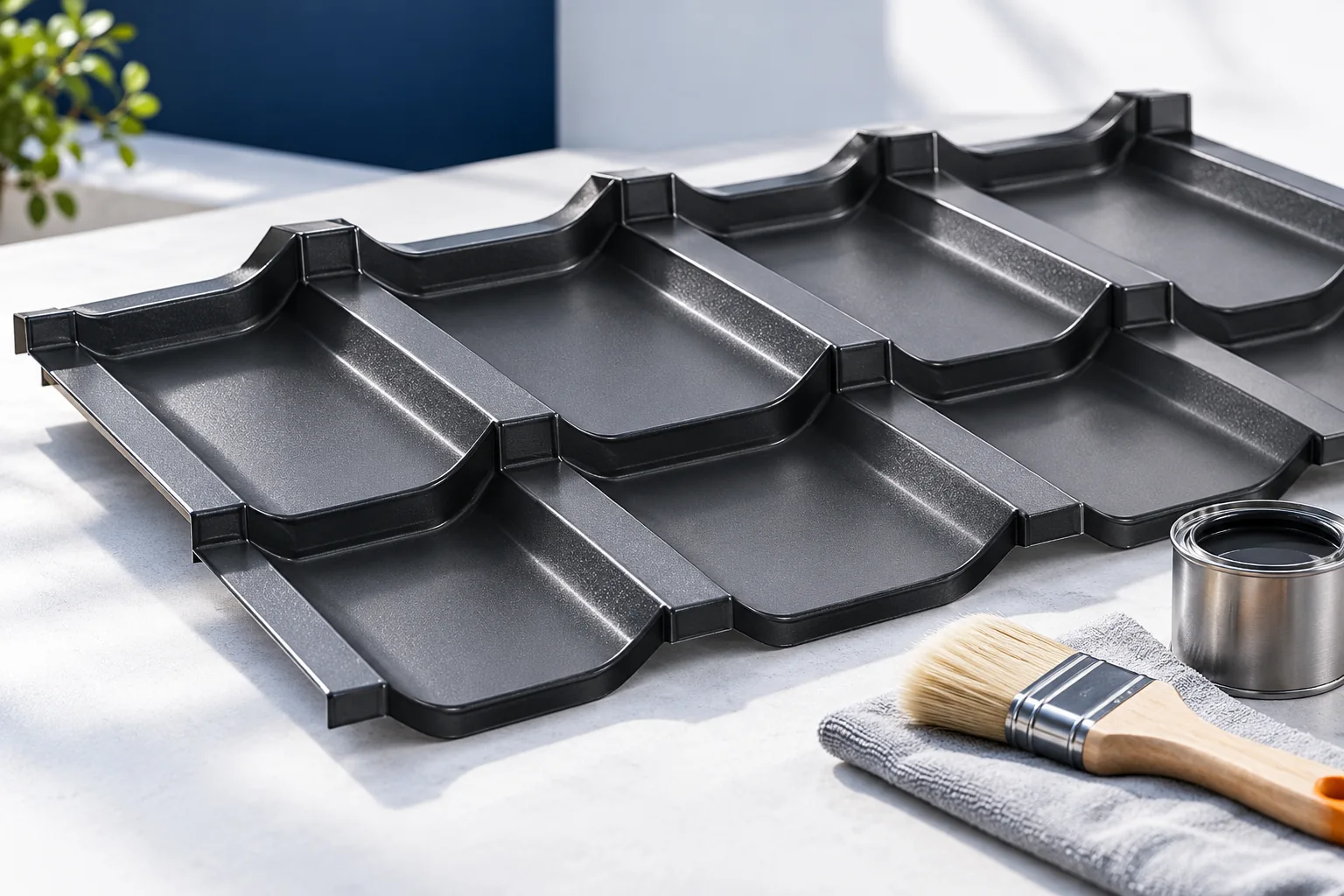
The steel core is responsible for the mechanical properties, while the metallic protection and coatings limit environmental exposure. Their construction depends on the product. Protection should not be judged solely by the thickness of the colour layer or by the length of the warranty slogan. What matters is the intended use of the coating and the conditions in which the roof will operate.
Moisture, contamination and the building surroundings influence the risk. Different conditions prevail in an ordinary house than in industrial processes or in a room with an aggressive atmosphere. For insulated panels, the internal facing must also be selected. A nice colour on the outside does not solve the problem of inadequate protection on the inside.
Why is swarf so troublesome?
After drilling and cutting, small metal particles may remain on the roof. They rust quickly and form stains on the surface. This does not always initially mean damage to the sheet itself, but leaving contaminants encourages further problems. Swarf must be removed promptly and after completion of the work. One should not wait for rain to wash it away.
Tools approved in the instructions are used for processing. Cutting with an angle grinder is often prohibited due to heat and hot sparks. Damage may also occur beyond the cut line. Sheets must be protected during work on adjacent elements. Sparks from processing another material can reach the finished covering.
Where does moisture most often accumulate?
Leaves and debris retain water in roof valleys, at chimneys and behind protruding details. Dirt accumulating in the gutter has a similar effect. A permanently wet contact is a harsher environment than a surface that dries freely. During inspection, it is therefore worth looking not only at the colour of the sheet but also at places where water is retained and at the patency of drainage.
Moisture can attack from below. A leaky layer from the interior and a lack of required ventilation encourage condensation. Anti-condensation fleece has a limited ability to retain condensate and needs to dry out. It does not replace addressing the cause of excessive moisture. Discolouration on the underside of the covering should prompt an assessment of conditions throughout the entire assembly.

How to inspect edges and fixings?
Cut edges, scratches and processed areas deserve particular attention. The method of protecting edges follows the recommendations for the given product. Not every edge should be coated with an arbitrary paint. An unsuitable product may adhere poorly or damage the existing coating. Before repair, the condition of the substrate and the correct technology must be established.
Seals and the contact pressure of the screws should also be checked. A loose fastener can let water through, while an overtightened one can deform the surface. Replacement should use a component suited to the substrate and environment. Accidental mixing of metals in permanently damp contact can create additional corrosion risk. Material compatibility should follow from the system solution.
How to clean a roof without damaging the coating?
Cleaning is carried out using gentle methods specified by the manufacturer. Usually abrasion and aggressive substances should be avoided. The water jet should not be directed so as to force water under the laps. If a pressure device is used, the parameters and distance must correspond to the recommendations. Stronger washing is not automatically more thorough maintenance.
First it is worth checking what kind of soiling is involved. Biological film, industrial deposit and rust from filings may require different treatment. A test on a small, less visible area helps assess the surface reaction. Work at height must be organised safely. The risk of falling is not justified by the wish to remove a few stains oneself.
When is a touch-up sufficient and when is a repair needed?
Minor coating damage can be repaired if the documentation and the condition of the material permit it. The touch-up should be limited to the damaged area. Extensive painting with a different paint can produce a clear difference in colour and gloss. Deeper corrosion, a leaking joint or a weakened sheet require an assessment of the scope of repair, and sometimes replacement of the component.
Regular inspection makes it easier to catch a problem at an early stage. It is good to keep photos and a record of the work carried out. This makes it possible to see whether the change is growing. Corrosion protection is not a one-off coating of the entire roof with a preparation. It is a combination of the right material, careful installation, moisture drainage and controlled maintenance.
7 branches. Materials closer to your project.