Renovation and repairs
When does a roof need repair and when does it need replacing?
In brief
The condition of the whole roof assembly and the cause of the fault, not the age of the covering, should determine whether to repair or replace. Before comparing costs, establish the water’s path: it may travel along the membrane or flashing and appear far from the point of entry. Check whether the problem is limited and can be permanently removed, or whether it involves widespread corrosion, repeated leaks or damaged layers. Also distinguish a leak from condensation. A diagnosis from outside and from the accessible interior allows the scope of work to be matched to the actual cause.
Does the location of the stain indicate the cause of the problem?
Not always. Water can travel along the membrane, flashing or structural element and appear far from the point of ingress. Before deciding to replace a sheet, its path must be established. Observing the relationship with rain direction, wind and temperature helps. Photographs taken while the problem is occurring are often more useful than a description after everything has dried out.
A leak must also be distinguished from condensation. Moisture can result from vapour ingress from the rooms and blocked ventilation. In that case, new roofing without improving the layers beneath may not solve the problem. The diagnosis should cover the roof from outside and the accessible interior, and where structural damage is suspected, an assessment by a suitably qualified person as well.
When does a local repair make sense?
A local repair is justified when the cause is limited and can be permanently eliminated. It may concern a single flashing, a damaged fastener or a local crack. The remaining roofing should be in a condition that allows further use. The scope of the repair should be matched to the material technology and the availability of parts.
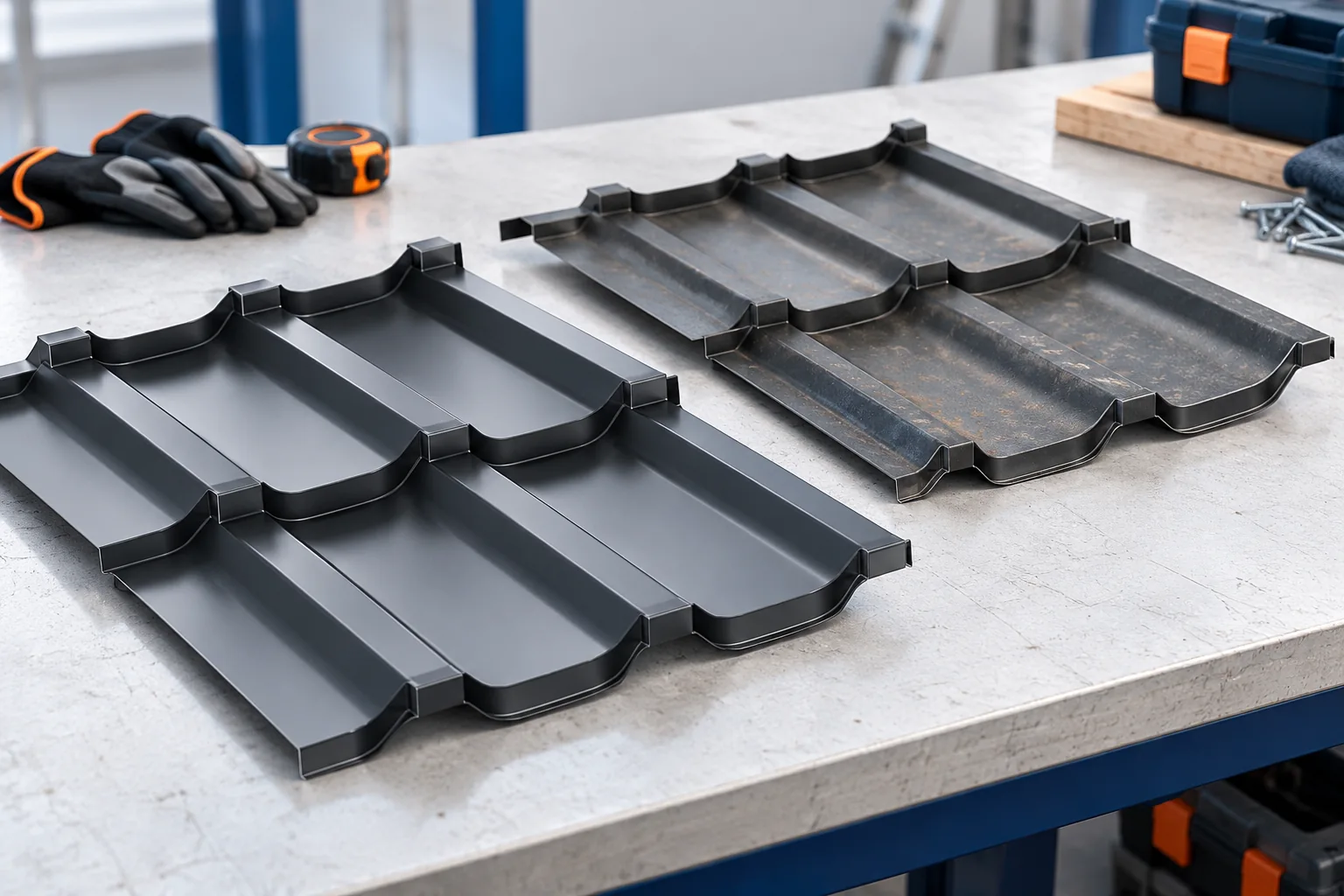
A repair should not consist solely of covering the problem area with another layer of compound. If water is flowing along the wrong path, the detail must be corrected. When replacing an element, the conformity of profile, laps and coating is important. Even a technically matched new sheet may differ in appearance from the old roof surface, which is worth taking into account before carrying out the work.
What symptoms point to a more extensive renovation?
Extensive coating damage, corrosion penetrating through the sheet and numerous leaky connections may indicate that spot repairs are no longer sufficient. The same applies to a deformed substructure or a damaged layer beneath the roofing over a large area. Replacing only the sheet metal then makes sense only after the causes in the substrate and details have been eliminated.
Repeated repairs of the same places are also a cause for concern. It is worth collecting their history and costs. If the problem returns, it may result from incorrect geometry, mismatched roofing or a lack of continuity between layers. Another correction need not be wrong, but it should result from a new diagnosis. There is no point in endlessly repeating actions that do not eliminate the cause.

Is the age of the covering enough to make a decision?
Age alone is too imprecise a criterion. The quality of the material, the surroundings, the installation and the maintenance all matter. Two roofs installed in the same year can be in very different conditions. A specific service life should not be promised on the basis of the coating name alone. An inspection and a comparison of visible changes with the documentation are needed.
Similarly, the length of the warranty does not indicate an expected replacement date. The warranty describes the scope of liability under specified conditions. It does not replace a structural survey or an assessment of the seals. If the covering is in good condition, replacement may result from planned refurbishment or insulation improvements rather than from wear of the sheet metal itself. These reasons should be separated in the cost calculation.
How do you compare the costs of both options?
A repair should have a defined scope, an expected outcome and access to the damaged area. Replacement must include dismantling, waste, substrate preparation and new details. It is not enough to compare the price of a patch with the price per square metre of sheet metal. In both options, there are additional costs for work organisation and protecting the building and the site.
For a larger renovation, replacing the covering can be combined with improvements to insulation, ventilation and drainage. This increases the scope of expenditure but can eliminate several causes of problems at once. It is worth obtaining separate prices for the necessary repairs and the planned improvements. This makes it clear what results from the technical condition and what results from a desire to change the standard of the roof.
How do you make the decision without rushing or delaying?
First, the immediate danger is removed and the leak is secured. Then a diagnosis is prepared along with two comparable options, if both are technically feasible. A more extensive renovation may require formalities depending on the type of work. Changing the structure and shape of the roof is not a simple replacement of the covering. This must be established before signing the contract.
A good decision answers three questions: what is damaged, why it happened and how the planned work will remove the cause. If a repair achieves a lasting result within a limited scope, there is no reason to replace everything. If the problem affects the entire system, the saving on another temporary seal can quickly disappear with the next leak.
7 branches. Materials closer to your project.