Renovation and repairs
Finding the cause of a roofing sheet defect before making a claim
In brief
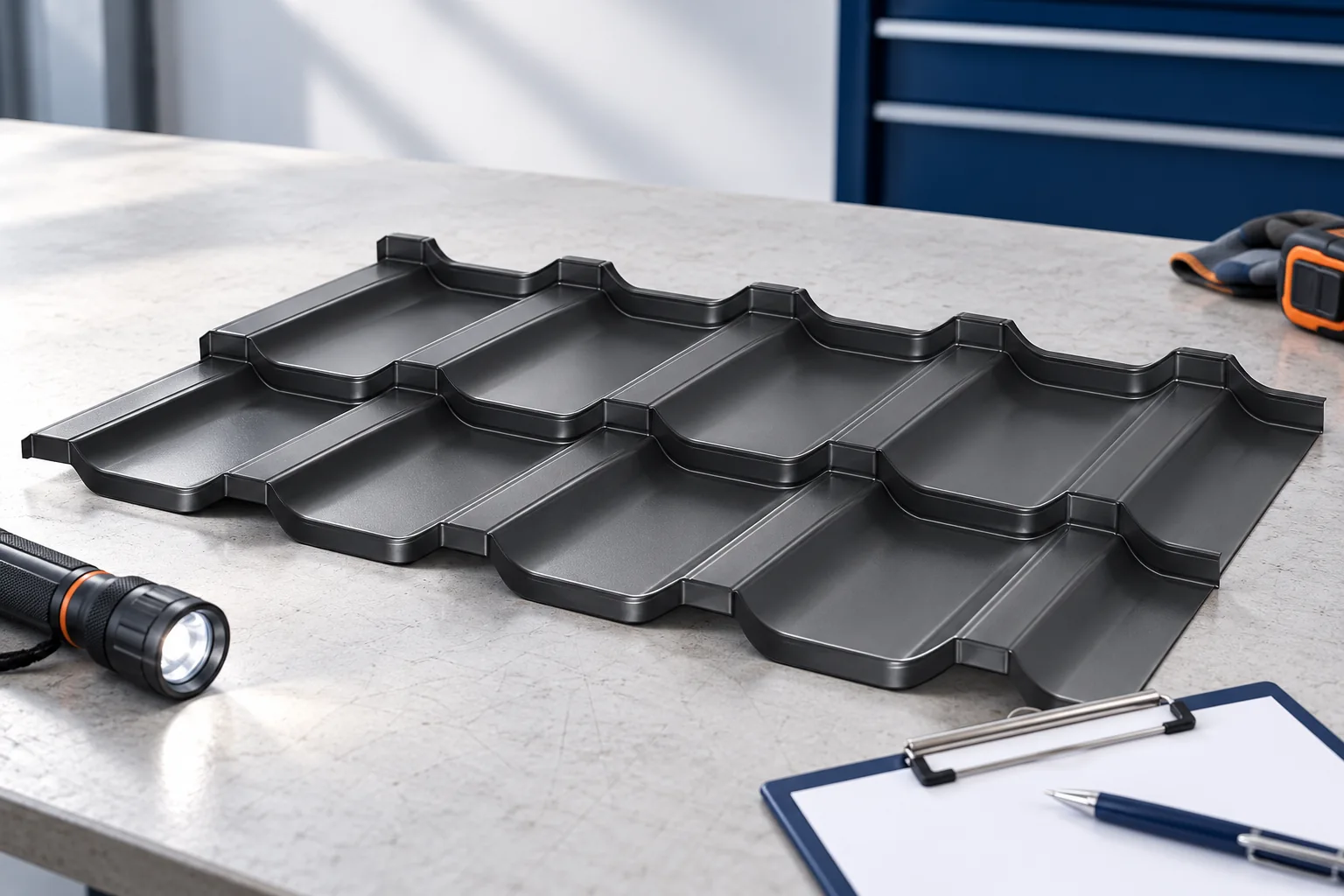
Before making a claim about roofing sheets, identify where the fault occurs. A problem across a whole slope calls for a different investigation from a leak at a single junction. Record the extent of the damage, when it appeared and how the sheets were stored and installed. Colour variation, rippling, leaks and rust spots can have different causes. For example, small particles of steel from drilling or cutting can rust on the surface. Keep the labels and document the condition of the roof before cleaning it.
Do rust spots mean corrosion of the sheet?
Small rusty marks may come from filings left after cutting or drilling. The particles corrode on the surface and form stains, although the coating itself does not initially have to be breached. Corrosion developing in a scratch or at a damaged edge presents a different picture. Identification requires inspecting the location, not assessing a single photograph from a distance.
It must be established whether work with tools producing hot sparks was carried out nearby. The accumulation of wet leaves and sediment is also significant. The mark should not be immediately rubbed off with an aggressive method that removes evidence or damages the coating. It is worth taking photographs first and agreeing on the method of assessment. Cleaning should correspond to the type of surface.
Why can adjacent sheets look different?
The difference may result from the material batch, a different coating, the direction of light reflection or ageing. Sometimes a new replacement is compared with a covering that has been in use for several years. It is worth checking the markings and the order document. The same colour number does not guarantee identical gloss on different finishes. What matters is what exactly was to be supplied.
The assessment should be carried out in comparable light and taking into account the geometry of the roof slope. A photograph may enhance the contrast through reflection of the sky. However, this does not mean that every difference should be regarded as an illusion. If the delivery was to form a coherent surface, its conformity and the scope of the declared properties must be checked. It is worth keeping the package labels.
Where does waviness or deformation come from?
The cause may be damage during transport, incorrect handling or an uneven substrate. A long sheet poorly supported during lifting can be permanently bent. On the roof, in turn, excessive tightening of fasteners can force a shape inconsistent with the geometry. Therefore, the condition before installation must be compared with the visible problem after screwing down.
Support and loads are also significant. Not every deformation is purely an aesthetic defect, especially in structural sheet metal. In such a case, an assessment of load-bearing capacity and operating conditions is required. The element should not be straightened by force before the cause has been established. Repair may require adjustment of the substructure or replacement of the damaged sheet.

Does a leak prove a material defect?
Water may penetrate at the lap, flashing, fastener or installation penetration. The cause does not have to be located directly above the stain inside. It is worth establishing whether the problem occurs with every rain or only with a specific wind. The slope, the execution of the detail and the conformity of the covering with the instructions should be checked. A tight sheet surface alone does not guarantee the tightness of the entire roof.
Condensation must also be ruled out. Water on the underside of the sheet may originate from moisture inside the building. Replacing the covering will not resolve a leaky layer on the room side and blocked ventilation. If the cause is a product defect, data confirming its extent are needed. A reliable assessment should neither blame the material in advance nor automatically dismiss that possibility.
What can cause the coating to detach and become damaged?
The surface is sometimes damaged mechanically, chemically or by improper storage conditions. Moisture trapped between sheets can lead to changes even before installation. Film left on too long also hinders later surface preparation. Damage occurring at a single point requires a different check from a repeated change on many elements.
It is worth establishing what the roof was washed with and whether touch-ups were carried out. An unsuitable paint or solvent can alter the appearance and adhesion. At the same time, a factory non-conformity cannot be ruled out without inspection. Before extensive repair, it is advisable to agree the assessment and keep documentation. Masking the entire surface may make it difficult to determine the original symptom.
How should the problem be documented so that it can be clarified?
Photographs of the entire roof slope and close-ups, the location of the changes and the date they were noticed are needed. It is worth collecting product markings, the order, and delivery and installation documents. Information about the weather and previous repairs also helps. The description should separate fact from supposition: “water at the window after rain with wind” says more than the mere statement “defective roof”.
The method of notification depends on the basis of liability and the purchase documents. It is not necessary to determine the cause oneself before an expert has inspected the location. However, the building must be protected from further damage, documenting the actions taken. A good diagnosis leads to repair of the specific problem. This makes the complaint a route to clarifying it, rather than an exchange of general accusations.
7 branches. Materials closer to your project.