Polystyrene and thermal insulation
How do you calculate the thermal resistance of an EPS layer?
At a glance
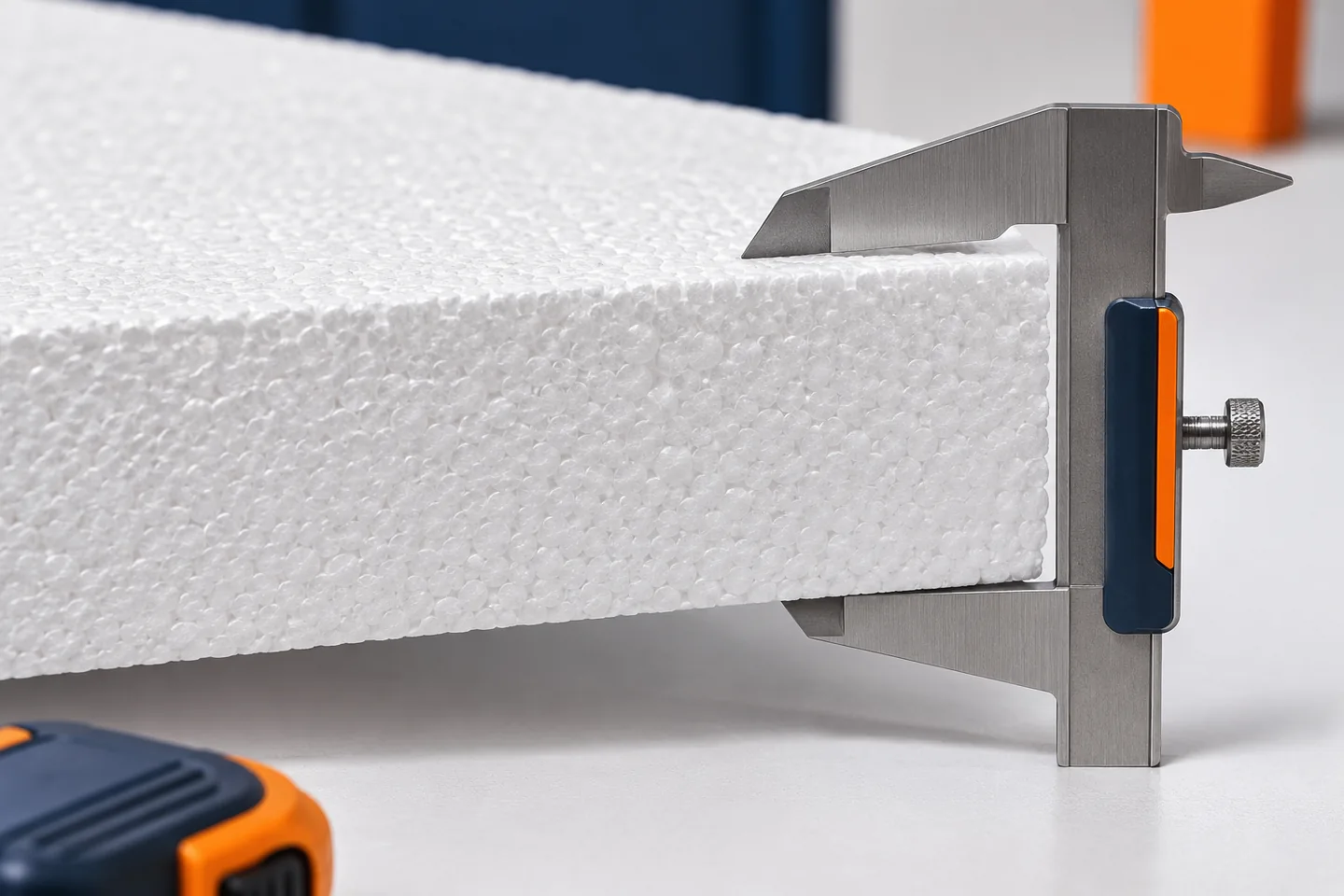
Thermal resistance shows how a layer of polystyrene restricts the flow of heat. For a simple calculation you need the thickness and the appropriate lambda. The most common mistake is using centimetres instead of metres or confusing R with the U-value. We show the individual steps, a comparison of thicknesses and the rules for adding up several layers. First, establish the thickness of the material. The calculation uses metres, so 15 cm is 0.15 m and 200 mm is 0.20 m. Next, read off the thermal conductivity λ in W/(m·K). To compare boards on a common basis, you can use the declared values. A design calculation should use data appropriate to the conditions of application.
What data are needed for the calculation?
Check the exact designation of the product. Two boards of the same thickness and colour do not have to have an identical lambda value. Do not copy values from a random page describing an entire group of materials. What is needed is the data sheet or declaration for the specific variant. When a delivery includes several types of EPS, calculate their thermal resistances separately according to where they are used.
How do you apply the formula R = d/λ?
Divide the thickness in metres by lambda. For 15 cm and λ = 0.031 W/(m·K), the calculation is 0.15/0.031. The result is approximately 4.84 m²·K/W. For the same thickness and λ = 0.040 W/(m·K), you get 0.15/0.040, i.e. 3.75 m²·K/W. A lower lambda gives a higher thermal resistance here, because the thickness remains unchanged.
Do not enter the number 15 in the numerator if you mean centimetres. Such an error will overstate the result a hundredfold. The unit m²·K/W helps you check whether you are calculating the right quantity. Do not replace it with W/(m²·K), because the latter belongs to the thermal transmittance coefficient. A seemingly similar notation describes heat flow through the building component in the opposite way.
How do you compare different EPS thicknesses?
With the same lambda, a layer twice as thick has twice the material resistance. For example, 10 cm of EPS with λ = 0.036 W/(m·K) gives approximately 2.78 m²·K/W, and 20 cm gives approximately 5.56 m²·K/W. This is a linear relationship for a homogeneous layer. It does not mean that the heating bill for the whole house will fall by exactly half.
When thickness and lambda change, compare the quotients rather than individual numbers. A 20 cm layer at λ = 0.040 has R = 5.00 m²·K/W. The same resistance of the boards alone is given by 15.5 cm at λ = 0.031. In practice, you have to select an available dimension and check the other requirements. This is a thermal comparison, not proof that the products are interchangeable in every application.
Can the thermal resistances of several layers be added together?
For successive homogeneous layers in a simple arrangement, their thermal resistances are added together. If you install 10 cm of EPS with λ = 0.040 and 10 cm with λ = 0.031, you get approximately 2.50 + 3.23 = 5.73 m²·K/W. You should not calculate a simple average of the two lambda values and apply it without thinking. The clearest approach is to calculate each layer separately.
The arrangement must correspond to the assumptions of the calculation. Cavities, thermal bridges, non-homogeneous elements and other directions of heat flow may require a more detailed method. Two layers of EPS should have stable support and correctly positioned joints. The result from the calculator alone does not confirm the quality of the workmanship. The mechanical properties of the whole stack must also be checked independently of its thermal resistance.
How does the calculated result differ from the RD on the label?
The manufacturer may state a declared thermal resistance RD for a specific thickness. This value results from the rules for declaration and rounding. Simple division on a calculator may produce more digits than the product table. This does not automatically mean the documentation is wrong. To identify the declared properties, use the value recorded in the relevant document.
In comparative calculations, do not round too early. Keep several digits in the intermediate steps and give the final result with reasonable accuracy. A small difference in the third decimal place is often less important than the actual thickness or a gap in the insulation. Do not base a purchasing decision on apparent precision that the input data do not support.
What does the thermal resistance of the polystyrene alone not settle?
The R of the layer is not yet the Uc of the whole wall. The remaining layers, surface resistances and appropriate corrections are needed. For a floor on the ground, rules that take geometry and the ground into account are also added. Nor does the result determine the load-bearing capacity of EPS, its water absorption or its compliance with ETICS. Each of these issues requires separate information.
EPS boards with different lambda values are produced by, among others, Yetico, Styropmin, Termo Organika and Swisspor. The calculation must use the data for the specific grade of material.
Record the result together with the assumptions: thickness, lambda and place of application. This makes it possible to check it after a change of offer or design. The number R on its own quickly loses meaning. A simple calculation is very useful if it remains a tool for comparing the layer and does not replace the assessment of the whole building element.
7 branches. Materials closer to your project.