Insulation and thermal insulation
Roof insulation: comparing PIR, EPS, XPS and mineral wool
In brief
The choice of roof insulation depends primarily on the available thickness and the required thermal resistance, not on the material name alone. Check whether a layer with the necessary lambda can fit in the given space and whether the product has declared mechanical and fire properties for the specific assembly. PIR can achieve high thermal resistance with a relatively thin layer, but it does not replace XPS in areas of prolonged water exposure. EPS comes in many variants, while mineral wool stands out for fire and acoustics. Compare complete options, not just board prices.
Why does a small thickness favour PIR?
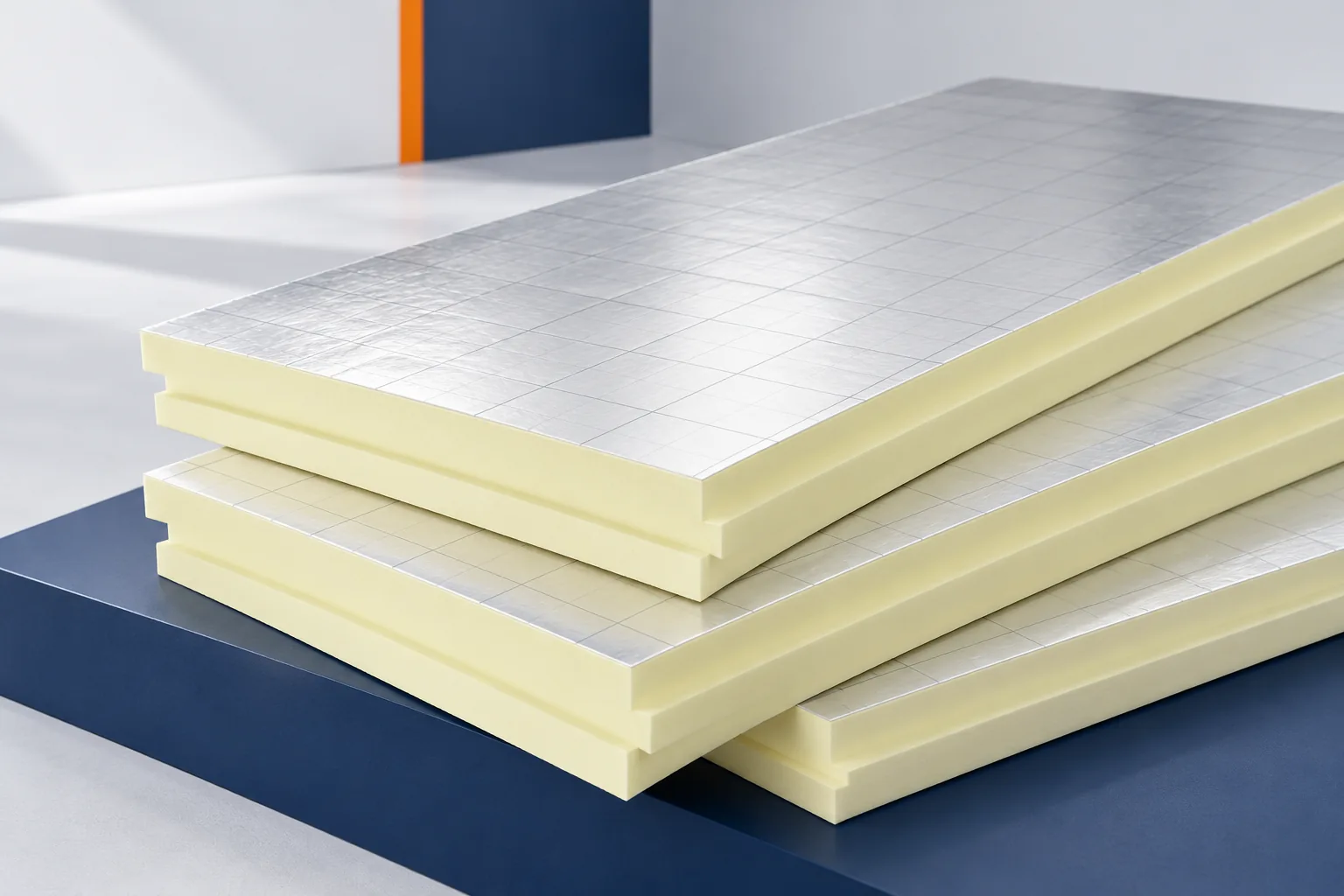
The basic thermal parameter of a material is the thermal conductivity coefficient lambda. At the same thickness, a lower value gives greater thermal resistance. For an example PIR board with a thin aluminium facing, the declared lambda is 0.022 W/(m·K). This allows the insulation thickness to be reduced compared with a material with a higher lambda, if the other conditions are the same.
A smaller thickness is useful at the eaves, thresholds, parapets and when renovating a loft. It can make it easier to connect the insulation with windows or to preserve usable space. However, it does not mean that an arbitrarily thin board will meet the building’s requirements. The required thickness results from a calculation of the entire building element. Thermal bridges and gaps can significantly change the final result.
When is EPS a sensible choice?
EPS is a broad group of products with different parameters. Individual grades differ in lambda and mechanical resistance. A material chosen for a façade does not necessarily suit the loaded layers of a roof. For roof application, the intended use, compressive stress and long-term load conditions must be checked. The name “styrofoam” alone does not identify the required product.
Where greater thickness is available, EPS can be an economical solution. However, the cost comparison should include the layer that provides the required thermal resistance and all additions. It is not enough to compare the price of boards of identical thickness. If thicker insulation requires raising the flashings or changing the details, these works also form part of the cost of that variant.
Will XPS always be better in a damp location?
XPS is often chosen for systems requiring low water absorption and adequate compressive strength. This does not remove the need to select the product for the application. The declared properties, conditions of water exposure and the type of load are checked. In an inverted roof, the material must meet the requirements of such a system, not merely have a name associated with moisture resistance.
PIR may compare favourably in terms of thermal thickness, but it does not automatically replace XPS in zones of prolonged water exposure. The type of facing and the required method of protecting the board matter. The roof should drain water, and the insulation should remain under the conditions permitted by the manufacturer. The phrase ‘closed cells’ is not sufficient as an application instruction.

What speaks in favour of mineral wool?
Mineral wool is sometimes chosen because of fire requirements and its contribution to improving the acoustics of the building element. However, it comes in various forms and densities. A flexible mat between rafters is not a substitute for a board intended for the loaded layer of a flat roof. The parameters should be read for the selected product and the complete solution.
PIR is an organic material and should not be presented as non-combustible. The reaction-to-fire class of an insulation board is not the same as the fire resistance of the entire assembly. Likewise, the steel facings of an insulated sandwich panel do not allow the type of core to be disregarded. Where the project sets fire requirements, the relevant system classifications must be compared under the specified installation conditions.
How to match the material to the roof insulation method?
Between the rafters it is easier to lay a material that fills the space precisely. A layer above the rafters can in turn limit the thermal bridges created by the timber. Rigid PIR boards fit well into selected above-rafter systems, but require designed fixings. The weight of the covering and the wind forces must be transferred to the structure. The insulation alone is not a supporting frame for the sheet metal.
On a flat roof, the substrate, the loads and compatibility with the waterproofing layer are what matter. Not every adhesive or welding method suits every panel facing. On a roof with structural trapezoidal steel sheet, the support of the insulation must also be checked. An even drawing of the layers in a diagram does not replace the detail of the penetration through the ribs and the areas at the parapets.
How to compare quotes without mixing up parameters?
Ask for the lambda, thickness, intended use, mechanical parameters and installation requirements. For the whole roof, a thermal, moisture and fire assessment is needed. Include the sealing layers, tapes, fixings and labour in the price. The high thermal resistance of the board alone will not help if air flows freely through gaps beside it.
PIR is worth considering especially where good insulation is needed within a limited thickness. EPS, XPS and mineral wool may be the more appropriate choice under other conditions. A sound decision comes from comparing complete variants. It does not require accepting one material as the best for every roof and every part of a building.
7 branches. Materials closer to your project.