Polystyrene and thermal insulation
What does the reaction-to-fire class of an EPS board tell us?
At a glance
The reaction-to-fire class describes the behaviour of a product under specified test conditions. For many EPS boards this is class E. It should not be confused with the classification of the finished ETICS, the fire resistance of the wall or the assessment of the roof. We explain these differences and show which documents to check before selecting the insulation and carrying out the works. Class E is a declaration of the reaction to fire of a specific product under specified conditions. It does not mean non-combustibility. EPS is an organic material and requires application in accordance with the design and the documentation. The data on the label must be read together with the scope of the classification. The symbol alone does not determine whether the board is suitable for every building and every building component.
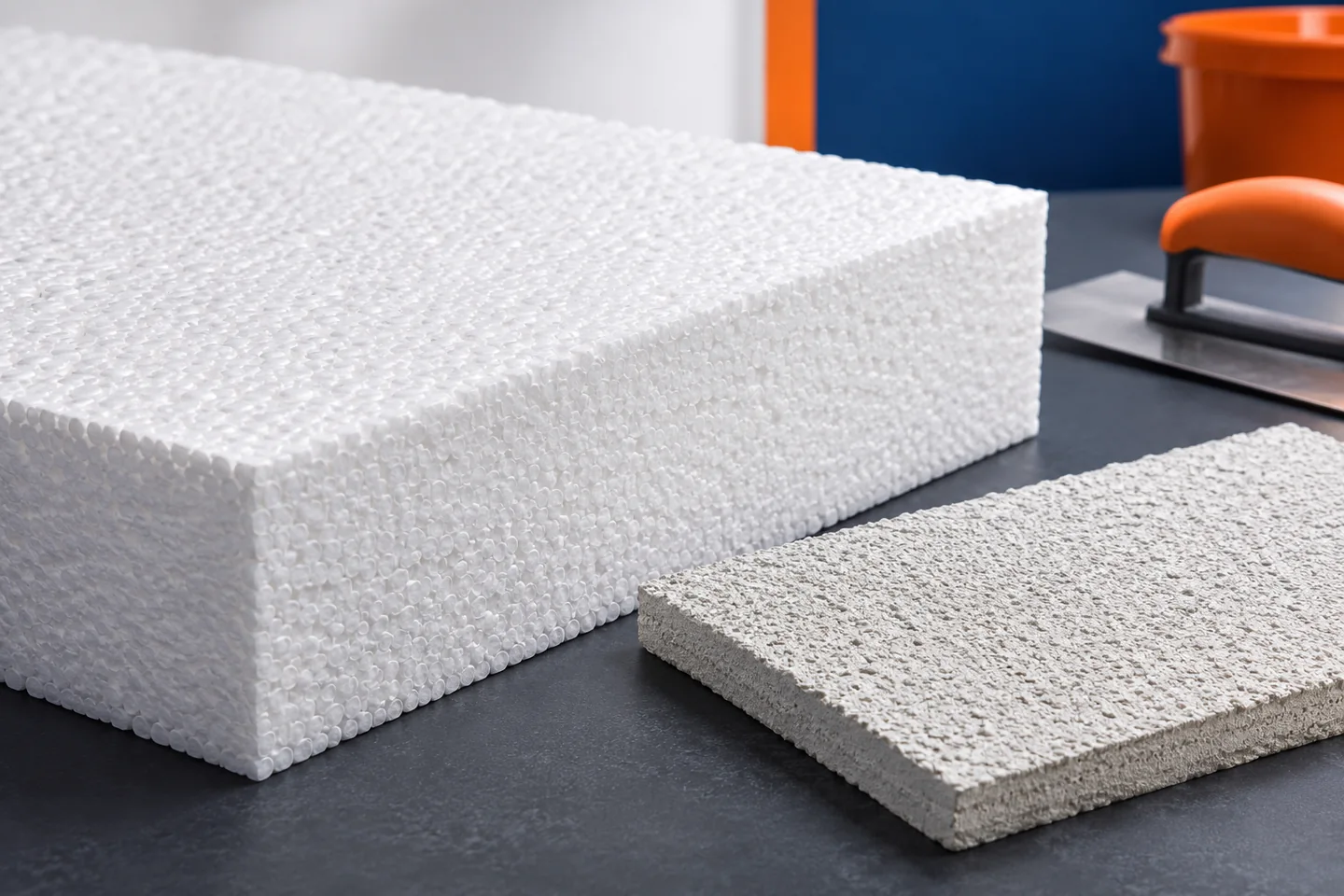
What does class E mean for EPS board?
The term “self-extinguishing” should likewise not be understood as resistance to any fire. It does not permit boards to be left near an open flame, nor does it allow protective layers to be omitted. The behaviour of the material depends on the conditions of exposure. In practice, the most important thing is to use the product in a solution whose requirements and method of execution have been properly specified.
Why can ETICS have a different class?
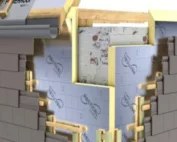
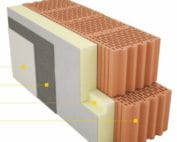
The complete system comprises EPS, adhesives, mesh, reinforcing layer and render. It is a defined assembly that is tested and classified. Its behaviour is not the same as that of the exposed board. In system documentation, classifications such as B-s1,d0 may be found, for example. This applies to a specific set and to conditions that must be checked in the relevant document.
The letter and additional designations describe various aspects of reaction to fire, including smoke and burning droplets or particles. The classification must not be transferred to any arbitrary mixture of materials from different sets. A change of render, layer thicknesses or other components may go beyond the assessed scope. A good EPS board does not by itself confirm the class of the entire completed thermal insulation system.
How does reaction to fire differ from fire resistance?
Reaction to fire describes the contribution of a product to the development of a fire under test conditions. Fire resistance refers to the behaviour of a building element over a specified time and may include loadbearing capacity, integrity and thermal insulation. These are different issues. The class E of a board is not the fire resistance time of a wall and does not by itself allow such a time to be calculated.
Fire spread in the relevant applications is also assessed separately. The designation NRO does not mean that every material in the assembly is non-combustible. It is necessary to check what the classification refers to and in which configuration it applies. Abbreviations seen in advertising should not replace the documents describing the exact scope of the façade or roof solution.
How should information about the roof be read?
A roof has its own layer build-up and separate exposure conditions. A designation relating to external fire, such as BROOF(t1), applies to the assessed roof solution. It should not be attributed to every EPS board used beneath the covering. What matters is the waterproofing, the substrate, the insulation and the other components listed in the classification.
Likewise, a board with a bituminous facing does not become non-combustible by definition. Its use must be compared against the roof documentation. If the covering or the method of fixing is changed, it is necessary to check that the required properties are maintained. Fire performance and thermal performance describe different aspects. A low lambda gives no information about the permissible layer build-up from the point of view of fire.
What changes safety during installation?
Store and install exposed boards away from sources of ignition and excessive heat. Pay attention to burners, welding, hot tools and other work being carried out nearby. The finished solution may have protective layers that are not yet present at the construction stage. Work organisation should take this difference and the proper protection of materials into account.
Do not use arbitrary solutions at chimneys or hot installations. Distances, shields and the type of material follow from the design and from the documentation of the appliances and flues. EPS is not a material for arbitrarily filling spaces next to a heat source. Openings made later in the finished building element should also retain the required fire solutions.
How can the choice be verified without confusing classes?
Establish the requirements for the specific building and building element. Then check the board’s declaration, the system documentation and the relevant classifications separately. Pay attention to the thickness range, the components and the installation conditions. Finding the right symbol in a catalogue is not enough. It must relate to the solution that is actually going to be installed.
EPS boards are produced by companies including Termo Organika, Swisspor, Arbet and Austrotherm. Reaction-to-fire classes must be read from the documentation for the specific products.
When changing the material or carrying out a refurbishment, return to the project requirements. The selection rules may depend on the function and geometry of the building and on the regulations applicable to the project. They cannot be reduced to a single sentence about the flammability of polystyrene. A reliable assessment distinguishes between the property of the board, the performance of the entire system and the requirements placed on the building element.
7 branches. Materials closer to your project.