Polystyrene and thermal insulation
How to read the declaration of performance for EPS insulation
In brief
The declaration of performance lets you check which characteristics the manufacturer attributes to a specific product. It contains the identification of the board, the basis of assessment and a table of parameters. However, it is not an insulation design. We explain how to read the document, what NPD means and what to do when the label, the technical data sheet and the declaration do not agree. Compare the product name and code with the delivery label. A manufacturer may offer many boards with similar names but different lambda values and mechanical properties. The version of the document and the range of thicknesses are also important if they affect the declared data. A file found for an earlier variant does not necessarily describe the material just delivered to the construction site.

First, make sure you are reading the right document
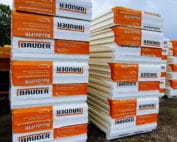
Check the declaration number and the manufacturer’s details. They make it easier to link the documentation to a specific product. Do not rely solely on a photo of the front of the pack or a shortened name from the shop’s offer. Keep the legible label, the invoice and the relevant document together. If questions about the parameters arise later, such a set makes it possible to avoid searching for the product on the basis of how the boards look.
What do the intended use and the standard say?
The declaration states the intended use of the product and the basis for describing its properties. For factory-produced EPS boards for the thermal insulation of buildings, EN 13163 often appears. Information about insulation in construction does not yet mean suitability for every building element. Detailed selection requires checking the parameters, the instructions and the requirements of the project.
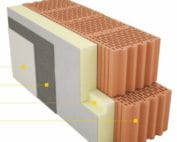
Do not treat the board’s document as the declaration of the entire ETICS system. The façade system has its own documentation covering the interacting components. Similarly, a defined roof assembly may require separate classifications. Each document answers a different question. Combining several materials that have declarations does not automatically prove that an assessed system assembly has been created.
How do you read the table of properties?
Start with the characteristics needed for the given application. Check λD and RD, if it is given. Then read the mechanical, water-related and geometric parameters and the reaction to fire. Pay attention to the units and the inequality signs. A value of “not more than” has a different meaning from a declared level of “at least”. It is not enough to copy the number alone.
TR100 denotes a different type of load from CS(10)100, despite the identical number. Likewise, the percentage for WL(T) is not a percentage change in lambda. If the table contains different values for thicknesses or variants, select the correct row. To compare two offers, data relating to similar conditions are needed. Juxtaposing random columns can lead to an incorrect choice.
What does the abbreviation NPD mean?
NPD means that no declared performance has been determined for a given characteristic. It is not a result equal to zero, nor confirmation that the phenomenon does not occur. If NPD appears next to water absorption, the board cannot be regarded as completely non-absorbent. Where NPD concerns creep, no arbitrary long-term load may be assumed on that basis.
The absence of a declaration must be set against the requirements of the application. Not every characteristic is equally important in every building component. If, however, the design requires a specific result, you need the relevant data or a different product. Clarify this before installation. A later attempt to reconstruct the properties of a covered material can be costly and will not always give an unambiguous answer.
What should be done if the data conflict?
Compare the versions of the documents and the exact designations. The difference may result from an update, a mix-up of variants or an error in the table. Do not automatically choose the more favourable number. If the data sheet states a different level of water absorption from the declaration, an explanation from the manufacturer is needed for the specific delivery. Until the matter is resolved, do not assume that the more demanding application is met.
Record what discrepancy was noticed and keep both versions of the documents. This will make it easier to obtain a precise answer. A general description on a website alone may be too brief for assessment. The declaration, in turn, does not replace all installation instructions. A material may have correct parameters yet require a specific adhesive, covering, support or protection from the sun.
How can the document be used at acceptance?
Compare the data with the design and check that the correct board has been installed in the correct part of the building. The documentation confirms the declared characteristics of the product, but not the quality of the bonding or the continuity of the insulation. The acceptance inspection should therefore also cover the workmanship. The labelling and the declaration are not a promise that an arbitrarily installed EPS will deliver the required performance of the entire building envelope.
Well-known EPS manufacturers include Polstyr, Austrotherm, Yetico and Termo Organika. The document should be matched to the specific product and its identification.
Keep the declaration together with the technical data sheet, labels and photographs taken before covering. If the supplier or the variant changes, repeat the comparison. This is a simple step that helps avoid accidental substitution of material. The greatest value comes from reading the document against the specific requirements of the project, rather than treating it as an attachment needed only for the file.
7 branches. Materials closer to your project.