Sandwich panels and façades
How to choose a durable external window sill
In brief
Follow the water from the glazing, down the frame and across the sill when choosing an external window sill. A suitable outward fall, a drip edge clear of the façade and a sound junction with the window matter more to durability than the colour or finish. Select the coating once these details have been settled. On a refurbishment, lift the old sill and inspect what supported it. An uneven or poorly formed base may let water reach the wall long before a stain appears on the visible surface.
What should a good window sill do?
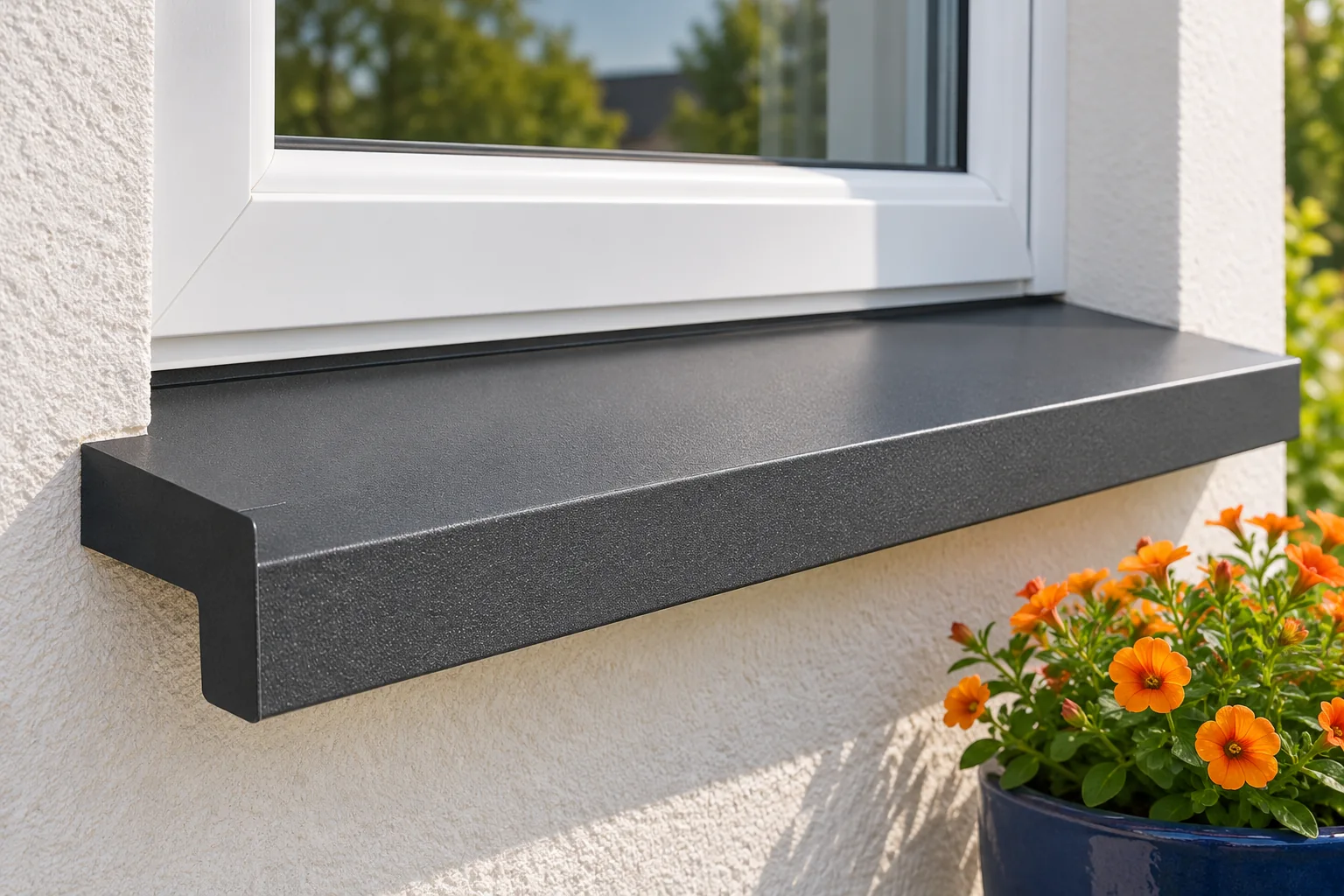
Water from the glass and frame lands on the surface of the window sill and should then drain away to the outside. The formed front edge detaches droplets from the underside and limits trickling down the render. This detail is called a drip edge. If the edge is too close to the façade or has the wrong shape, water can return under the window sill. A nice surface will not compensate for incorrect geometry.
The window sill does not seal the entire window-to-wall connection on its own. Proper layers are also needed in the area under the frame and at the sides. An inaccuracy hidden under the metal sheet can lead to dampness without a clear trace on its top. Therefore, the choice of material should be combined with determining the installation method. During renovation, it is worth inspecting the condition of the substrate after removing the old element.
When does coated steel work well?
A steel window sill has a low mass and can be adapted to various recess widths. The coating can reference the roof, windows or façade flashings. This is a practical solution when consistency of finish is important. However, the type of surface protection must be determined, not just the shade. Conditions by the street, near plants or in a damp location may increase maintenance requirements.
The metal sheet requires stable support so that it does not deflect excessively or work loudly under precipitation. The installation method should correspond to its width and the instructions. It is not worth choosing a product solely on the basis of sheet thickness. Edge profiling, the substrate and the execution of connections are important. The final performance depends on all these elements together.
How to determine length and width?
The measurement should take into account the finished façade thickness, not just the wall before insulation. The window sill must extend beyond the face of the render and have appropriate side terminations. The way it is inserted at the frame also affects the width. It is worth measuring every opening, even if the windows are nominally identical. Differences in the execution of reveals may be visible after installing evenly cut elements.
The length is determined taking into account the type of terminations and the required space for thermal movement. A metal window sill should not be pressed between the reveals to a butt joint. Temperature causes dimensional change, and rigid blocking can lead to stresses and cracks in the render. The correct detail allows tightness to be maintained without immobilising the entire element. The specific clearances result from the installation solution.

How to connect the window sill to the window?
The rear edge and seals must work together with the frame construction. The window drainage openings must not be covered. Water from the profiles must be able to escape to the outside. Accidental positioning of a high flashing or a thick layer of sealant can close this path. It is worth checking the window documentation, especially when replacing the window sill without replacing the window.
The substrate should be prepared and dry to the extent required by the materials used. Adhesives, tapes and sealants must be suitable for the surface and for external conditions. Not every sealant adheres equally well to every coating. A joint made on a dirty or wet substrate may look correct and later come unstuck. Waterproofing should be continuous in the corners as well.
What mistakes should be avoided with the façade?
A common problem is the lack of a fall to the outside. Water then collects at the window or in a local depression. Another mistake is rigidly plastering the sides without allowing for their movement. The end pieces are not there for decoration alone. They can direct water and separate the metal from the façade layers. They should be selected for the specific sill, not forced to fit from a random set.
During further plastering work, the surface should be protected against soiling and scratching. The factory film has a defined removal time and must not remain in the sun indefinitely. After the work is completed, waste is removed without scraping with a sharp tool. Particular care is needed with dried mortar. An accidental solvent can damage the coating more than the soiling itself.
How to assess the result and maintain the window sill?
Check that water drains to the outside and that no open gaps remain at the frame and sides. The sill should be stable and not deform under a light, accidental touch. It is not, however, a shelf to stand on while cleaning the window. The type of support and its intended purpose do not allow for arbitrary human loading. Access to the windows should be organised separately.
During cleaning, dust, leaves and soiling are removed with a soft cloth and a product suitable for the coating. It is worth checking the joints after winter and after work on the façade. A small scratch or detached sealant is easier to repair before the substrate becomes damp. A durable sill is a combination of the right material and a detail that effectively drains water through the coming seasons.
7 branches. Materials closer to your project.