Insulation and thermal insulation
What is a roofing underlay membrane and which properties matter?
In brief
A roofing membrane is a layer under the covering that protects against water and allows water vapour to escape. When selecting its parameters, check above all the product’s intended use, diffusion resistance Sd, waterproofness and mechanical strength. Grammage alone is not enough for assessment. The key decision variable is compatibility with the temperature under the covering, the type of substrate and the planned installation time. Remember that the membrane does not replace the metal sheet or the internal airtight layer, and its strips and joints must form a continuous layer.
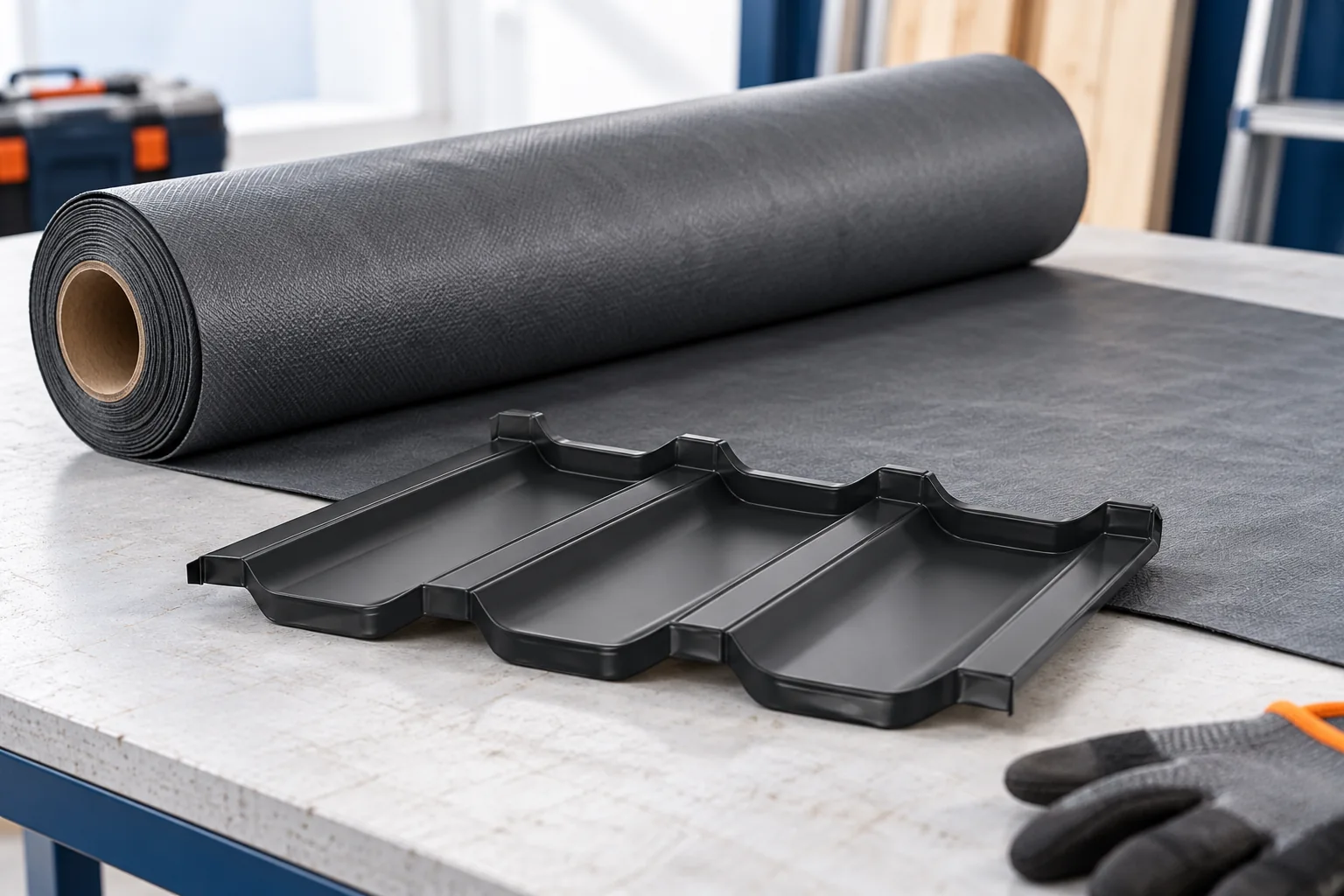
What work does the membrane perform beneath the covering?
Small amounts of water can get in through laps and openings in the covering. Moisture also appears as condensation on the underside of the steel sheet. The membrane provides an additional drainage path for this water to the eaves. Its strips, flashings and connections should therefore form a continuous layer. A gap at the chimney can undo the effect of careful laying across the entire remaining surface.
The second task is to allow the roof layers to dry outwards. A membrane with low diffusion resistance lets water vapour through but does not ventilate rooms. Moisture from the kitchen or bathroom is removed by the building’s ventilation. An airtight layer on the inside, in turn, limits the inflow of humid air into the assembly. Each of these elements has its own function.
What does the Sd value mean?
Sd describes the resistance to water vapour diffusion. It is given in metres of equivalent air layer. A lower value means vapour passes more easily through a given material. It is not, however, a standalone assessment of the quality of the whole roof. The selection must be matched to the other layers, the indoor humidity and the way the ventilation gaps are made.
In the data sheet of an example membrane under steel coverings, Sd equals 0.04 m. This is a parameter of a specific product, not a mandatory value for every roof slope. It should not be compared directly with the designation of a vapour barrier film. The latter layer is located elsewhere and is intended to limit vapour flow. Swapping the materials can trap moisture inside the insulation.
Does a higher grammage mean a better choice?
Grammage specifies the mass of one square metre of membrane. It says something about its construction but does not reflect its full mechanical resistance. In the documentation, also look for tensile strength and tear resistance at the fastening points. Both axes of the material matter. A stronger membrane can make work easier on a difficult roof, but it will not fix incorrect laps or damage.
Check the watertightness class and the permitted type of substrate separately. A material intended for laying directly on insulation does not always have the same conditions of use as a product on full boarding. The roofer should know this difference before opening the rolls. A choice based on the phrase ‘thick roofing film’ leaves too many important properties unanswered.

How do you allow for sun and temperature beneath the steel sheet?
UV stabilisation provides limited protection during construction. It does not mean the membrane may be left without covering for an arbitrarily long time. From the documents of a specific product, the permitted exposure and the protection conditions, including from below, must be read. If the general description and the instructions differ, clarify the requirements before starting work.
Under dark steel sheet, summer conditions differ from those in a shaded loft. The service temperature range should match the roof build-up and the covering requirements. Do not choose a product solely on rain resistance. The condition of the rolls also matters: how they have been stored, absence of cuts and no prior prolonged exposure to sunlight.
Where are installation mistakes most likely?
Roof valleys, windows, chimneys and service penetrations require particular attention. In these locations, continuity of drainage and tightness of connections must be maintained. Laps are made in accordance with the instructions, taking into account the roof pitch. Tapes and sealants should be suitable for the given substrate. Ordinary packing tape is not a durable substitute for roofing material.
Counter-battens create the space required in a ventilated build-up. Laying the membrane alone does not allow the inlet at the eaves or the outlet at the top of the slope to be blocked. Nor should it be tensioned or laid with slack according to random habit. The method of laying, fixing and sealing penetrations follows the instructions and the adopted design for the entire roof.
What should be clarified before ordering rolls?
Prepare information on the covering, pitch, insulation and deck. Establish whether the loft will be heated and when the roof will be closed. Add laps and details to the purchase area, not just the outline of the roof slope. Also order the correct tapes, collars and sealants. Saving on these accessories can make it difficult to achieve continuous protection against water and draughts.
After laying the membrane, it is good practice to take photographs before fixing the covering. They allow the course of the layer at the eaves and around openings to be checked. Any damage is repaired with materials specified for the given system. Fleece bonded to the underside of the steel sheet is not an automatic substitute for the membrane: it retains condensation temporarily and must have conditions to dry out.
7 branches. Materials closer to your project.