EPS insulation and thermal insulation
Profiled or square-edged EPS boards: how to choose
At a glance
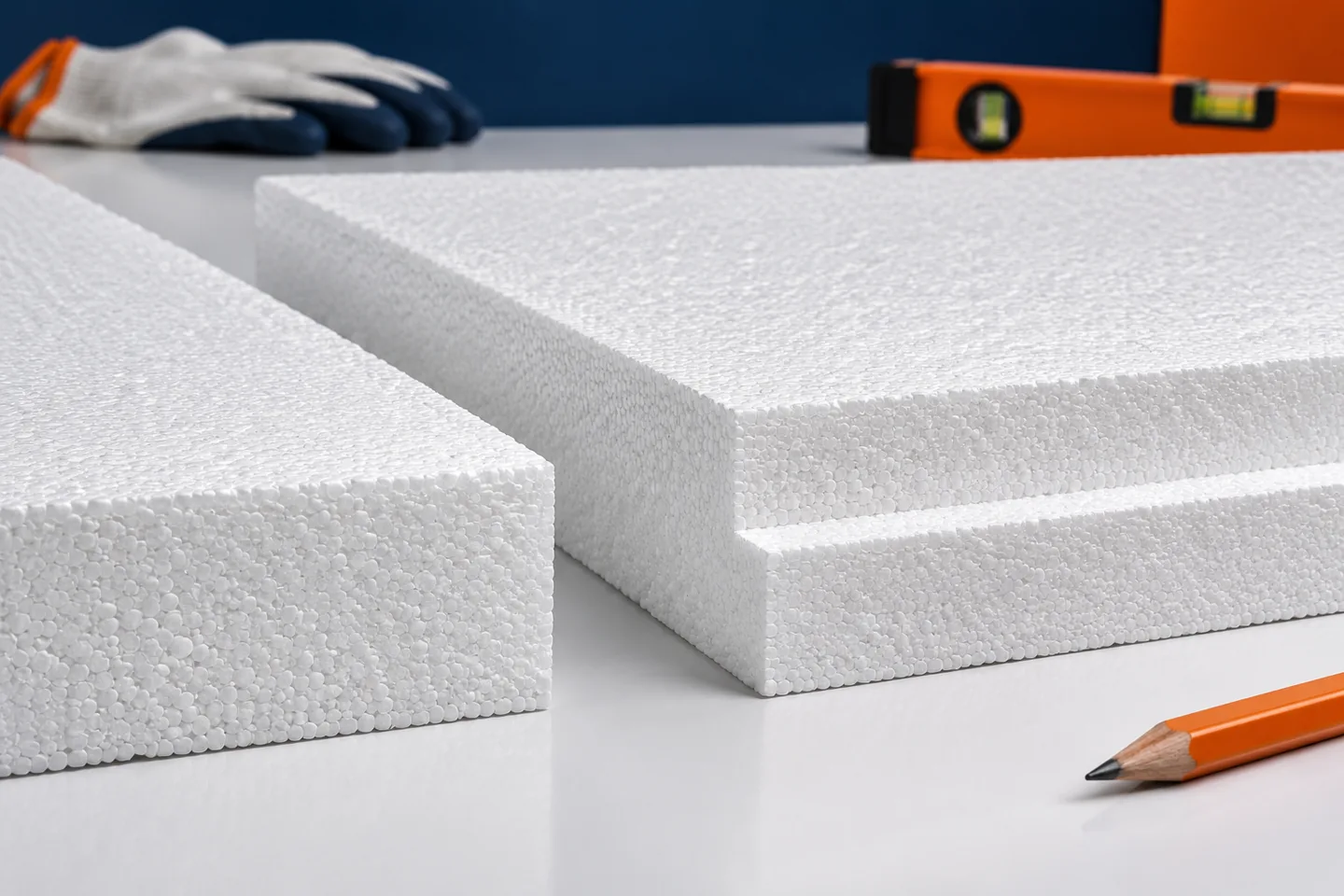
A square edge and a rebated overlap profile are two real ways of finishing EPS boards. They differ in how they are joined, but neither removes the need for careful installation. We explain when a profiled edge helps, how to calculate the covering area and why the profile alone neither improves lambda nor creates waterproofing. A board with a square edge meets the adjacent element side to side. A board with a rebated overlap profile has a correspondingly shaped edge that overlaps the edge of the next board. The exact profile dimensions depend on the product. It should not be assumed that every edge profile has the same shape or that it is a tongue-and-groove joint.
What is the difference between the edge types?
It is worth checking the name in the technical drawing.
A profiled edge can lengthen the path of any gap through the insulation layer. However, it does not guarantee the complete absence of thermal bridges. The boards must be properly fitted, stable and laid in accordance with the design. A crumbled rebate or a gap left behind can negate the intended effect. The factory shape helps during installation, but it does not make the joint on the crew’s behalf.
Does the edge profile change the insulation performance of the material?
The edge treatment alone does not lower the lambda of EPS. If the material and thickness remain the same, the thermal resistance of the homogeneous part of the board still follows R = d/λ. The difference concerns the design of the joint. A board with a profiled edge cannot be regarded as warmer simply because it has a more elaborate profile. Data for both specific products are needed for comparison.
For the same reason, the insulation thickness should not be reduced arbitrarily after choosing a profiled edge. The design effect depends on the entire system. A well-made joint limits discontinuities, but it does not replace the required amount of material. When comparing offers, separate the thermal characteristic from installation convenience and geometry. This allows you to assess what you are actually paying for.
When are square edges practical?
Boards with straight edges are easy to cut and adapt to many geometries. In a multi-layer system, the joints of successive levels can be offset. This solution is often used in floors and roofs if it corresponds to the design. However, this does not mean that every configuration of two thin boards will be equivalent to a single thicker one in all properties.
On a façade, a square edge requires the joints to be pressed together precisely and the boards to be laid out correctly. Mortar should not get between the elements. Gaps are repaired with the material and method specified in the system. The layout around openings, corners and movement joints remains important regardless of the edge. A square-edged board is not inferior by definition if it meets the requirements of the solution.
When is it worth considering a rebated edge?
A rebate can make it easier to maintain continuity of the joints in a given layout. It occurs, among other things, in boards for façades, floors and foundation zones. The choice depends on the documentation and the operating conditions. Not every variant is offered with a rebate in every thickness. Before ordering, check the actual availability of the dimension instead of assuming that any combination is possible.
In foundations, a profiled edge does not replace waterproofing. Water can reach the joints and other details. The correct scope of application of the board, suitable water absorption and protection of the wall are still needed. Do not buy a material solely on the basis of a picture of the rebate. The drawing shows the shape, while the documentation defines the properties and application limits.
How do you calculate the area of a pack?
Check whether the stated dimensions refer to the nominal size, the overall size or the effective coverage. The rebate can affect this difference. It is safest to use the pack area declared for the specific variant. Do not automatically convert every board to 0.5 m². Formats other than the popular 1000 × 500 mm are also available on the market.
Compare the price per area required to install the same insulation thickness. Allow for cuts at corners and openings. A board with a larger format may reduce the number of joints, but in a small or irregular area it may lead to different offcuts. The final quantity depends on the layout. It is worth drawing up a simple plan before you order full packs.
What should you watch out for when cutting and transporting?
The rebate is often more susceptible to local crumbling than a full edge. Protect the edges during handling and storage. After cutting a board, the factory profile may disappear. The new joint must be prepared in accordance with the layout and the instructions. Do not assemble an important corner from damaged offcuts just because most of their surface looks correct.
Boards with different edge finishes are offered by, among others, Arbet, Termo Organika, Yetico and Austrotherm. The shape and dimensions must be confirmed for the selected product.
Before applying the next layer, accept all joints. Check the fit, gaps and stability. If the rebate makes it difficult to push the board into place because of dirt or damage, remove the cause instead of forcing the board. Quality is determined by the finished joint and the conformity of the entire system with the design, not by the mere mention of a profiled edge on the pack.
7 branches. Materials closer to your project.