Sheet metal and roofing
When should you choose long tile-effect metal roofing sheets and when small modules?
In brief
The choice between a made-to-measure sheet and a module starts with the roof drawing. On a wide rectangle, long elements can simplify the layout. With numerous slopes, small modules make cutting and handling easier. There is no single winner for every roof shape. It is worth comparing two covering plans for the same roof slope. Most often it concerns selecting the sheet length within a given profile. The width and rhythm of the profiling remain determined by the product. A made-to-measure order therefore does not mean any rectangle with any arrangement of waves. The length must take into account the module, the ends and the production rules.
What does made-to-measure tile-effect metal roofing really mean?
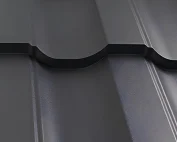
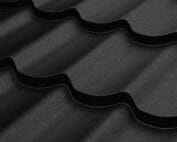
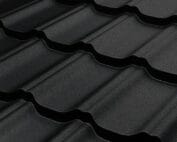
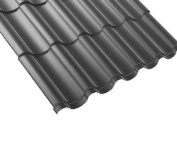
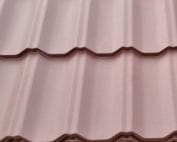
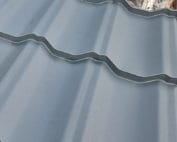
An example long sheet has a longitudinal module of 350 mm and a cover width of 1105 mm. Its limiting lengths and required pitch are set out in its own documentation. A modular version with a similar profile may have different conditions of use. Do not transfer the minimum angle from one format to another simply because the coverings look similar.
How does the format affect a simple roof slope?
On a roof slope without openings, sheets running from eaves to ridge can be considered. This limits the number of transverse joints. However, the recommended length for the given profile and the feasibility of handling the elements must be checked. A very long sheet is more easily damaged by incorrect lifting.
Assume a roof slope width of 7.50 m and a cover width of 1.105 m. Seven strips are needed, giving 7.735 m of nominal coverage. The remaining 0.235 m must be planned at the edges. The number of strips will be similar for modules of the same cover width. The difference lies primarily in the division along the pitch, the number of elements and the way they are joined.
What happens at roof valleys, corners and dormers?
On a hip or diagonal edge, part of the sheet is cut off. With a large format, the offcut may have a considerable area, but it cannot always be turned around and used on the other side. The direction of the profile and the position of the lap are obstacles. Reuse of the cut piece should not be assumed without checking the drawing.
Small modules limit the size of individual pieces. They make it easier to fit short sections of roof slope and to transport onto the roof. At the same time, they create more transverse joints. Their layout must comply with the instructions. Choosing modules does not remove the need for cutting plans. On a complex roof, it is worth drawing each row, especially next to windows and narrow dormers.
How to compare the quantity and price of both variants?
Prepare two schedules for an identical roof. In the first, enter the lengths and number of sheets. In the second, enter the number of modules together with their effective coverage. Compare the purchased area, the planned cuts and the possibility of using the remaining pieces.
For both variants, add flashings, fixings, transport and labour. Do not assume the same lifting cost. Do not compare the price per module with the price of long sheet per metre without converting. On a small roof, the difference of a few full elements may matter more than a small difference in unit price. It is also worth establishing the cost of any subsequent order for missing parts.

When can site conditions determine the format?
On a narrow plot, a long sheet may be difficult to turn and pass up to the roof slope. Fences, trees, cables or the neighbouring wall get in the way. Before choosing the format, check the route from the vehicle to the installation point. Roof dimensions do not describe the whole logistics.
Modules are easier to carry by hand, but the pack still requires proper unloading. A short element can also be scratched or bent. The material must be laid and secured according to the recommendations. When planning the work, take wind into account. A large sheet behaves like a sail, which increases the difficulty of safe lifting and maintaining its shape.
How should repairs and future extension be taken into account?
Replacing a small module and a long sheet requires a different scope of dismantling. Access to the fixings and the laying order of adjacent elements matter. However, do not choose the format solely on the assumption that a small part can always be replaced without disturbing the rest of the covering.
For a planned extension, record the exact profile, coating and colour. Keep the order documentation. In a few years, the available variants may change, and the old surface will already reflect light differently. If a new wing of the house is to be built later, consider clearly separating the roof slopes. Such a solution is often easier to match aesthetically than attempting to invisibly extend the old covering.
Questions before ordering
Is it worth ordering one sheet for the entire slope on every simple roof?
Not always. The permissible length, transport, lifting and installation conditions must be checked. A shorter division may be more advantageous organisationally.
Do modules always mean less waste?
No. The result depends on the shape of the roof slope and the format of the specific module. Less waste must be confirmed on the cutting plan, not assumed as a fixed product feature.
7 branches. Materials closer to your project.