Selecting sandwich panels
Choosing PIR wall panel thickness when insulation and space both matter
In brief
The thickness of a wall PIR panel affects both insulation performance and the dimensions of details. It is not worth choosing it solely by price or by the limited width of the plot. First, the thermal, fire and structural requirements must be established. Only then should you check how the panel will fit at the plinth, around openings and at the boundary of the available space. To assess a panel, its thermal transmittance is used, described accordingly in the data for the variant. Lambda refers to the material, and the R-value of a layer is not the same as the U-value of the complete building envelope. These figures should not be compared in one column without explanation.
Which parameter shows the insulation performance of the finished panel?
Also check whether the data covers a wall or roof panel. The same nominal thickness can give a different result. Establish the exact type of facings and joints. Not every panel described as PIR 100 mm has identical properties and conditions of use.
What does the example of one wall family show?
In an example variant, PIR of 40, 60, 80, 100 and 120 mm have Uc of 0.58, 0.37, 0.27, 0.22 and 0.18 W/(m²·K) respectively. The values relate to that specific panel construction. A different lock or variant may have its own data.
If the project has adopted a target U of no more than 0.20 W/(m²·K), the stated 100 mm panel does not achieve it with the parameter 0.22 alone. The 120 mm version with Uc 0.18 provides a different starting point. This is a comparison with the assumed project target, not a universal statement about a requirement for every building.
How does the heating method affect the choice?
Constant temperature and only periodic heating are different conditions of use. Moisture and the expected time people spend there are added. The requirements must be established for the function of the facility. A thin panel cannot be chosen just because the building is called a garage or warehouse.
Allow for future changes. If you plan a workshop heated later, it is worth checking the target setup straight away. Additional insulation can change the moisture conditions and the method of fixing. It is not always a simple layer that can be added to a finished wall without consequences.
How much space does additional thickness change?
While maintaining the external dimensions of the building, increasing two opposing walls from 80 to 120 mm reduces the internal dimension by 80 mm. This is a purely geometric example, disregarding the other layers and structure. In a narrow passage, such a difference may be noticeable.
If you maintain the internal dimension, the external outline will increase. Then check the positioning and available space. The choice of insulation must be combined with the design of the entire building envelope. Collisions should not be resolved by arbitrarily reducing the panel thickness below the required parameters.

What needs to change for windows, gates and the plinth?
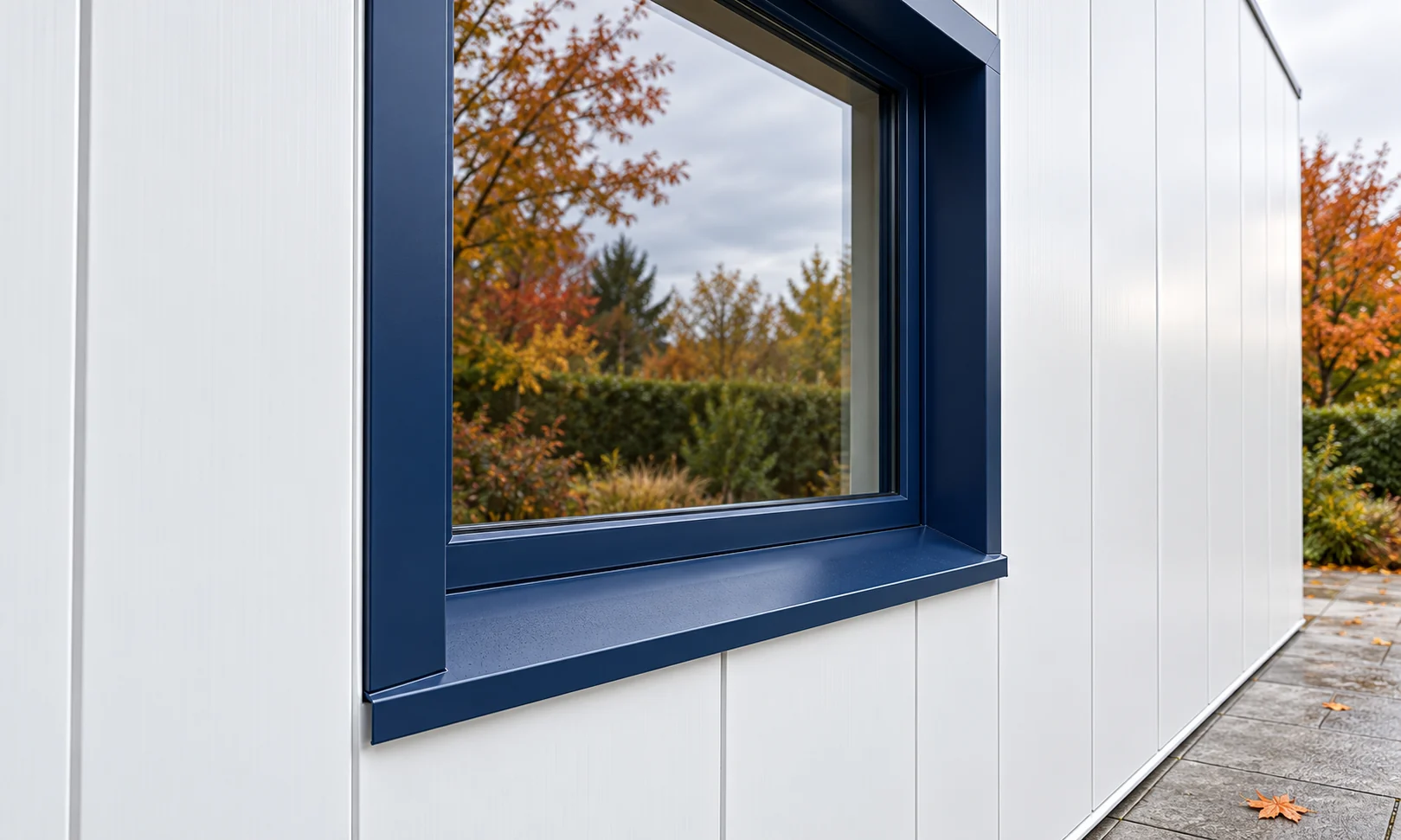
The panel thickness affects the reveals, window sills and the width of flashings. It may change the position of the external face relative to the gate guides. Therefore, when changing the variant, check the detail drawings, not just the screw length. Old flashings may no longer fit.
At the base, the support and closure of the connection are important. At the corner, the continuity of seals must be maintained. Do not reduce the thermal assessment to the panel field alone. Joint locations and point fixings also affect the finished partition and may need to be taken into account in the calculations.
With several windows arranged in one line, check the common level of the window sills and the depth of the flashings. A difference in panel thickness may require adjustment of the detail across the entire façade. It is worth identifying this before manufacturing made-to-measure joinery.
Does a thicker panel automatically meet all requirements?
No. The load-bearing capacity must be verified for the supports, claddings and loads. The fire properties relate to a specific assembly and installation conditions. An increase in thickness alone does not confirm any EI class. It also does not replace the required coating resistance in an aggressive environment.
If necessary, compare several panel families. It may turn out that an important requirement leads to a different core or configuration. The decision should result from a complete list of conditions. One favourable thermal figure does not describe the entire suitability of the wall.
How do you compare the cost of two permissible thicknesses?
Calculate not only the difference in panel price but also the fixings and flashings. Check the impact on cutting and transport. If both variants meet the design, the comparison may also include anticipated operation. However, do not promise specific energy savings without building data.
Before approving the order, record the parameters, lengths and installation direction. On acceptance, confirm that the markings match. The right choice of thickness is one that fits the required thermal insulation and the actual details. Only then can the limited space and budget be assessed reliably.
Questions before ordering
Will a wall made of 100 mm PIR panel meet the requirements of every heated building?
No. The parameter of the specific panel and the project requirement are needed. The thickness designation alone does not give a complete answer.
When changing from 80 to 120 mm, is it enough to buy longer screws?
Not always. The reveals, plinth, flashings, support and the other requirements of the entire solution must be checked.
7 branches. Materials closer to your project.