PIR insulation
PIR boards in renovation: when their construction offers a practical benefit
At a glance
In renovation, PIR boards are often considered because of limited space. Before choosing a thinner layer, however, the condition of the old building element must be checked. The new material will change the conditions under which it performs. Good investigation allows the advantages of PIR to be used without covering up existing problems. Polyurethane insulation made from prefabricated boards has the properties declared for a factory-made product. This does not mean that installation ceases to matter. Cutting, joints and contact with other layers still affect the performance of the building element. The board’s document and the laying instructions describe two complementary areas. The names of materials found under the finish are often uncertain. An old light-coloured core is not enough to determine its properties.
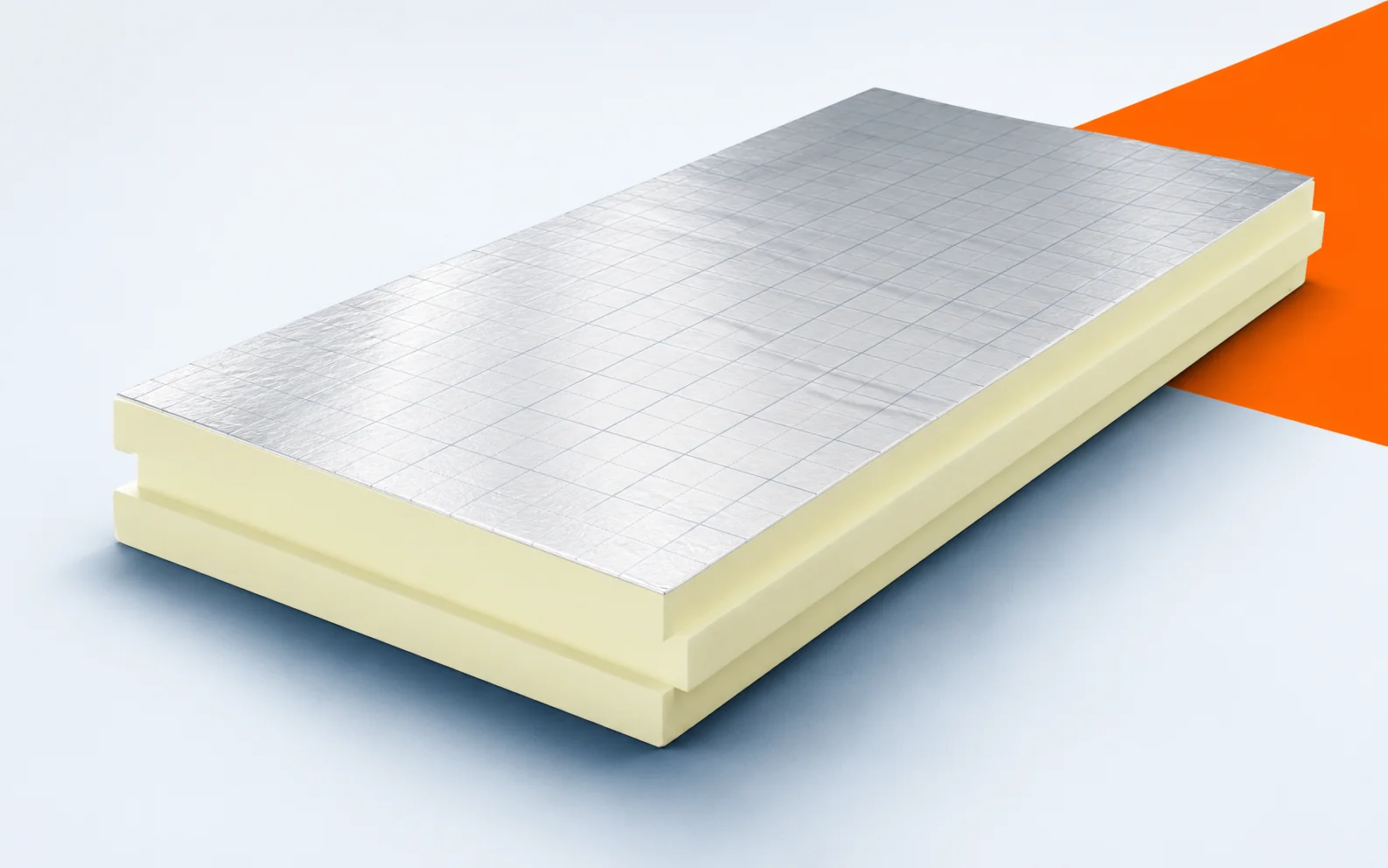
The PIR core and the significance of the name
New polyurethane foam in a factory-made board has its own documentation, but it does not describe what has remained in the building. These two layers must be assessed separately. During modernisation, one should not attribute the parameters of the currently offered product to the old insulation merely because it looks similar.
The facing changes the way it is used
When adding thermal insulation to an old system, inspect the surface of the board being ordered. The cream colour of the core does not allow a product with aluminium laminate to be distinguished from the variant with a mineralised veil. The difference matters for vapour transmission and for contact with retained and new layers. The renovation specification therefore needs the full product designation together with the facing.
Adding a board with a facing of high diffusion resistance can change the drying capacity of the old system. This is particularly important when the material is to be placed on the internal side of the partition. Before making a choice, the composition of the existing layers and the sources of moisture must be established. A declaration of low water absorption for the new core alone does not answer the question about the condition of the timber or masonry. An assessment of the connection between the new part and what already exists is needed.
Why a smaller thickness may be sufficient
PIR boards are often chosen primarily because of their low lambda. Where floor height or a reveal is limited, this allows a thinner layer to be considered. The comparison should be based on current data for the specific product. Some facings and thickness ranges have different declared values.
The advantage of a small thickness is often most visible where elements are difficult to move. This may be a threshold, a window sill or the edge of an old flashing. Measure such places before pricing the whole surface. It is easy to select insulation for a large area and only later discover a clash at the perimeter. It is worth drawing at least the most difficult detail. PIR boards can help fit the layers in, but resolving their junction still requires separate consideration.
The application depends on the specific product
In some places a different insulator may be the better choice. This applies, for example, to particular requirements for non-combustibility, sound attenuation or performance under the influence of water. Reliable selection does not consist in naming a winner in every category. It consists in assigning the right material to the specific task.
Modernisation does not have to mean leaving all the old layers in place. If the substrate is damaged or wet, the scope of the repair must be established. New polyurethane insulation can reduce heat losses, but it does not remove a leak. Nor does it restore the load-bearing capacity of a weakened structure. In the cost estimate it is worth separating the repair of the cause from the installation of the new thermal insulation. Then a saving at one stage does not consist in omitting necessary work.
The edge helps, but does not replace care
After laying the first strip, check whether the adjacent boards have actually been pushed together. The groove helps guide the installation, but soiled or damaged edges can leave a gap despite the correct marking on the packaging. Acceptance of the joint consists in inspecting the contact; the delivery declaration of profiled boards alone does not confirm the continuity of the completed layer.
Old surfaces rarely have perfectly even geometry. With rigid boards, the support must be checked, not merely the visible edges pushed together. An overlap may close the joint at the top while an unplanned void remains beneath the element. The method of preparing the substrate should follow from the technology. It is not worth masking unevenness by randomly inserting pieces of material. Such places are difficult to assess later once the partition has been covered.
Parameters worth checking alongside lambda
A good product data sheet describes more than heat conduction. For a floor, loads will be relevant, and for a roof also the fixing and compatibility of the facings. Fire requirements apply both to the product and to the assembly. PIR should not generally be called a non-combustible material. The correct classification must be used.
In the renovation documentation, also record the scope of the investigation of the old assembly. A photograph of the exploratory opening may be more useful than a general description of the whole building. If a different section appears in the next stage of the works, the decision must be verified. The parameters of the new board remain the same, but the surroundings may change. This is a good reason to carry out acceptance in stages and not automatically transfer conclusions from one fragment to all the others.
What to check before modernisation
In an old building, a small height reserve encourages the use of PIR. First, however, a damp or uneven substrate must be assessed. Thinner insulation does not replace repair. The benefit of the thickness makes sense once the correct conditions for the new layer have been restored.
When renovating, first ask why a particular option was chosen. Polyurethane boards can address a lack of space, but the design must also deal with moisture, support and connections. Insulation with polyurethane works best as part of a well-ordered work plan. Record measurements of limiting heights and the condition of the elements being retained in the building. Such a set of data allows real solutions to be compared instead of offers based on the general assumption that a new layer will cover up every defect.
7 branches. Materials closer to your project.