Polystyrene and thermal insulation
Can one EPS grade insulate an entire building?
At a glance
One type of EPS can have several approved applications, but it should not be designated for the whole house from the outset. The façade, foundation, floor and roof each require other properties to be checked. We explain when a common material is justified, where a special grade is needed and how to plan delivery without mistakes. All polystyrene boards belong to one material group, but they can differ in composition, structure and declared properties. Lambda describes heat conduction. Other parameters describe compression, tension, water absorption or dimensional behaviour. Choosing only by colour and thickness ignores some of the requirements placed on the material in a building. The application follows from the documentation for the specific grade and from the design.
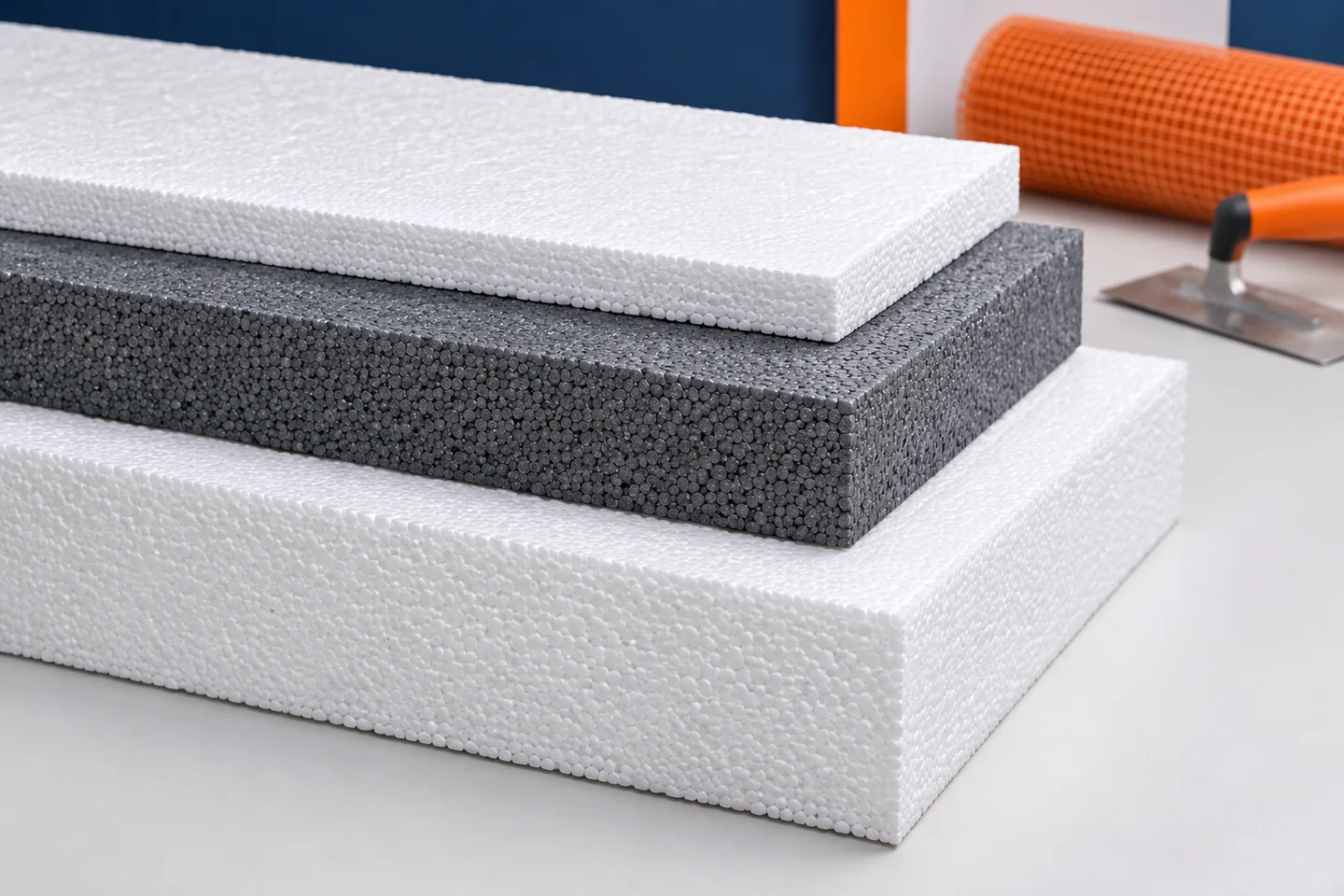
Why does the name EPS not describe the whole task?
A board described as “roof–floor” can indeed work in several places. However, this does not mean it is suitable for every roof and every floor. The layer build-up, loads and moisture must be checked. Multi-purpose use is possible when the product meets the complete set of conditions for the given application.
What does a façade in ETICS require?
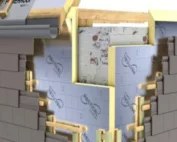
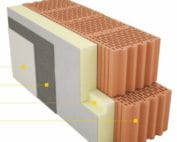
On the wall, what matters is the thermal properties, the geometry and the parameters required by the system, including the appropriate TR level. The board works together with the adhesive, the reinforcement and the render. High compressive strength alone does not confirm compliance with ETICS. A façade board should not be replaced with a flooring material without checking its documentation and the scope of the system.
The installation conditions are equally important. Graphite EPS requires protection from direct sunlight in accordance with the instructions. The layout of the boards around windows and at corners must follow the execution rules. No material is universal in the sense that it allows wall preparation or details to be omitted. The product properties and the quality of installation must be assessed separately.
What distinguishes a foundation from a dry wall?
At ground level, contact with water and loads from the surroundings become more important. Suitable water absorption and mechanical parameters are needed, as well as an approved scope of application. A façade EPS with a very low lambda does not thereby become a foundation board. Water can change the operating conditions of the insulation and must be taken into account separately in the design.
A board with limited water absorption still does not replace waterproofing. The continuity of the layers, a compatible adhesive and protection against backfilling must be planned. Some products have specific restrictions on depth or type of water exposure. Transferring surplus façade material to the foundation can be a false economy if the required properties have not been confirmed.
Why does the floor need a separate assessment?
Under the screed, EPS carries the weight of the layers and the loads associated with use. CS(10) and the necessary data on long-term deformation are checked. CS(10) is not a permissible service load. Heavy equipment, a partition wall and furniture on small feet may require a different approach from a uniformly distributed pressure. The way forces are distributed through the screed also matters.
A floor between flats may need a resilient acoustic EPS. A rigid board with a favourable CS(10) does not automatically replace such a layer. Dynamic stiffness, compressibility and the separation of the screed from the walls matter. In one building, the use of two floor grades may therefore be justified, even though both parts of the project have a similar area.
What additional conditions does the roof impose?
On the roof, loads, support, fixing and compatibility with the covering must be taken into account. With profiled metal sheets, the conditions for supporting the board between the supports may be important. In equipment zones, concentrated pressures occur. Tapered products also have a defined geometry that cannot be replaced by randomly placing offcuts under ordinary boards.
An inverted roof requires a material expressly intended for such conditions. The entire EPS group should not be automatically excluded, nor should every grade within it be accepted. The specific product and the entire roof are checked. Similarly, a board with a bituminous facing has its own installation rules. Compliance of the lambda value with the design alone is not sufficient to confirm a suitable solution.
How can purchasing be simplified without incorrect substitutions?
Prepare a schedule for each zone of the building. Enter the area, thickness, lambda and required additional properties. Only then check whether one product can cover several items. This will allow you to reduce the number of deliveries where justified. Do not start by purchasing one large batch on the assumption that you will later adapt the design to it.
Various EPS grades are offered by, among others, Termo Organika, Swisspor, Yetico and Styropmin. Their documentation specifies the applications and properties of the individual boards.
On site, label the packs according to their intended use and keep the labels. Similar boards are easily confused once unpacked. Surplus material can only be used after confirming that it is suitable for the next task. Good planning reduces waste and corrections. It does not require a single material for everything, but a clear assignment of each grade to the place where it will meet the required requirements.
7 branches. Materials closer to your project.