PIR insulation
Can PIR be combined with existing mineral wool during renovation?
At a glance
When renovating a roof or wall, the question often arises whether old mineral wool can be topped up with PIR boards. The answer depends on the condition of the material and on the entire build-up. A thin layer of insulation can help, but moisture, junctions and space constraints must first be identified. Do not treat the centimetre conversion factors quoted online as a fixed rule. A change in the lambda value of one product changes the ratios. It is just as important to allow for the structure and the junctions. The insulation layer alone may have good resistance even though the whole assembly contains significant thermal bridges. A comparison of new materials does not automatically describe the layer that has been in the building for years. Its condition must be checked separately.
Comparing thicknesses requires specific figures
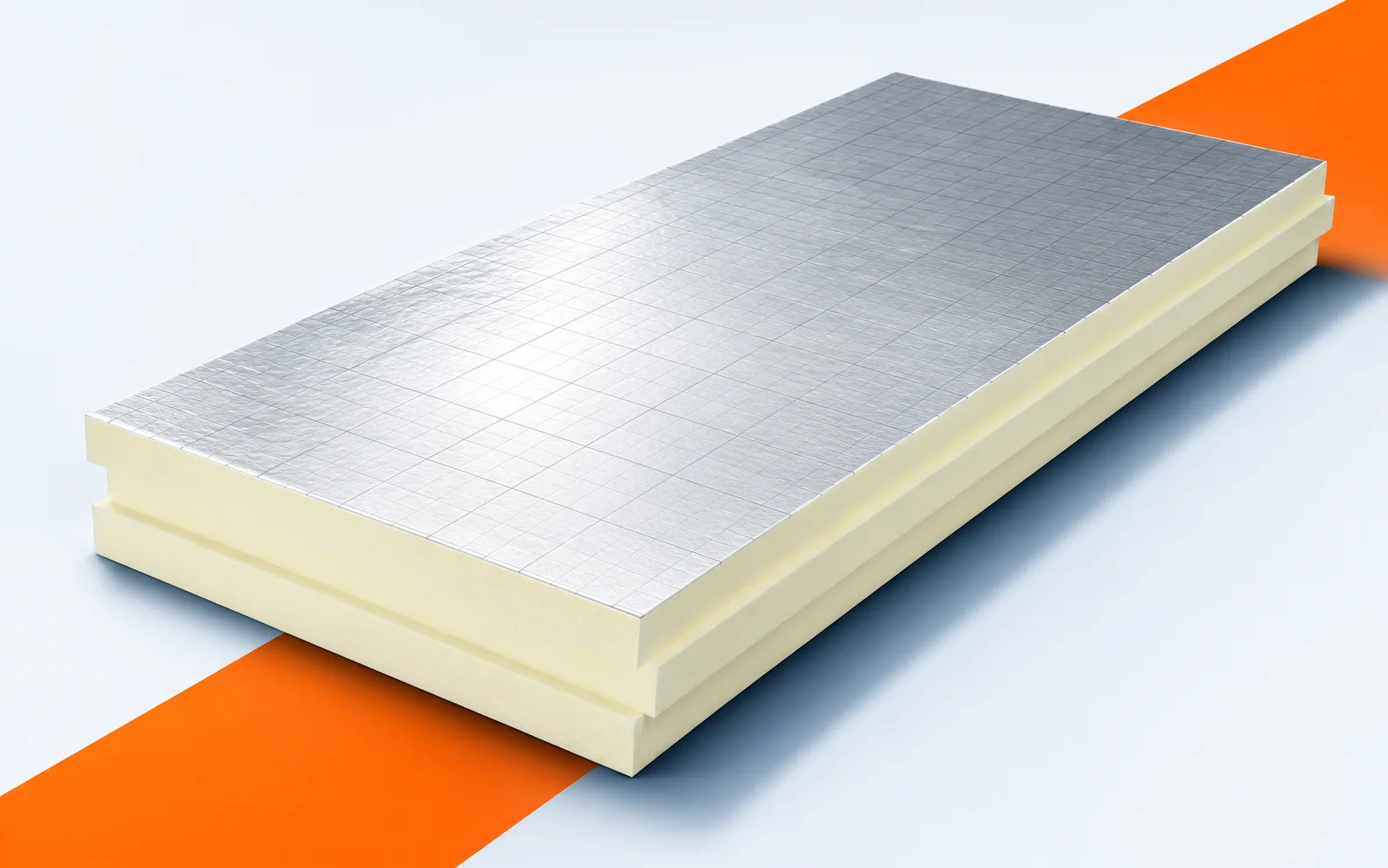
Polyurethane boards have current declarations, but similar certainty must not be transferred to unidentified old insulation. In the calculation it is worth clearly indicating what remains and on what basis its properties were assumed. Only then can the required thickness of the new part of the building envelope be determined.
Reaction to fire requires a separate assessment
Before you supplement the retained mineral wool with boards, check the fire requirements of the planned assembly. If non-combustibility decides the selection, a comparison of lambda and occupied space is not enough. For PIR, data on the specific product and an assessment of its role in the system are needed. A classification obtained for a specified configuration does not automatically carry over to a roof after the layers have been changed.
Changing the assembly during renovation may matter for fire requirements. It should not be assumed that any additional insulation is neutral for the earlier solution. Polyurethane foam in boards requires an assessment of the specific product and the manner of installation. If documents for the previous assembly exist, their scope must be checked. After reconstruction they may no longer describe the entire building envelope, even when it looks similar from the outside.
Thermal insulation does not mean sound attenuation
Noise from rain, airborne sound and impact sound are different problems. A single material parameter does not describe them. In a floor, a layer limiting the transmission of vibrations may be important. In a wall, the facings and airtightness also matter. Adding hard PIR alone does not guarantee sound insulation.
It happens that the existing mineral wool also served as part of an acoustic solution. Removing it and replacing it with a rigid board can change that effect. The polyurethane insulation should be assessed together with the facings and the joints. It is worth asking the occupants what problems are to be solved. If both cold and noise are at issue, the renovation should take both goals into account instead of focusing solely on saving a few centimetres.
Rigid boards and flexible insulation are installed differently
With above-rafter insulation, the fasteners, loads and eaves details must be taken into account. It is not enough to lay boards on the structure. With between-rafter insulation, care must be taken to ensure filling and continuity at the timber. Both arrangements require a complete solution, not a single universal rule.
Old structures may have irregular spacing and uneven surfaces. A rigid board requires adequate support and cutting. A flexible material should also not be laid at random or compressed excessively. Before pricing, it is worth inspecting a section with difficult geometry. This allows the labour intensity to be determined realistically. Comparing the cost of materials without these conditions can give a misleading picture of the entire renovation.
Water vapour and moisture depend on the entire cross-section
Adding PIR from the room side changes the conditions under which the old mineral wool and the elements adjacent to it will remain. Their temperature and drying path may change. Therefore, the design of such a combination should include a moisture assessment of the entire existing building envelope. An improvement in the thermal conductivity of the new layer alone does not confirm that the retained insulation will perform correctly.
Damp mineral wool should not be sealed beneath new cladding without establishing the cause of the dampness. Repair of a leak or another source of water transport may be needed. PIR with a low water absorption of the core does not solve this problem. The new layer may additionally change the temperature and the ability of the old elements to dry out. A moisture assessment should therefore precede the decision to retain the old materials.
The choice can combine the advantages of different materials
Compare complete solutions with the same function. If one includes an additional acoustic layer and the other does not, the price of the insulator alone will be misleading. A reliable comparison takes into account labour, accessories, flashings and finishing layers. Then it is clear what effect is being paid for.
If the design provides for combining old and new insulation, the places where they meet must also be described. PIR boards can increase thermal resistance where height is limited, but they will not repair accidental gaps in the existing layer. Polyurethane insulation should be part of a coherent scope of modernisation. It is worth establishing the boundaries of demolition and repair before ordering. This ensures that the new delivery corresponds to the actual condition of the building, and not only to its earlier description.
What to check before modernisation
Mineral wool has been retained in an old roof, and PIR boards are planned from the outside. The combination may require a thermal and moisture analysis. First, the condition of the old material must be assessed. Covering damp layers is not a way to achieve effective modernisation.
For the renovation, start by exposing and measuring the difficult area. Record which layers are dry, functional and can be retained. Then compare the PIR option with a solution using suitable mineral wool. Take acoustics and the requirements of the entire assembly into account. Saving thickness is an important advantage, but it does not justify covering up a defect. A well-prepared design shows how the new material interacts with the existing structure and what problem the modernisation actually resolves.
7 branches. Materials closer to your project.