Installation and workmanship
Joining timber beams: how to choose a connection
In brief
The choice of how to connect timber beams depends primarily on the forces the joint must transfer, not on the appearance of the connection. Extending a beam, supporting it on a post and joining two members at an angle are separate tasks, so no single variant is best in every situation. Check the load direction, geometry, timber class, edge distances and access for installation. Also establish whether the connection is mainly to provide bearing or must additionally resist uplift. Leave the design of the detail itself to the structural designer.
First determine what the connection is to transmit
Beams can transmit compressive forces, tensile forces, shear forces and moments. Some connections mainly provide bearing, while others must also resist uplift. The direction of loading matters. A connection with good load-bearing capacity in one axis does not necessarily have similar resistance in the others.
The design also covers the behaviour of the entire system. Sometimes a specific displacement is needed, sometimes it must be restrained. Overly rigid fixing is not always an improvement. It can introduce forces not foreseen in the calculation. The detail should therefore correspond to the structural scheme rather than result from the installer’s habit.
When are traditional timber joints used?
Notches, halving joints and other shaped contacts allow elements to bear on selected surfaces. Their execution requires accuracy. Removing part of the timber reduces the cross-section at a specific location. The notch should not be enlarged arbitrarily to make it easier to fit the beam to a curved support.
Bearing alone may not be sufficient to transfer all forces. The design may require an additional fastener or connector. Uplift and tensile actions are particularly important. A connection that performs well under compression does not automatically become resistant to separation of elements.
What do bolts, nails and screws change?
Dowel-type fasteners transmit loads through interaction with steel and timber. Diameter, length, type of thread or shank and method of embedment matter. Two screws of similar appearance may have different applications. Not every screw intended for finishing work is suitable for a structural joint.
The layout must account for spacings between fasteners and from beam ends. Accidental clustering can promote splitting. A greater number of holes should not be regarded as certain reinforcement. Depending on the system, specific rules for drilling and screw direction are also required.

When are steel connectors useful?
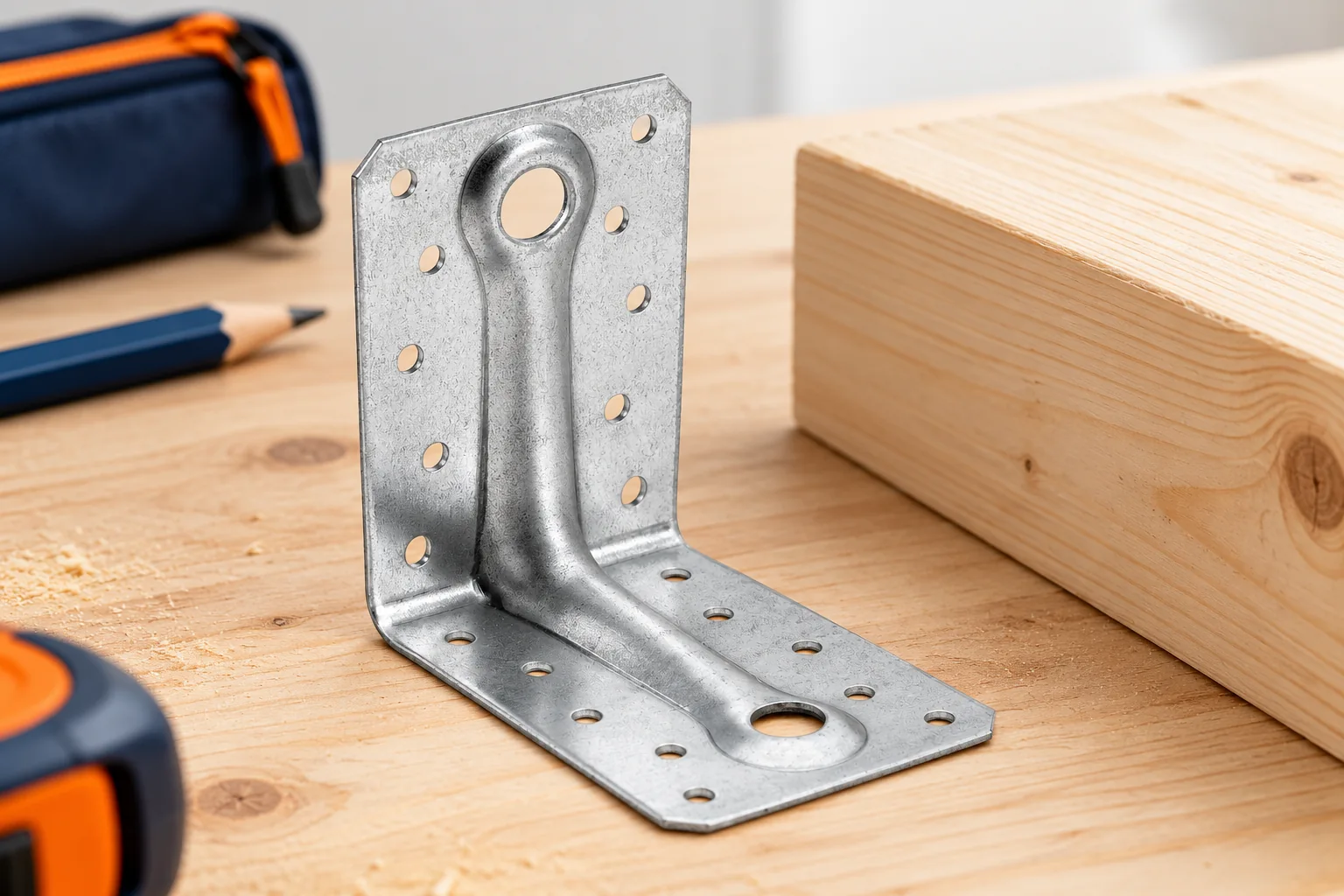
Hangers can be used to support the end of a beam at another element. Angle brackets connect parts in a specific geometry, and special connectors handle selected truss nodes. Their shape and perforation are related to load-bearing capacity. The element should not be bent independently or additional holes made without approval for such a change.
The system also includes the specified nails, screws or anchors. The bare connector plate does not have independent connection load-bearing capacity. The complete installation scheme counts. The documentation may distinguish between full and partial fastening. This does not mean freedom to choose any holes to fill.
How is beam extension resolved?
The contact point should result from the structural layout. A connection near the support may behave differently than in the middle of the span. Two shorter beams connected with a board should not be considered equivalent to one long beam. The way forces are transferred requires verification, as does local weakening of the cross-section.
During renovation, the condition of the existing timber must also be assessed. A new element will not provide a strong node if the connectors hit a damaged part of the old beam. Reinforcement should cover the identified cause of the problem. An additional cover plate alone is not a universal repair for cracking or deflection.
Why are service conditions important?
Moisture affects the timber and the connection parameters. Metal connectors require protection suited to the environment. A solution intended for indoors does not have to be suitable for an exposed terrace structure. Wood preservatives and their compatibility with metal may also be relevant.
It is worth limiting places where water persistently remains. The support and cover should allow proper use of the detail. Excessive enclosure may hinder inspection. If the node will be concealed, its acceptance and documentation must be carried out earlier, before access is restricted.
How can the correctness of a completed joint be checked?
Compare the connector type, the number and type of fasteners and their position with the documentation. Assess the fit of surfaces, the support and the condition of the timber. It is not enough to check whether the bolts are visible. Missing elements on the other side and compliance with the required arrangement of connector pairs are also important.
A questionable node should be assessed before loading or covering. This applies especially to a change made on site. A well-chosen connection can be described by a drawing and a set of parameters. Such documentation provides more certainty than the belief that a larger screw or thicker plate will always suffice.
7 branches. Materials closer to your project.