Steel halls and structures
Planning a steel building with an overhead travelling crane
In brief
An overhead crane changes how production is handled, but also the requirements placed on a steel hall. Its load capacity matters, but it is not enough to design the supports. The equipment moves, brakes and transfers forces through its wheels onto the track. Span, working height and mode of operation all count. These data must be established before the final choice of structure, not after the frame has been erected. The type of loads carried, their mass and the required reach must be specified. Operating frequency and transport routes are also significant. A steel hall may handle single lifts or an intensive technological process. Such applications are not equivalent. The equipment requirements should follow from the actual mode of use.
Start with the work it is to perform
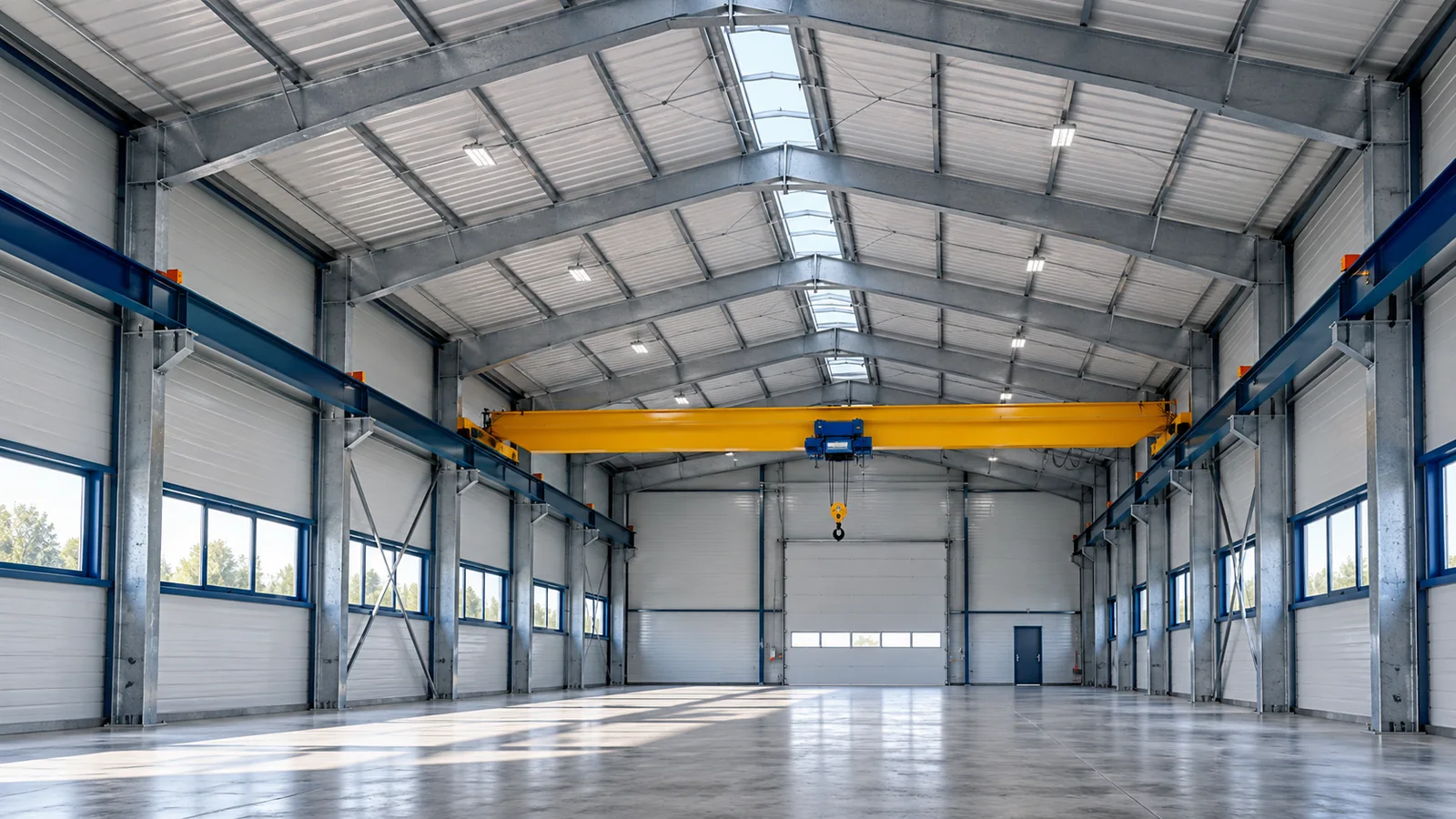
Lifting height must be distinguished from column height and ridge height. The bridge, trolley, track and roof structure all take up space. The required clearances are also needed. Steel structures must be coordinated with the crane’s overall dimensions so that the ordered hall does not restrict the equipment’s working range once it has been installed.
The track needs designed supports
Crane runway beams transfer loads to the columns or to a separate support system. In certain solutions they bear on frame brackets. They should not be treated as ordinary equipment bolted to any column. In a steel hall, the entire system from the track down to the foundations matters.
The steel structure may require different sections, connections and bracing than a similar building without a crane. The choice of solution is determined by calculations and the equipment’s requirements. Sometimes independent track supports are considered. However, every variant must be coordinated with the floor slab, foundations, traffic and working space.
Horizontal forces and repeatability matter
A crane transfers not only vertical weight. Horizontal actions occur during travel and braking. The way these are transferred must be allowed for in the bracing and connection system. The steel hall should maintain the required stiffness in the directions associated with the equipment’s operation. Adding a stronger beam does not solve all of these tasks.
Under appropriate operating conditions, a fatigue assessment is also important. It concerns repeated load changes and sensitive details. Steel structures serving intensive transport require data on the expected service life. The selection should not be based solely on the maximum weight of a single lifted element.
Displacements affect operation
The track must have a geometry that matches the crane’s requirements. Beam deflections, frame deformations and relative displacements of the supports matter. Even when an element has adequate load-bearing capacity, excessive deformation can hinder the equipment’s operation. A steel hall with a crane therefore requires coordination of structural and operational requirements.
The frame spacing affects the span length of the crane runway beams. Changing the module can bring benefits in one part of the building and increase requirements in another. Modular steel structures must be assessed as a complete variant. A standard spacing is not automatically the best solution for every track.

New equipment in an existing steel-framed building
Before adding an overhead crane, the documentation of the steel hall and an assessment of the condition of the completed elements are needed. The foundations must also be checked. The mere possibility of fixing a bracket does not confirm that the column will take the additional forces. Earlier modifications or damage may change the result of the assessment.
If the crane was planned from the outset, its actual parameters should be compared with the assumptions made. A greater load capacity, a different span or more intensive operation may require re-verification. A steel structure does not have unlimited reserve simply because space was left for a track.
Installation and subsequent servicing
The method of bringing in and assembling the equipment and service access must be planned. The steel hall should allow inspection of the track and the required connections. It is also important to separate pedestrian traffic from load transport zones. Appropriate preparation of the building facilitates later work organisation but does not replace the operating rules of the equipment itself.
For the steel hall, collect data from the crane supplier before approving the structure. Agree the requirements for the geometry and permissible displacements of the track. Check steel structures together with the crane runway beams and foundations. State the planned intensity of operation and the possibility of using additional equipment. Do not fix the track to the purlins.
In the steel hall, leave the space needed for replacing and repairing equipment components. The load data should cover the relevant equipment variant. Carry out work on the nodes and the track according to the agreed documentation. It is worth comparing the regular column spacing with the process requirements before the hall series is selected.
The structural solution should ensure not only load-bearing capacity but also correct operation of the transport. Additional service platforms also require defined loads. Keep the documentation of the track and the adopted operational requirements.
7 branches. Materials closer to your project.