Gutters and drainage
Gutter installation: planning falls, brackets and outlets
In brief
Installing gutters begins with dividing the roof into catchment areas and determining the outlets. Before choosing the cross-section, brackets and falls, establish whether the outlet will be at the end or in the middle of the gutter – this affects how the whole system performs. Also check the position of the downpipes relative to windows, entrances and rainwater discharge at ground level to avoid flooding the pavement. Bear in mind that one universal bracket spacing or fall does not suit every gutter; the specific system’s guidelines and the condition of the substrate are key.
How to determine the number of downpipes?
Each downpipe receives water from a specific part of the roof. When selecting, the effective catchment area, the pitch and the position of the outlet are taken into account. An outlet at the end of a long gutter does not perform in the same way as an outlet in its middle section. The tables for a given system help to select dimensions, but their assumptions must be observed. The perimeter of the house alone is not sufficient to calculate capacity.
The position of the downpipes should be agreed with the arrangement of windows, entrances and the discharge of rainwater at ground level. A downpipe terminating at a random location can flood a pavement or the area next to the foundation. If the water is to go to a tank or an underground installation, the method of connection and cleaning must be provided for. Moving an outlet after the façade has been completed is often troublesome and leaves marks from the fixings.
How to select hooks and their substrate?
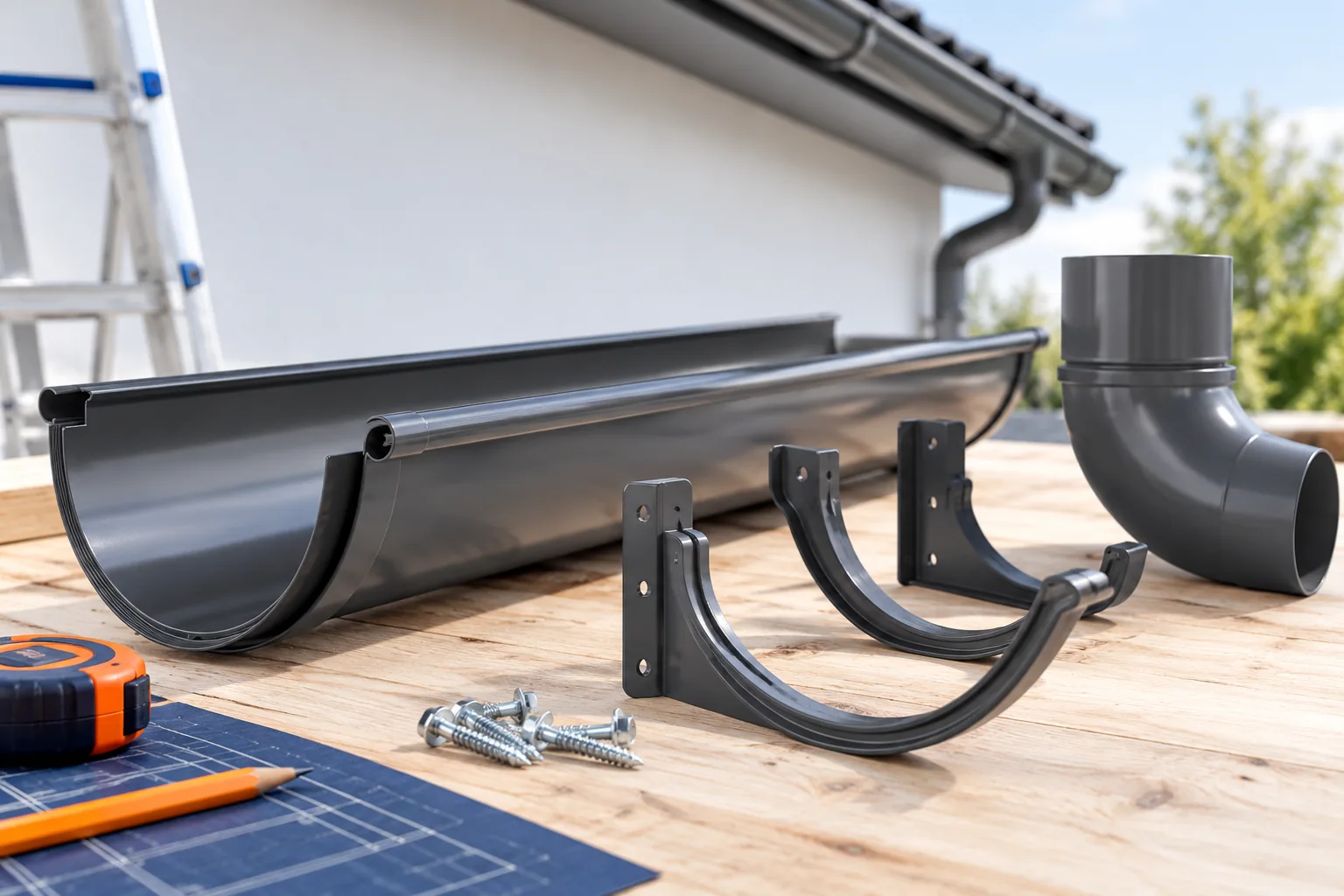
Brackets may be fixed to the fascia board, rafters or another prepared element. They must match the gutter system and the load conditions. The spacing is specified in the instructions. The condition of the substrate and the type of screws also matter. Even a strong bracket will not provide reliable support if it is fixed into a weakened board or with connectors that are too short. These places should be checked before the eaves are covered.
The position of the gutter relative to the extension of the roof slope limits the risk of damage by sliding snow. It should not be raised arbitrarily to cover inaccurate flashing. The gutter is to collect water, but not to act as a snow barrier. On some roofs separate snow guards are required. Their selection requires an assessment of the slope and the structure, irrespective of the strength of the brackets.
What slope should be provided?
In many systems the gutter has a fall towards the outlet. Its magnitude follows from the system instructions. There are also solutions with a cover profile, for which horizontal installation is provided while maintaining specified conditions. Therefore one figure should not be applied to all gutters. It is important that the prepared system complies with the documentation, not with a habit carried over from a previous building.
Before fixing the subsequent brackets, their position relative to the extreme points and the outlet is determined. The line of the entire section is checked. A slight local depression can retain water despite a correct fall between the ends. It is not worth trying to repair such a place by randomly bending the finished gutter. It is better to correct the support before the system is joined into a whole.

How to make connections and outlets?
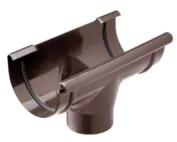
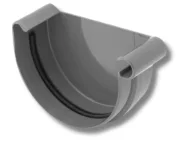
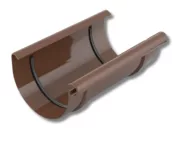
Connectors, end caps, corners and outlets should belong to a compatible solution. A similar diameter does not guarantee that the seal and the joint fit. In some systems the connections have factory seals and do not require additional sealant. In others a different method of connection is used. Arbitrary lubrication of all contacts can hinder thermal movement or later disassembly.
The outlet opening should be cut so as not to leave sharp swarf and not to damage the coating. The edge must direct water in accordance with the instructions. An opening that is too small or imprecisely cut can restrict flow. After work, remove filings also from inside the gutter. Leftover particles not only dirty the water but can also create pinpoint corrosion marks on the protected surface.
How should downpipes be fixed?
Clamps and their anchoring are selected according to the substrate and the thickness of the insulation. The thermal insulation layer alone is not a load-bearing substrate for an arbitrary plug. The connection should transfer the weight of the system and operational loads. The working method intended for the pipes must also be maintained. Excessive pressure or incorrect support can deform the component and hinder its thermal movement.
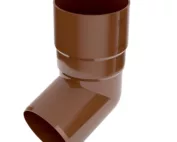
Bends under the eaves require a properly fitted connecting section. The entire assembly should not be twisted by force so that the pipe reaches a previously chosen location. The alignment should be checked before the clamps are finally fixed. At ground level, access to an inspection opening or silt trap is left. Burying the cover with soil turns a minor service task into excavation work later.
What should be checked at handover?
The inspection covers the stability of the brackets, the gutter line, the seating of the seals and the patency of the outlets. A water test shows the direction of flow and any leaks. However, it does not replicate every intense rainfall, so it does not replace the correct selection of capacity. It is also worth observing the ends of the baskets and the gutter aprons that direct water into the gutter.
Establish how cleaning will be carried out later, especially on a tall building or a roof surrounded by trees. Leaves can block the outlet even in a correctly installed system. An inspection after the first heavier rainfall helps detect local ponding. Well-installed gutters do not end with an aesthetic run at the eaves. They must safely convey water onward and remain accessible for maintenance.
7 branches. Materials closer to your project.