Sheet metal and roofing
When will felt-backed steel sheet reduce dripping and what does it need to work?
In brief
Felt under steel sheet can temporarily retain some condensate. This means less water drips into the interior. However, it must dry out afterwards, so it needs adequate air exchange. It is neither insulation nor a repair for a leaky roof. Its usefulness is best assessed together with ventilation and how the building is used. Water vapour can condense on the cool surface of the covering. It does not have to have rained beforehand. After a cold night, the steel sheet may be cooler than the indoor air. If condensation conditions are met, droplets appear on the underside. This is a different phenomenon from a leak through a joint.
Where does water under tight steel sheet come from?
In a garage, the source of moisture may be a wet car or snow on the wheel arches. In a warehouse, damp goods and the substrate matter. First identify when the problem arises. Observing the link with rainfall, temperature and the way the building is used helps establish the right direction for action.
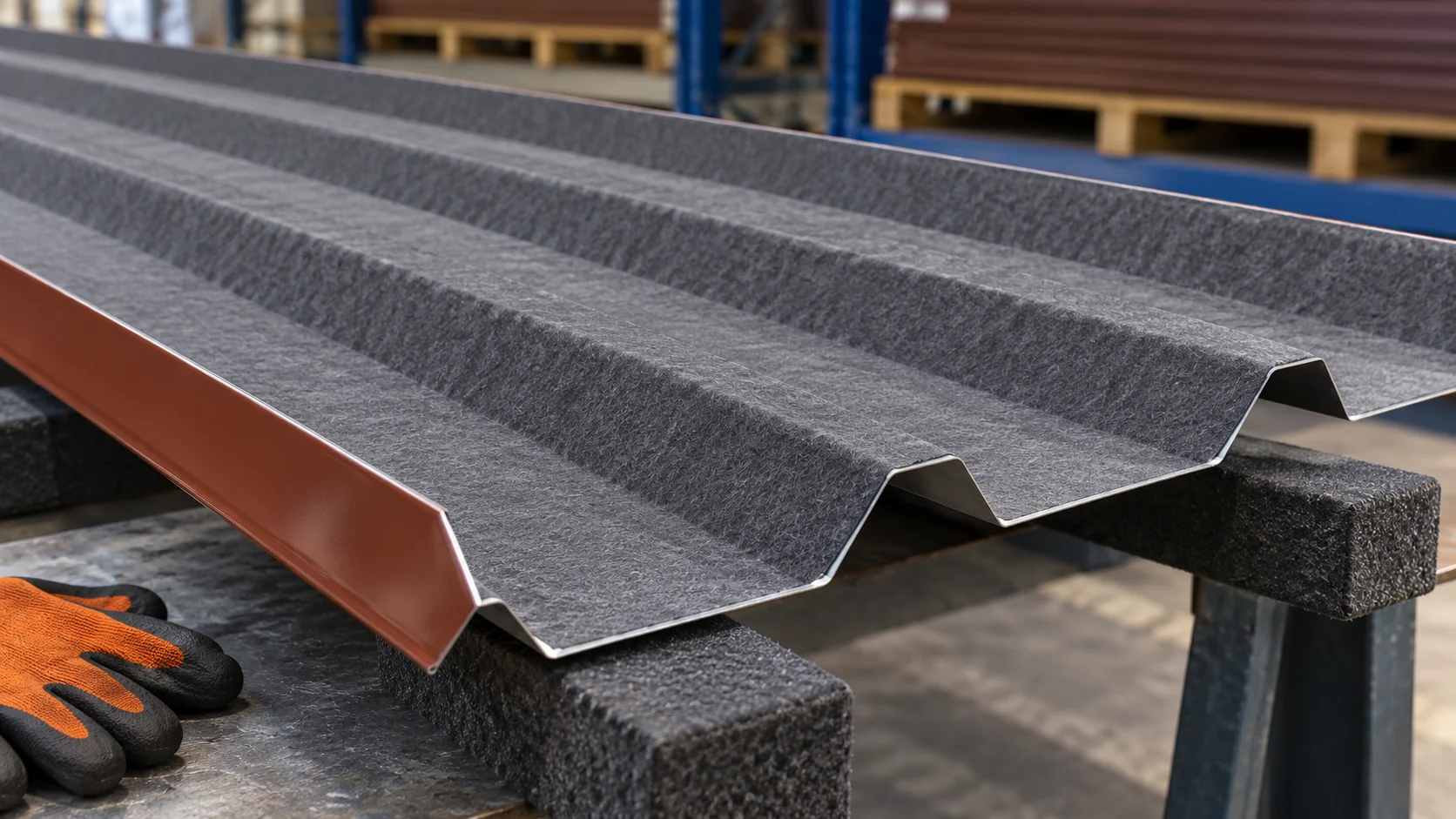
What does the fleece bonded to the underside of the sheet do?
The anti-condensation layer takes up some of the water in its structure. Its capacity is limited. This does not mean that all moisture is retained forever. Under favourable conditions, the accumulated water should evaporate. It is precisely this cycle that determines the effectiveness of the solution.
The mere presence of felt does not mean the roof has become thermally insulated. A thin nonwoven does not replace a properly selected insulation layer. Nor does it automatically define the properties of the entire covering. Data on absorbency and other characteristics must be checked for the specific variant.
Why is ventilation a prerequisite, not an add-on?
If moisture constantly flows in and the layer has no way to dry out, the buffer may become exhausted. Air exchange planned for the building is needed. A single opening visible in the wall does not prove effective airflow. What matters are the inlet and outlet paths and whether they are unobstructed.
In a small enclosed storage room, check whether shelving or stored material is blocking the openings. In an open-sided shelter the conditions may differ, but they also depend on screens and geometry. Later enclosing of the open sides changes the situation. It is then worth reassessing the moisture balance.
What to check at the eaves and laps?
The fleece should not create an uncontrolled path for water to be drawn up. This requires proper termination at points of contact with rainwater and at overlaps. The specific zones and preparation method are defined by the solution for the given sheet. Do not transfer dimensions from another system.
These details must be planned before ordering and cutting. It is not enough to lay fleece on every centimetre of the underside. Also check that the edges are not left unprotected from external conditions. With a short eaves, even a small change in sheet position can affect the detail.

When won’t felt solve the main problem?
It will not stop water entering through damaged flashing, nor will it seal a poorly executed overlap. It will also not replace the full layer build-up in a heated roof. If the interior requires insulation and vapour flow control, these functions must be designed separately.
Persistent high humidity requires its causes to be reduced. Replacing just the sheet with a fleece-backed version may only change the symptom. With recurring dampness, check ventilation, water sources and surface temperatures. Only then select the solution.
How should delivery and installation be prepared?
Store the sheets in accordance with the rules for the material, with protection against damp. For installation, the layer should be in an appropriate condition. Do not close up a wet pack and assume that the fleece will cope with any amount of water. Also monitor for damage to the fleece.
When handling, protect the coating and edges. Plan cuts so as not to disturb the prepared zones at the ends. If the sheet length is changed on site, re-check the termination of the layer. A correct factory detail may need to be reproduced after cutting.
How do you assess whether the extra cost is worthwhile?
Combine the usage method, the risk of condensation and the possibility of drying out. With an uninsulated enclosure, this may be a necessary element to limit dripping. In another build-up, designing insulation and sealed layers will prove more important. There is no single answer for all roofs.
Compare the cost of the whole solution with ventilation and details. Ask about the rules for maintaining the fleece, especially in a dusty environment. After the building is commissioned, observe it on cooler days. A change in humidity or storage method may require adjusting usage and reassessing the conditions.
Questions before ordering
Can the fleece remain permanently wet and still perform the same?
It should not be assumed so. Its function is based on temporarily absorbing water and subsequently drying out. Permanent dampness requires identifying the cause.
Must dripping only after a cool night mean a hole in the roof?
No. Condensation from below is possible. It must be distinguished from a leak by assessing the conditions and the places where water appears.
7 branches. Materials closer to your project.