Maintenance and safety
How long can tile-effect steel roofing last?
In brief
The service life of tile-effect metal roofing cannot be pinned down with a single figure that applies to every roof. What matters is the steel, the anti-corrosion protection, the coating, the home’s surroundings and the quality of installation. The warranty is also not the date on which the covering is due to be replaced. A well-chosen material requires inspections and minor repairs. The owner has the greatest influence on removing dirt, checking water drainage and reacting quickly to damage. Two sheets in the same colour may have different surface protection. They differ in the type of coating, its thickness and the permissible environment of use. Colour does not describe these features. The term “matt sheet” likewise says mainly something about appearance. Resistance to service conditions is demonstrated by the data for the specific variant and the conditions of its use.
Why do similar roofs age differently?
Two sheets in the same colour may have different surface protection. They differ in the type of coating, its thickness and the permissible environment of use. Colour does not describe these characteristics. Likewise, the term “matt sheet” says mainly something about appearance. Resistance to service conditions is demonstrated by the data for the specific variant and the conditions of its use.
The roof is exposed to moisture, sun and dirt. The proximity of the sea, industrial plants or trees matters. Leaves trapped in the gutter hinder drying and drainage. A similar problem arises in a spot that stays shaded for a long time. That is why the age of a neighbour’s roof cannot be treated as a forecast of how long your own covering will last.
The time before installation is also important. A damp, tightly closed pack is not a safe store. The material must be stored according to the instructions, protected from water and able to dry out. Defects arising during storage over many weeks may only become apparent after the sheets have been laid out on the roof slope.
What does the warranty period really mean?
Before purchase, the technical scope of the warranty must be distinguished from the scope relating to appearance. The document may describe perforation of the sheet and aesthetic changes separately. These are different events, with different assessment conditions. A long number in an advertisement alone does not explain what will be repaired or what obligations rest with the owner.
Check the requirements for inspections, cleaning, location and proof of purchase. The exclusions for damage during transport or improper cutting are relevant. The end of warranty protection does not automatically mean the end of the roof’s serviceability. Conversely, new material may be damaged during unloading and require repair before installation.
Which mistakes shorten the life of a new covering?
Frequent problems include left-behind swarf and cutting the sheet with a tool that heats it strongly. Hot particles damage the coating alongside the cut line as well. That is why cold-cutting tools specified in the instructions are used. After drilling and trimming, the waste must be collected before moisture binds it to the surface of the covering.
The tightening force of the fasteners also matters. A crushed washer does not provide better sealing. A screw that is too loose also does not work correctly. The chimney flashings, roof valleys and slope edges must be assessed separately. Prolonged standing water at a poorly executed detail can locally destroy even a material with good parameters.

Does the sheet also have to dry from below?
Yes. Condensation can form beneath the covering. In a ventilated roof, the air should have a designed path from the eaves to an outlet at the ridge or another designated point. Blocking this path does not improve the roof’s tightness. It hinders moisture removal and can worsen the working conditions of the other layers of the assembly.
The underlay and correct sealing from the interior serve separate functions. The external covering will not repair a leaky vapour barrier. When moisture appears in the attic, its source must be identified. A water mark may come from a leak, condensation or an installation. Each of these causes requires a different repair method.
How should roof inspections be carried out without damaging the roof?
The condition of the covering should be checked regularly, in accordance with the manufacturer’s recommendations, and after events that may have damaged it. The inspection should cover the coating, fasteners, flashings and gutter flow. A preliminary visual check can be carried out from a safe position. Accessing the roof slope requires suitable access and fall protection.
Dirt is removed using a method permitted for the coating. This usually means gentle agents and soft tools rather than scrubbing with a hard brush. Small scratches are repaired with the appropriate touch-up material. Extensive damage must first be assessed. Painting over dirt or corrosion without preparing the surface does not remove the source of the problem.
When to repair and when to consider replacement?
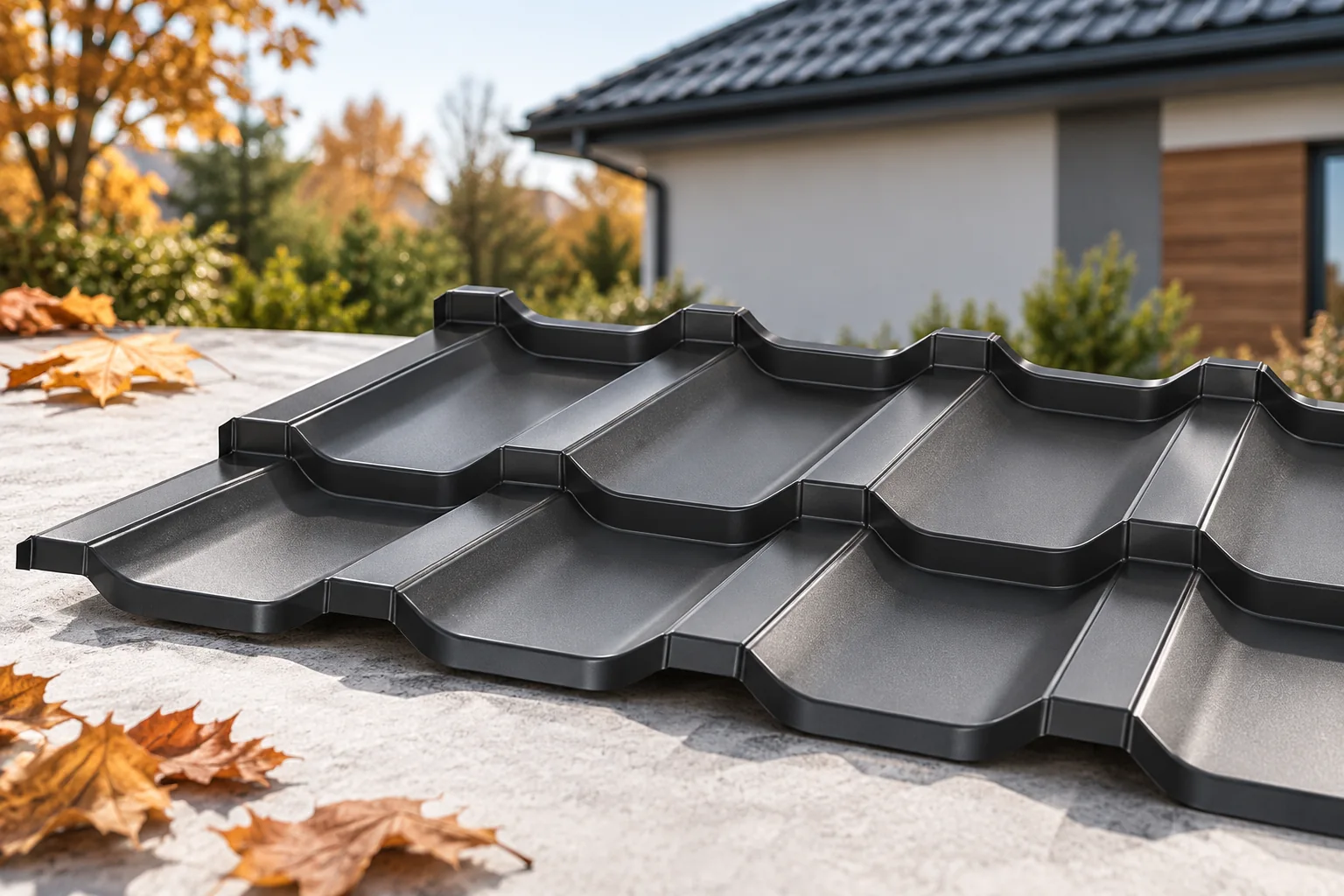
A local problem does not always justify replacing the entire roof. A damaged flashing can be replaced, the fastening improved or a single covering element substituted. The scope depends on the condition of the adjacent sheets and the availability of a matching profile. In a modular roof, the small format can facilitate repair, but the method of dismantling results from the arrangement of the laps.
A full assessment is worth commissioning where there are numerous corrosion spots, recurring leaks or a planned attic modernisation. A specialist should also inspect the layers beneath the sheet. The decision is determined by the condition of the assembly and the cost of an effective repair, not by the age of the building alone. Inspection records make it easier to notice whether the damage is progressing.
7 branches. Materials closer to your project.