Insulated wall panels and façades
Five reasons to consider steel window sills
In brief
A steel window sill is worth considering above all when a lightweight trim tailored to a specific opening and façade thickness matters. The key decision, however, is not the colour or coating itself but the measurement of the finished layer build-up — including the recess under the frame, side terminations, clearances and the outward fall. Check whether support and the division of long sections have been planned, and whether the transport film will remain on the surface too long. Only then assess the aesthetic qualities and ease of cleaning.
1. Dimension matched to the opening
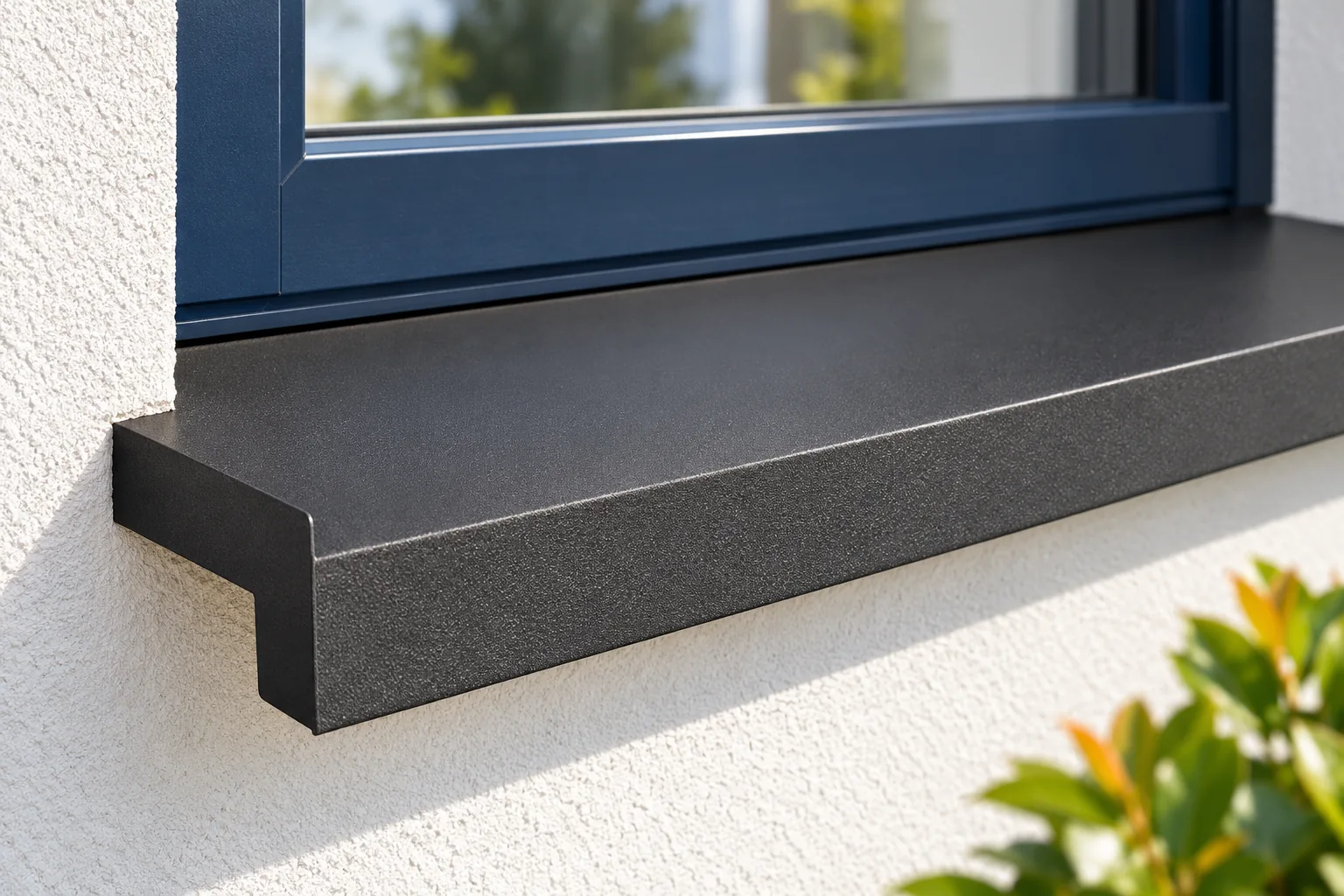
A metal flashing can be made for a specific window width and façade thickness. This allows the projection in front of the wall and the water-drip edge to be planned. The measurement should relate to the finished layer build-up. If additional insulation is added later, the previously ordered element may turn out to be too narrow.
It is not enough to measure the clear window opening alone. The way it is pushed under the frame, the side terminations and the allowances must be taken into account. The fall to the outside is also important. The dimensions are best agreed with the window and façade contractor. Fitting at the ordering stage reduces cutting of the finished, coated element on site.
For a very long sill, the way the sections are divided and joined must be determined. One long element is not always more convenient to transport or easier to install. The connector should be part of the intended solution, not a random overlap. An agreed detail helps maintain water drainage and space for material movement.
2. Low weight and easy handling
A thin steel flashing does not load the installation point like a massive stone element. This makes it easier to handle the sills and organise work on many windows. However, low weight does not mean there are no support requirements. A wide, poorly supported sill can vibrate and deform despite correct fixing at the frame.
The substrate should ensure stable seating according to the adopted system. The sill is not a shelf for standing on or for placing heavy tools. During façade work it must be protected from mortar and impacts. The greatest benefit from a lightweight element is obtained when the team treats it as a finished flashing rather than a working platform.
Rain noise also depends on how the sheet is seated and supported. If a damping material is specified, it must be compatible with the installation solution and must not block drainage. Accidental filling of the entire space without controlling the fall can make it difficult to remove moisture. This detail should be clarified before the reveals are completed.

3. Consistent colour with the other flashings
Steel sills are available in various coatings and colours. They can be matched to the gutters, gate, roof or façade details. It is not necessary to use the same colour everywhere. A dark sill can emphasise the window, while a light one can blend it gently with the render. The decision should be based on a larger sample viewed against the planned façade.
Before ordering, check the gloss level and texture. Two materials with the same colour code can look different. A wood-effect finish also has its own pattern scale. It is worth comparing them with the actual window frame. Ordering all the sills for one façade together helps limit differences between batches and later shade matching.
The coating on the underside matters too. This surface is less visible, but it may come into contact with moisture or the mounting substrate. The protection of the whole product should not be judged by the decorative top layer alone. In the documentation, check the type of steel, the metallic protection and how both sides are finished.
4. Easy to keep the surface clean
A smooth coating can be cleaned with a soft cloth and a product approved for the given finish. Mud or dust should be removed before it forms a lasting deposit. After washing, the surface should be rinsed. A metal brush, abrasive powder or an unsuitable solvent can leave marks far more difficult to remove than the original soiling.
The transport film is not a cover intended to be left in place permanently. Its removal deadline follows from the recommendations for the product. Sunlight and prolonged storage can make later peeling more difficult. After the façade works, also check the sides and the drip edge. Hardened mortar or poorly applied finish should not create a path for water under the window sill.
5. Simple construction that makes the detail easy to assess
On a correctly prepared window sill, the drainage path is easy to trace. Water should flow from the window towards the outer edge and break away before the façade. The connection to the frame and the side terminations require particular attention. That is where a small error can direct water under the insulation, even though the central surface remains tight.
Before acceptance, check the slope, the support and the fixing. Make sure the window drainage openings have not been covered. Assess whether the sides are finished in accordance with the system and whether the coating has not been scratched. A steel window sill offers many possibilities, but its durability results from combining a suitable material with a well-resolved junction between window and wall.
7 branches. Materials closer to your project.