Roof and energy
Replacing an old roof covering: when to consider a solar roof
In brief
A necessary roof renovation is a good moment to compare a standard covering with a system integrated with photovoltaics. Part of the expenditure on a new roof surface has to be incurred anyway. BIPV allows the protection of the house to be combined with energy generation, and active and passive steel panels form a coherent whole. The decision should be made before ordering materials. First, however, it must be established whether the problem concerns the covering itself or also the layers and structure. Leaks, damaged flashings or a worn coating do not always mean the same scope of work. Sometimes repairing a specific spot is enough. In other cases, a large part of the covering has to be removed and the layers beneath it rebuilt.
When is renovation really necessary?
Before considering BIPV, it is therefore worth obtaining an assessment of the roof’s condition and the causes of the problems observed.
If a full replacement is justified, space opens up for a new solution. The layout of the roof slopes can be changed, penetrations planned and photovoltaic fields selected. This is a more favourable organisational moment than adapting an installation to a roof that has just been completed. It is not worth accelerating the demolition of a sound covering solely under the influence of advertising.
Why should the comparison cover two complete roofs?
The integrated variant should be compared with a new conventional covering and a separate PV installation. Both offers should include comparable works, flashings and required layers. The price of the cells alone does not show the value of the system that replaces part of the covering. Conversely, the price per metre of roof may not include the entire electrical installation.
Such a comparison shows what the investor is actually paying for. BIPV can reduce the duplication of certain elements and coordinate installation. This does not automatically guarantee the lowest cost. The result is determined by geometry, the condition of the substrate and the scope of renovation. It is worth demanding clear line items rather than comparing two final amounts without a description.
What does integration change in terms of appearance?
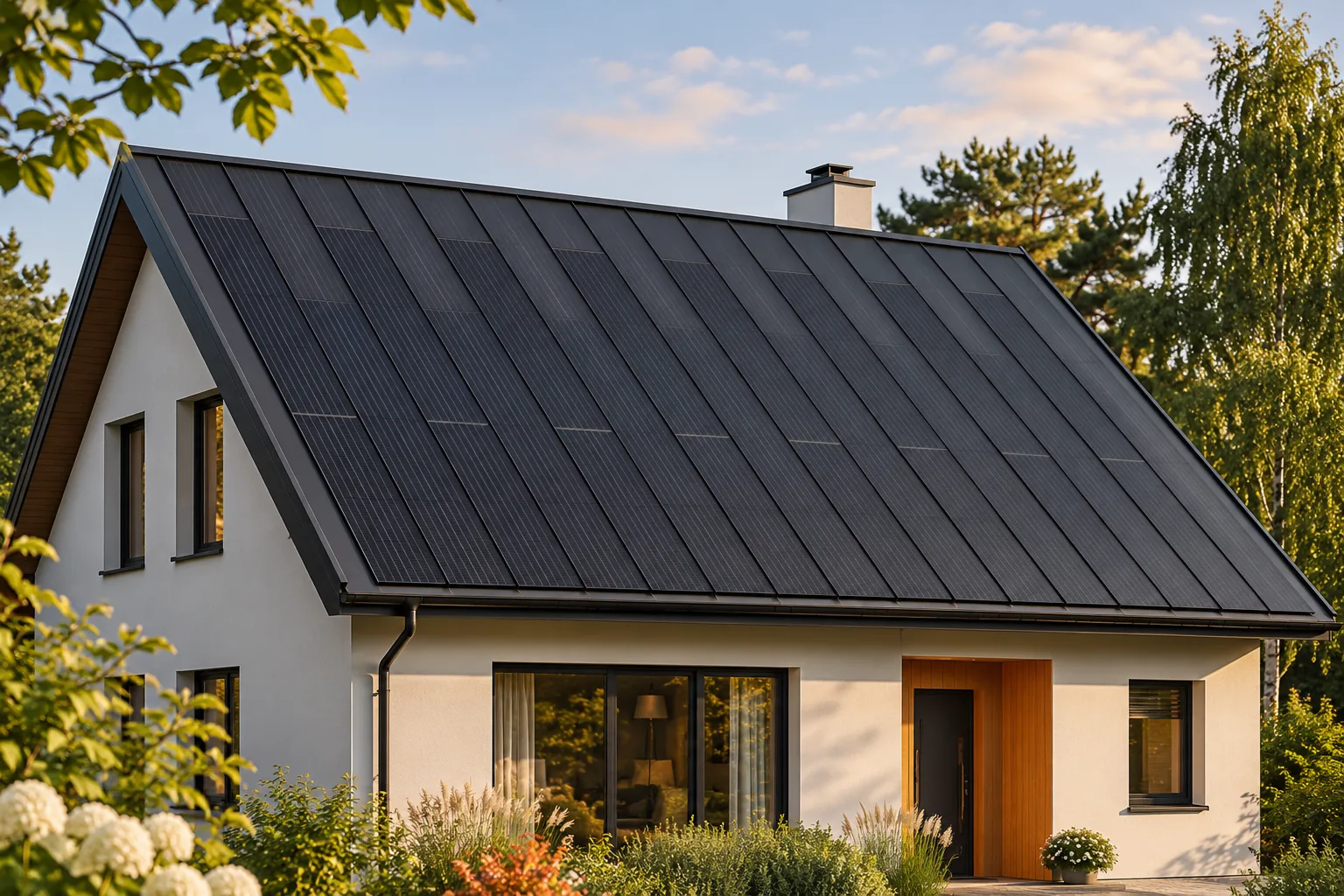
A steel covering with cells allows a regular, dark roof slope to be achieved without a separate mounting frame above the roof. Passive elements complete the areas where energy production is not needed or justified. As a result, the active part does not have to look like an added rectangle. It is part of the architecture from the start of the renovation.
This is a particularly valuable feature in a house visible from close range or on an open plot. Before deciding, it is worth viewing samples and photographs of actual installations. Differences in light reflection between surfaces may remain visible. A uniform design does not mean that every fragment looks identical in every weather condition.
How can you check whether an old house is suitable for the system?
An assessment of the structure, the actual pitch and the method of support is needed. An active steel panel has a different weight from ordinary sheet metal, so its sheet thickness alone cannot be used. The complete layer build-up and weather loads must be taken into account. The condition of the old connections also matters.
At the same time, the feasibility of routing cables and the location of equipment should be checked. In a finished house, not every route will be easy to implement. A roof renovation provides an opportunity for a tidy installation route before everything is covered again. This is a practical benefit worth incorporating into the schedule.
Do you need to order the largest possible capacity straight away?
No. Replacing the entire covering does not mean the whole roof slope has to be made active. The selection should take into account energy consumption, shading and planned changes to the home’s equipment. Passive panels allow aesthetics to be preserved with a limited cell area. It is worth comparing several rational power variants.
With a planned heat pump or electric vehicle, their future operation must be taken into account, but without assuming a certain consumption from advertising. Similarly, a battery storage system should be assessed separately. The roof can be prepared as a coherent investment, and the scope of equipment should result from needs and technical conditions.
How do you choose the right moment to order?
Ideally after determining the scope of repairs and the geometry, but before purchasing the covering and starting demolition. At that point, the work of the roofer, electrician and any insulation crews can be coordinated. Protection of the interior during the works and the possibility of changes after uncovering old layers should be anticipated. The schedule should have a realistic margin.
A BIPV roof is a particularly sensible option when it combines a necessary renovation with a well-justified energy investment. The benefit is a coherent appearance and jointly planned implementation. The choice should be based on a full cost estimate and an assessment of the house. This way, the new covering will address several specific needs rather than being just another addition.
Examples of companies and brands in roof-integrated photovoltaics are SunRoof, MDM NT (MyRoof), ML System, Ennogie, Electrotile, 3S Swiss Solar Solutions, SolRoof, LUMA Solar, Wienerberger Wevolt and Autarq.
7 branches. Materials closer to your project.

- SEROCK — Dzierżenin 34 E
- BŁONIE — ul. Sochaczewska 138A
- RADOM — ul. Grobickiego 8
- ŁÓDŹ — Natolin 8
- OLSZTYN — Barczewo, ul. Prosta 9
- WROCŁAW — ul. Jerzmanowska 10C
- GORZÓW WLKP. — ul. Zielona 33/34