Choice of covering
How much do T18 and T35 trapezoidal steel sheets weigh?
In brief
The weight of trapezoidal sheet is determined not by the profile symbol alone but by steel thickness, geometry and the unit given in the table. Before calculating, check whether the value refers to a square metre of coverage, a metre of length or kN/m², because these units are not interchangeable. In the available table, T18 at 0.50 mm thickness is given as 0.041 kN/m², while the indicated T35 variant of the same thickness is 0.044 kN/m²; these are examples, not universal values. Leave the choice of design data to the designer.
What values do sample tables show?
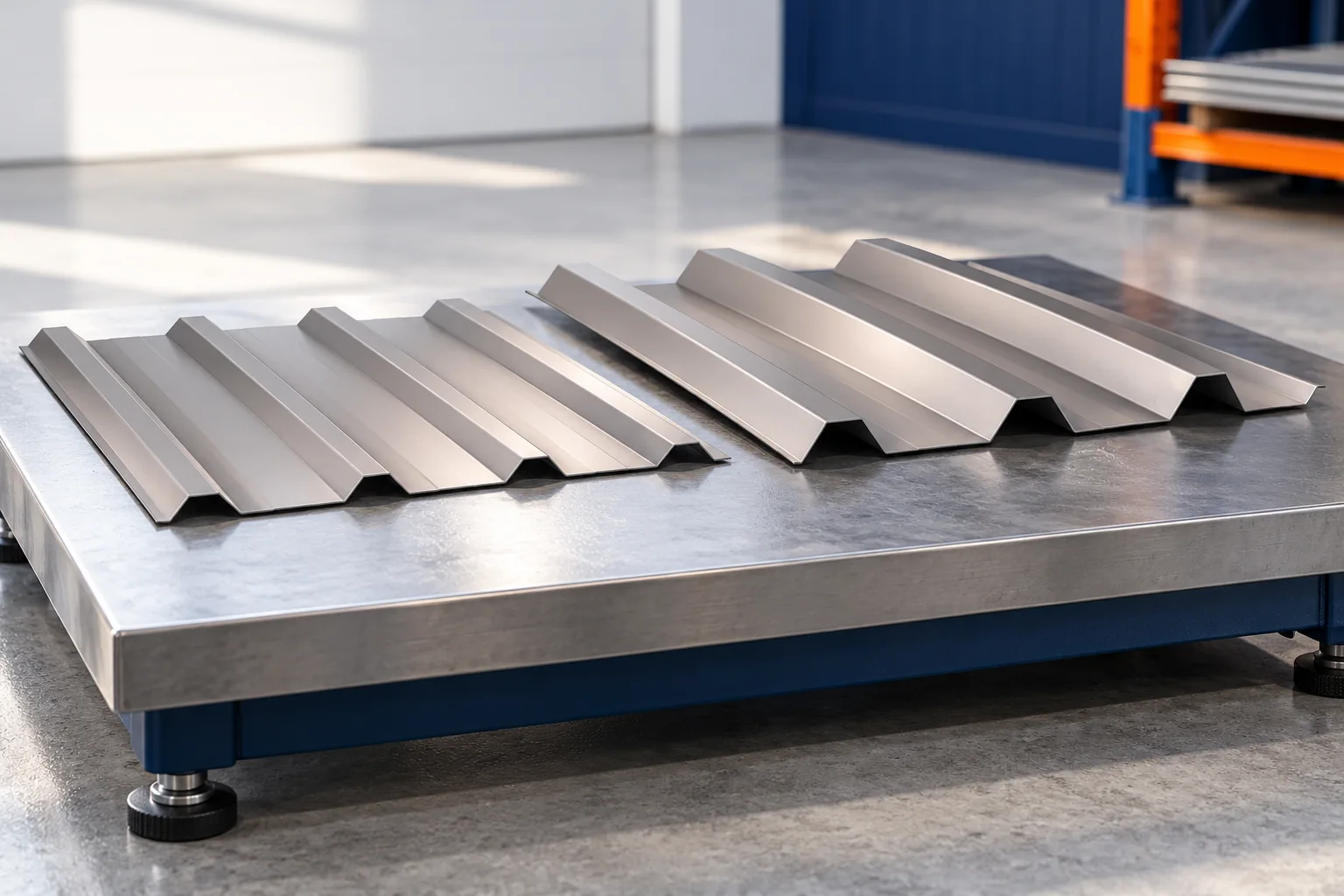
In the available table, one T18 profile with a thickness of 0.50 mm is given a weight of 0.041 kN/m². For the T35 variant listed there with the same thickness, it is 0.044 kN/m². Converted, this gives approximately 4.2 and 4.5 kg/m². These are examples of specific profiles described in the documentation, not universal values for every T18 and T35 product.
When ordering, you must use the data supplied for the selected sheet. Different geometry, thickness or material can change the result. Coatings and additional fleece also contribute to the actual delivery weight. For the structural design, the values and rules adopted by the designer apply, not the rounded weight from a general guide.
Why does the unit matter so much?
Square metres may refer to the total sheet area or to the effective covering area. The side lap means these are not equal. If the weight refers to a square metre of covering, it must be multiplied by the area calculated from the covering width. Using the total width in the same calculation will overstate the result.
Weight given per linear metre means a section of sheet one metre long and of a specified width. It is not the same as kilograms per square metre. kN/m², in turn, describes a force per unit area. The figure 0.044 must not be read as 0.044 kg. Such a mistake will completely change the assessment of the load.
How do you calculate the weight of a single sheet?
First check the length and width corresponding to the unit in the data sheet. For example, assume a sheet with an effective covering width of 1 m and a length of 4 m. If the declared weight is 4.5 kg per square metre of covering, the result is 18 kg. This is solely an example calculation with assumed data, not a description of any T35 sheet.
When the supplier gives unit weight per metre of length, it is sufficient to multiply it by the sheet length. For a pack, the number of items and the packaging must then be taken into account. The most practical figure for organising unloading is the weight of the entire delivery confirmed on the documents. It allows equipment to be selected for the actual transport conditions.
For comparison: assuming 100 m² of covering and a weight of 4.5 kg/m², the material alone weighs 450 kg. Across several pallets this remains the same total, but the load at the location where each pack is placed differs. Splitting the delivery into packs does not remove the need to assess the load-bearing capacity of the ground on which they are to stand temporarily.

Does a higher profile have to be heavier?
Profiling changes the shape of the sheet’s flange. Taller ribs can mean greater consumption of developed width per metre of effective cover. However, this does not mean that every T35 weighs more than every T18. A thicker low profile can be heavier than a taller one made from thinner steel. The complete set of data matters, not the number alone.
Within the same geometry, increasing the steel thickness increases the mass. At the same time, it can change load-bearing capacity and deflection. These relationships should not be reduced to the rule that ‘heavier sheet is always better’. For a specific roof, a profile matched to the supports, loads and service requirements is needed. Excess mass will not fix incorrect fixing.
What does the weight of the covering tell you about the roof structure?
The weight of the sheet is only part of the dead load. Battens or purlins, insulation, cladding, flashings and installations are added. The design also accounts for snow and wind. When replacing a covering, the truss cannot be assessed solely by comparing the kilograms of the old and new material. The condition of the timber and the way all actions are transferred are essential.
The low mass of a sheet facilitates part of the transport work, but it does not mean a low wind load. A large surface area can be strongly uplifted. Suitable fixings to the supports and connections at the laps are needed. The number of screws does not result from the weight of the sheet alone. Particular attention is required at corners and roof edges.
How can you use the data during delivery?
In addition to kilograms, check the length and susceptibility of the sheets to deformation. A light, long element can be difficult to carry without bending. The lifting method should provide support and protection of the coating. Sheets should not be slid over one another nor the pack grasped at random points.
Prepare a stable storage location in accordance with the instructions. On the roof, the pack must not be set down merely because an individual sheet seems light. The concentrated mass of the delivery acts differently from the evenly distributed finished covering. The location and manner of its temporary placement must be agreed with the person responsible for the structure and for organising the installation.
7 branches. Materials closer to your project.