Insulation and PIR
How do you convert EPS to PIR without confusing thickness with thermal performance?
In brief
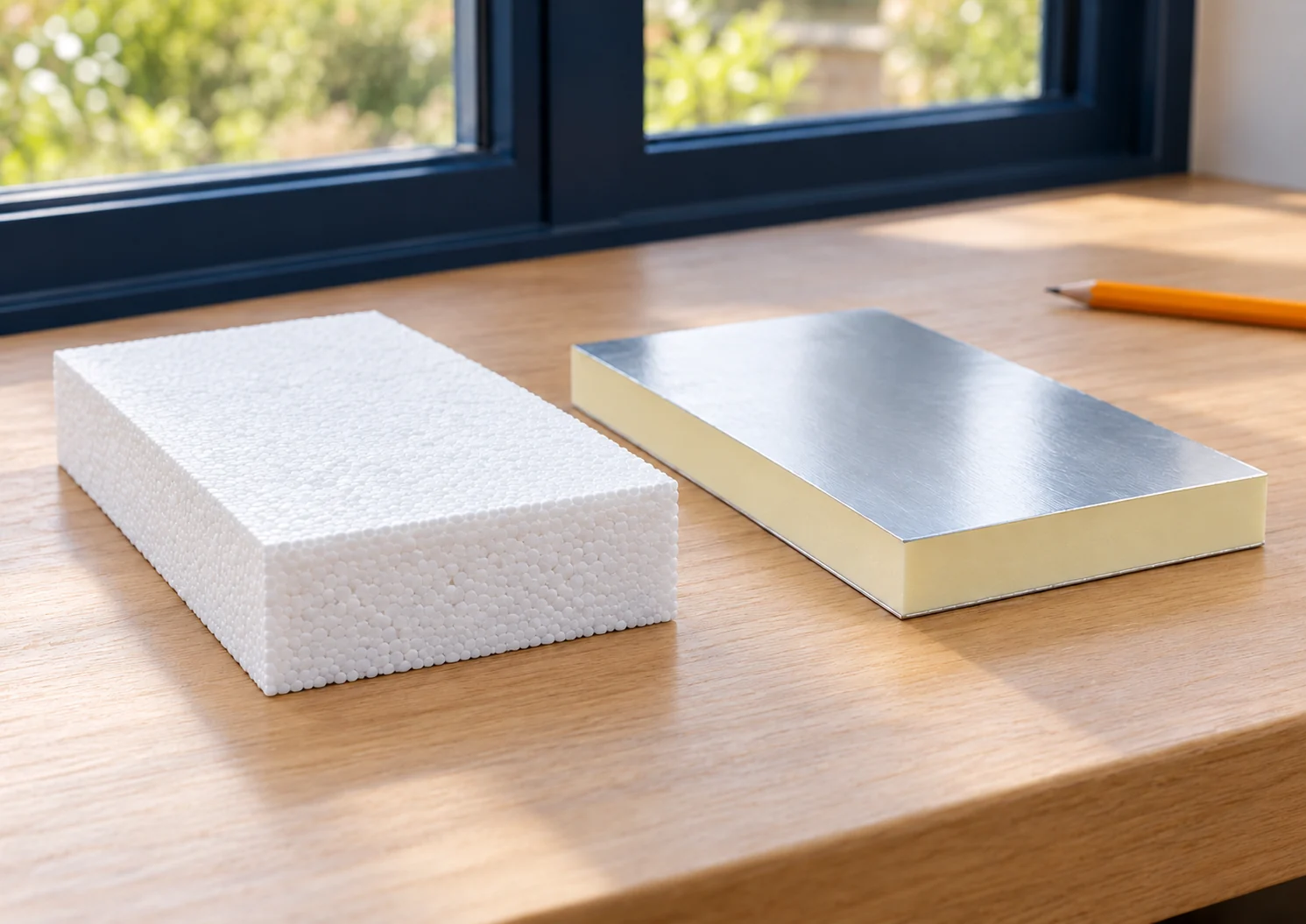
A centimetre of EPS does not provide the same thermal resistance as a centimetre of any PIR board. The comparison must be based on the lambda value of the specific material. The whole wall build-up and its finish are then checked. A thinner layer may make the reveal detail easier to resolve, but the difference in thickness alone does not determine the choice. First read the lambda value of both products under consideration. Do not assume a single figure for all EPS or for the entire PIR group. Properties depend on the variant. A board with a metallised facing may have a different application and parameter from a board intended for plaster.
What value should the comparison start from?
A simple comparison uses thermal resistance R = d/λ. The greater the resistance of a layer, the more it restricts heat flow. Thickness is entered in metres. The comparison should cover the same conditions and the same scope. Do not set the R of the insulation alone against the U of the finished wall.
How much PIR corresponds in calculation to 16 cm EPS?
Take polystyrene with a lambda of 0.038 W/(m·K) and a thickness of 0.16 m. Its resistance is approximately 4.21 m²K/W. To achieve the same resistance with a PIR lambda of 0.022, approximately 0.0926 m, i.e. 92.6 mm, is required by calculation. This is a worked example for two assumed parameters.
At a lambda of 0.019 the equivalent is 80 mm. This does not mean that any 8 cm of PIR replaces 16 cm of any polystyrene. The choice must be matched to the available thickness, the product declaration and the application. The result must not be rounded down without checking the required performance.
What changes with a PIR variant intended for plaster?
If the appropriate façade board has a lambda of 0.025 W/(m·K), the same resistance of 4.21 requires approximately 105.3 mm of insulation by calculation. Within a specific product family the lambda may depend on thickness. It is therefore necessary to check whether the assumed value actually applies to the selected variant.
A thinner board with a different facing should not be bought solely on the basis of a more favourable calculation. The material must work with the fixing and the finish. Façade systems, internal build-ups and flat roofs have different requirements. Equal thermal resistance does not mean the products are fully interchangeable.
How do you go from insulation to the whole wall?
The resistance of the wall, plasters and surfaces is added to the resistance of the new layer. For the whole building element, it is calculated from a properly accounted sum and corrections. Thermal bridges at the ceiling, window and fixings also matter. Two walls with the same insulation can have different results.
If the goal is a specific U-value, first calculate the missing resistance. Only then select the thickness. Comparing the layers alone is a good start, but it does not complete the design. Particularly with internal insulation, temperatures and humidity inside the building element must also be assessed.

Where does a smaller thickness deliver a real benefit?
The benefit can be clear with a narrow reveal, a short eaves overhang or a small interior. In an example room with a wall length of 4 m, a 5 cm difference in construction corresponds to 0.20 m² in plan for that one wall. This is a simple geometric example, without corners and other layers.
However, check the total thickness of the solution. The frame, finish and space for services can reduce the advantage of a thinner core. On the façade, flashings and connections to existing elements are added. It is best to compare two full sections drawn at the same scale.
How do you compare costs at equal performance?
Price the material needed to achieve a similar thermal result, not the same number of centimetres. Add adhesive, fixings, seals and finish. For a small area, the pack format and the amount of offcuts matter. The catalogue price per metre is not necessarily the price per metre of the finished wall.
Also allow for adjustments to window sills, fixings and services. The thinner variant may reduce some of this work, but this must be calculated. There is no single honest answer as to which material always costs less. The result depends on the specific geometry and the complete scope of work.
How do you check whether swapping the material is permissible?
Compare the application, reaction to fire, resistance to service conditions and system requirements. The thermal parameter is one of many properties. A board with a good R-value may not suit the existing plaster layer or fire solution. A change requires checking the whole.
In the order, record the exact type of facing and the thickness. After delivery, verify the material designation. If the contractor proposes a different variant, return to the comparison. A similar appearance and the same group name do not guarantee an identical lambda or a compatible installation method.
Questions before ordering
Is the PIR-to-EPS conversion factor constant?
No. It depends on the lambda values of the two specific products. A fixed rule of thumb such as “half the thickness” can lead to insufficient insulation resistance.
Do you have to order 92.6 mm as a non-standard thickness?
This is the result of an example calculation. In practice, an available variant is selected and the required result for the entire building component as well as system compatibility are checked again.
7 branches. Materials closer to your project.